Hi, what do you want to do?






University of New Orleans
Rock Cycle and Rocks Lab
Science rocks! Explore three types of rocks and the rock cycle with an igneous rocks experiment. Pupils discuss textures, composition, and learn how melts are formed from the Earth's crust. They weigh materials using a scientific scale...

National Institute of Open Schooling
Air Pollution
Seventy percent of the air pollution in China is due to car exhaust. Under the umbrella of environmental chemistry, learners extensively explore air pollution. From the makeup of our atmosphere to sources of major air pollutants, classes...

National Math + Science Initative
Introduction to Decimals
Three activities make up an introductory lesson designed to create a strong foundation in comparing fractions to decimals and exploring and building decimal models. Pupils brainstorm and complete a Venn diagram to show how decimals and...

Curated OER
How to Choose Articles
In this language arts worksheet, students read detailed information that helps students choose correct articles in their writing. Students learn about nouns that refer to one unique thing, countable nouns, uncountable nouns, proper nouns...

Florida State University
Florida State University: Magnet Lab: Timeline of Electricity and Magnetism: 1750 1774
With his famous kite experiment and other forays into science, Benjamin Franklin advances knowledge of electricity, inspiring his English friend Joseph Priestley to do the same.
Other
Science Alive: Synthetic vs. Natural: What's the Difference?
Explains the difference between a synthetic compound and one found in its natural state. Uses the example of Percy Julian and Josef Pikl making the compound physostigmine, a medicine that was used in the treatment of glaucoma, in their lab.
Science is Fun
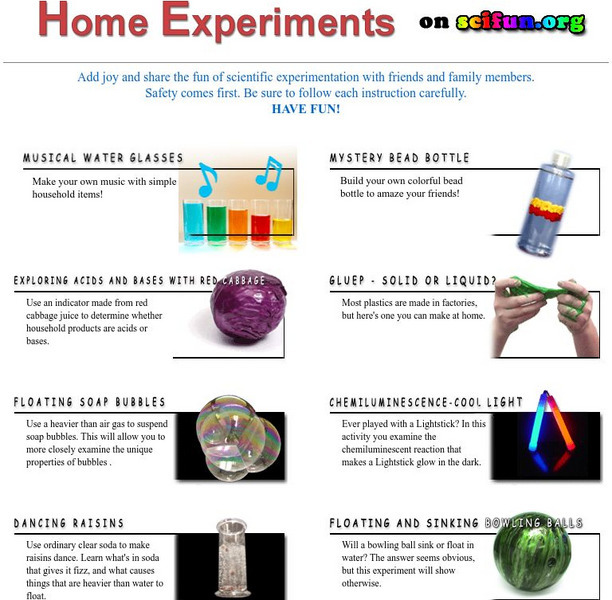
University of Wisconsin: Home Experiments
This resource presents a collection of simple science experiments kids can do using household materials. The procedures include diagrams and are simple to follow.
Lawrence Berkeley National Laboratory
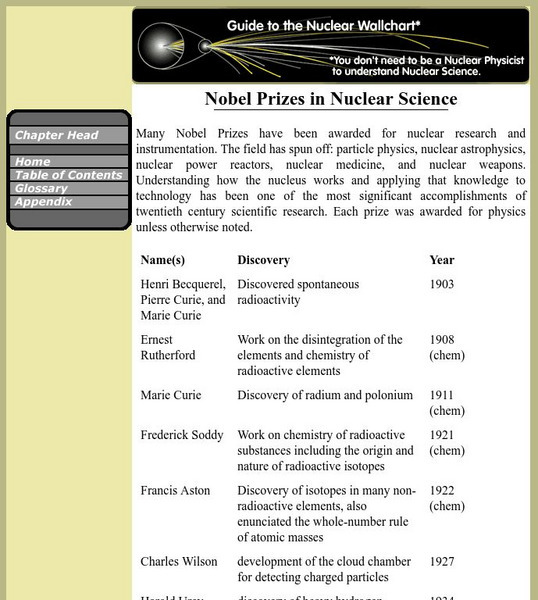
Berkeley Lab: Nobel Prizes in Nuclear Science
Provides a list of Nobel Prize winners in the field of nuclear science that includes the discoveries of spontaneous radioactivity, radium, and the neutron.

Lawrence Berkeley National Laboratory
Berkeley Lab: Misconceptions About Nuclear Science
This site sets the record straight on some common misconceptions about Nuclear Science.
National High Magnetic Field Laboratory
Magnet Academy: Robert Millikan
Robert Andrews Millikan was a prominent American physicist who made lasting contributions to both pure science and science education. He is particularly well known for his highly accurate determination of the charge of an electron via...
National High Magnetic Field Laboratory
Magnet Academy: Timeline of Electricity and Magnetism: 1960 1979
Computers evolve into PCs, researchers discover one new subatomic particle after another and the space age gives our psyches and science a new context.
National High Magnetic Field Laboratory
Magnet Academy: Gerd Binnig
Gerd Binnig co-developed the scanning tunneling microscope (STM) with Heinrich Rohrer. The STM allowed scientists entry into the atomic world in a new way and was a major advance in the field of nanotechnology. For their achievement,...
National High Magnetic Field Laboratory
Magnet Academy: Jack Kilby
The integrated circuit fueled the rise of microelectronics in the latter half of the twentieth century and paved the way for the Information Age. An American engineer, Jack Kilby, invented the integrated circuit in 1958, shortly after he...
National High Magnetic Field Laboratory
Magnet Academy: Heike Kamerlingh Onnes
Heike Kamerlingh Onnes was a Dutch physicist who first observed the phenomenon of superconductivity while carrying out pioneering work in the field of cryogenics. An important step on the way to this discovery was his success in...
National High Magnetic Field Laboratory
Magnet Academy: Isidor Isaac Rabi
Isidor Isaac Rabi won the Nobel Prize in Physics in 1944 for his development of a technique for measuring the magnetic characteristics of atomic nuclei. Rabi's technique was based on the resonance principle first described by Irish...
National High Magnetic Field Laboratory
Magnet Academy: Heinrich Friedrich Emil Lenz
At the turn of the 19th century, scientists were beginning to gain a rudimentary understanding of electricity and magnetism, but they knew almost nothing about the relationship between the two. Baltic German physicist Heinrich Lenz took...
National High Magnetic Field Laboratory
Magnet Academy: John Daniel Kraus
For a man whose career involved the entire known universe, John Kraus had a remarkably insular upbringing. He was born and raised in Ann Arbor, Michigan, and earned his bachelor's, master's and doctoral degrees in physics, all at the...
National High Magnetic Field Laboratory
Magnet Academy: James Clerk Maxwell
James Clerk Maxwell was one of the most influential scientists of the nineteenth century. His theoretical work on electromagnetism and light largely determined the direction that physics would take in the early twentieth century. Indeed,...

National High Magnetic Field Laboratory
Magnet Academy: Jean Charles Athanase Peltier (1785 1845)
Although he didn't start studying physics until he retired from the clock-making business at age 30, French native Jean Peltier made immense contributions to science that still reverberate today. Even with the primitive tools available...
National High Magnetic Field Laboratory
Magnet Academy: Timeline of Electricity and Magnetism: 1880 1889
Nikola Tesla and Thomas Edison duke it out over the best way to transmit electricity and Heinrich Hertz is the first person (unbeknownst to him) to broadcast and receive radio waves.
National High Magnetic Field Laboratory
Magnet Academy: Timeline of Electricity and Magnetism: 1870 1879
The telephone and first practical incandescent light bulb are invented while the word "electron" enters the scientific lexicon.
National High Magnetic Field Laboratory
Magnet Academy: Timeline of Electricity and Magnetism: 1850 1869
The Industrial Revolution is in full force, Gramme invents his dynamo and James Clerk Maxwell formulates his series of equations on electrodynamics.
National High Magnetic Field Laboratory
Magnet Academy: Timeline of Electricity and Magnetism: 1840 1849
The legendary Faraday forges on with his prolific research and the telegraph reaches a milestone when a message is sent between Washington, DC, and Baltimore, MD.
National High Magnetic Field Laboratory
Magnet Academy: Timeline of Electricity and Magnetism: 1830 1839
The first telegraphs are constructed and Michael Faraday produces much of his brilliant and enduring research into electricity and magnetism, inventing the first primitive transformer and generator.