Hi, what do you want to do?






Curated OER
Observing Sea Ice
Students study and observe types of sea ice found in Alaska. In this sea ice lesson, students use the student network for observing weather to study the different types of sea ice. Students study sea ice depicted in Alaskan art.

Curated OER
Perpetual Motion
Students discuss movement of air currents and then experiment to create visible models of air currents. Students connect the model to weather patterns.

Curated OER
In Harm's Way: Natural Disasters in My Community
Eleventh graders research and debate natural disasters that have occurred in their community. They assess whether these natural disasters were avoidable or were accidents. They investigate the extent of insurance coverage for disasters.

Curated OER
Antarctica
Students explore why Antarctica is so important to the planet. They investigate the physical characteristics. Students create their own unique treaty of governance for Antarctica and discuss how laws are enforced in Antarctica.

Curated OER
Environment: Erosion Boxes
Fourth graders discover how the processes of erosion and weathering alter the physical characteristics of the environment. In a student log,they record the various types of erosion and list ways to prevent it. Using clear, plastic...

Curated OER
Outdoor Survival
Students are introduced to basic outdoor survival concepts. They identify the seven basic needs for survival. Students describe the symptoms and treatment for frostbite and hypothermia. They compare and contrast the value of different...

A&E Television
History.com: How Early Humans Survived the Ice Age
The most recent ice age peaked between 24,000 and 21,000 years ago, when vast ice sheets covered North America and northern Europe, and mountain ranges like Africa's Mt. Kilimanjaro and South America's Andes were encased in glaciers. At...
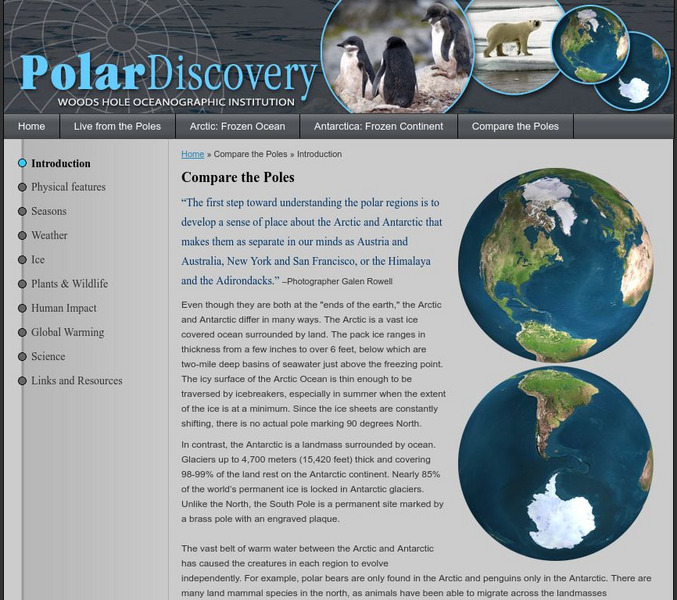
Woods Hole Oceanographic Institution
Polar Discovery: Compare the Poles
A detailed comparison of many aspects of the two polar regions. Includes physical features, seasons, weather, types of ice, plants and animals, human population, and climate change.