Hi, what do you want to do?






Curated OER
Goals of the Diversity of Life Unit
Students are introduced to the unit on the importance of diversity of life and the role that interdependence plays in our worlds. this is part of a multi-lesson plan unit on the diversity of life.

Curated OER
WHERE IS AGRICULTURE?
The students will identify many of the things in their lives that come from agriculture.See if someone involved in production agriculture will "adopt" your class. Students can correspond with the farmer or rancher's family. This will...

Curated OER
Mythical Animals
Students create imaginary animals by assembling pictures of body parts from pictures of real animals. This is one of three linked tasks. The others are "Who's Parts Do I Have?" and "Animals Piece by Piece."

Curated OER
Costa Rican Ecosystems
Students read about the Cloud Forests in Costa Rica and then answer critical thinking questions about how to prevent loss in this forest and how to slow down global warming.

Curated OER
Population Dynamics
Students watch a video on population dynamics. They conduct an experiment where they fill up a designated space with students. They recreate multiplying rabbits using beans.

Curated OER
Pulse
Students determine a baseline pulse rate then chart the changes in rate with exercise. They describe the changes and develop a rationale for their observations. The task assesses students' abilities to make simple observations, determine...

Curated OER
Tree Study
Students measure the lengths of provided leafs to the nearest millimeter. Students identify trends in the data as well as sourced of inaccuracy and formulate additional questions that could be investigated to enhance their understanding.

Curated OER
Insects and Spiders
Young scholars make either and insect or a spider using materials their teacher provides. They then draw of picture of their organism and defend why it is either a spider or an insect.

Curated OER
Grounded for Life
Second graders become familiar with the lives of penguins including their life cycles, habitats and basic needs. Students will experience the lives of penguins through stories and video.

Curated OER
Feedback and Flowcharts
Sixth graders explain what a negative feedback system is and they distinguish it from a positive feedback system. They describe examples of how negative feedback is used in both nature and technology. , Students define homeostasis, and...

Curated OER
Make Sense of Nature
Students participate in this program that heightens their awareness and curiosity of nature as well as their sense of adventure and exploring new surroundings. They identify and choose an object from nature after exploring it with other...
BBC
Bbc Schools: Ks2 Bitesize: Science: Living Things: Plant and Animal Habitats
Place the aliens in the habitats where they can survive the best. Following the activity, read more about plant and animal habitats, and then take a quick quiz to check for understanding.
Better Lesson
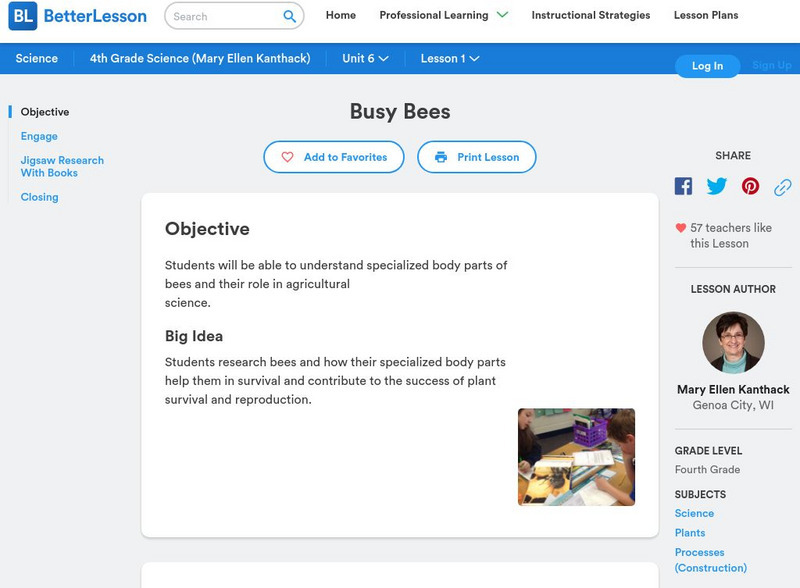
Better Lesson: Busy Bees
Fourth graders research bees and how their specialized body parts help them in survival and contribute to the success of plant survival and reproduction.

Alabama Learning Exchange
Alex: Mitosis: Divide to Survive
This lesson plan includes a Power Point presentation that will guide the students through an investigation of mitosis, or cellular division. The lesson plan will review the basic functions and parts of animal and plant cells and then...

ClassFlow
Class Flow: Life Cycles
[Free Registration/Login Required] Through this unit, children learn that plants and animals reproduce as part of their life cycle and that in every life cycle there are distinct processes and stages. They should begin to understand how...

Carnegie Museum of Natural History
Carnegie Museum of Natural History: The Iroquois of the Northeast
This site provides a brief look at the history of the Iroquois. The site has information about food, handwork, survival, and modern life.
BioEd Online
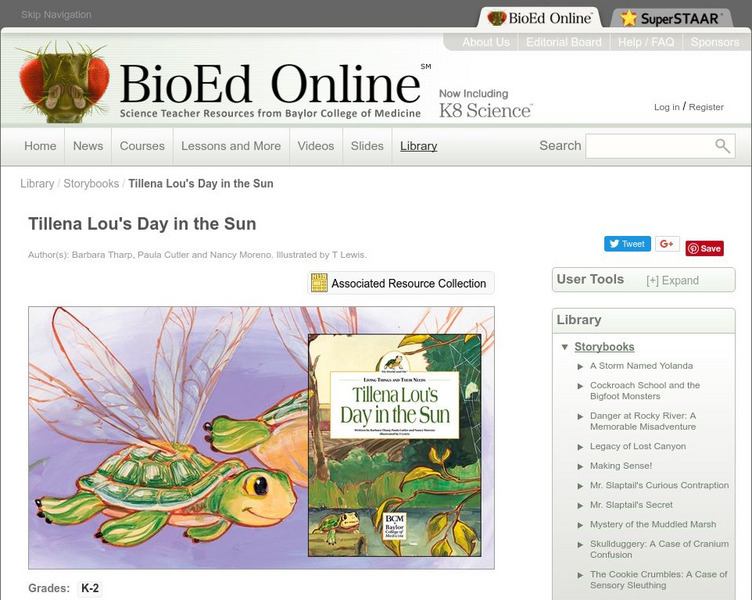
Bio Ed Online: Tillena Lou's Day in the Sun
Tillena Lou and her siblings spend a lazy day imagining what it might be like if they were other types of animals. What would they need to survive? Synopsis: Tillena Lou explores her home and discovers interesting things about the...
Utah STEM Foundation
Utah Stem Action Center: Backyard Organisms
Utah is a beautiful state with a rich and diverse population of living creatures. This activity challenges you to spend a few minutes outside thinking about and observing the organisms living in your backyard.
The Wonder of Science
The Wonder of Science: 4 Ls1 1: Internal and External Structures
Work samples, phenomena, assessment templates, and videos that directly address standard 4-LS1-1: internal and external structures.
NOAA
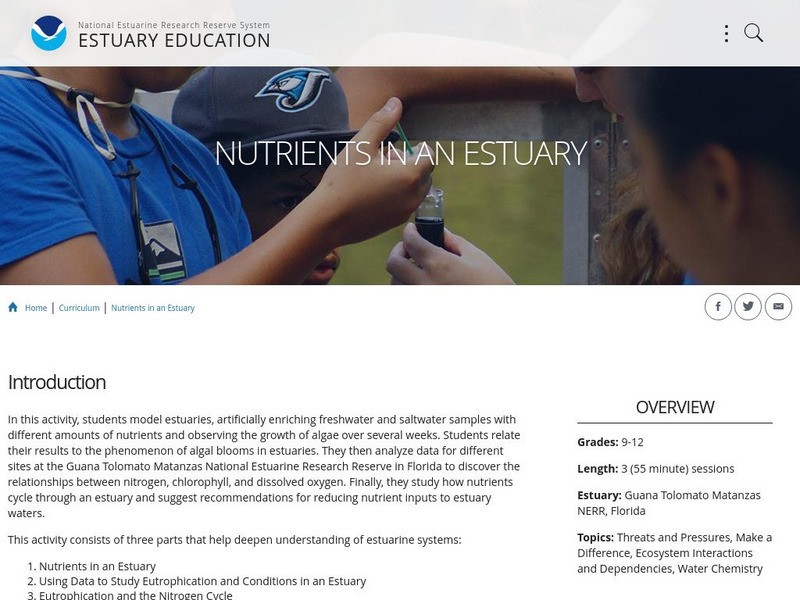
Noaa: Estuaries 101 Curriculum: Nutrients in an Estuary
An overload of nutrients, called eutrophication (Greek for "good-nutrition"), can be harmful to estuaries. This phenomenon is also referred to as "over-enrichment," or "nutrient pollution". Students will investigate the range of...
Curated OER
Kids Health: Why Drinking Water Is the Way to Go
Every person, plant, and animal needs water to survive. Learn why water is so important for our health and how you can keep yourself hydrated and healthy by drinking enough fluids every day.

ClassFlow
Class Flow: Understanding Ecosystems: Adaptations 3 of 4
[Free Registration/Login Required] Students will understand how animal and plant adaptations help them to survive in their ecosystem. Web links will allow students to play games and learn more about adaptations.