Hi, what do you want to do?






Curated OER
The Presidents Song
Remember learning to spell “encyclopedia” by singing along with Jiminy Cricket? How about using a singing exercise to learn the names of the presidents? “The Presidents Song,” includes the names, in order, from Washington to Coolidge....

PBS
Master of the Airwaves: How FDR Used Radio to Ease the Public’s Fears
The political and economic climate during the 1930's was uncertain and tumultuous. But Americans' minds and hearts were eased with the reassuring words of their president, Franklin D. Roosevelt, and addresses over the radio. High...

K12 Reader
The Greatest President
Who is the greatest US president? George Washington? Abraham Lincoln? FDR? Find out the opinions of your young historians with this cross-curricular writing prompt that engages them in researching the accomplishments of these influential...

Curated OER
My Secret War: Lesson 4
Fifth graders write a speech. In this history lesson, 5th graders define the word infamy and listen to a speech by FDR. Students work in groups to summarize his speech and rewrite sections of the speech.

Curated OER
The President and the Press ~ FDR's First Press Conference: March 1933
Students consider that many presidential aides now speak "off the record," in essence conveying a message from the president. They examine why most Presidents have fewer press conferences the deeper they get into their terms of office.

Curated OER
FDR's Fireside Chats: The Power of Words
Students examine Franklin D. Roosevelt's Fireside Chats. In this presidential history lesson, students listen to the radio broadcasts of select FDR Fireside Chats. Students analyze the effectiveness of his messages to the public as well...

Franklin D. Roosevelt Presidential Library & Museum
Pearl Harbor Activity #4: Who is the Audience?
Young historians use the prompts on a worksheet to analyze President Roosevelt's "Day of Infamy" speech. They identify the intended audience for the speech, the devices FDR used to persuade his audience, the responses promoted, and the...

Curated OER
Writing Exercises: World War II, #2
Comprehending the role of key players and events of WWII is a task all learners must undertake. Here, they respond to three critical thinking questions regarding the roles Roosevelt and Stalin played during the war as well as Germany's...

Curated OER
A Day of Infamy:Analyzing FDR’s Pearl Harbor Address
In 1941 FDR spoke out on the events at Pearl Harbor. The class will get to analyze word choice, word meaning, author's craft and structure by analyzing an actual draft of this speech. They will look critically at the words used,...

Curated OER
FDR's First Inaugural Address
High schoolers, in groups, describe a photo to the class. They determine which New Deal program is depicted in each of the images based on the research they conducted.

K12 Reader
What's the Purpose? FDR's Pearl Harbor Speech
FDR's December 7, 1941 address to the nation is the focus of a reading comprehension exercise that asks middle schoolers to read an excerpt from the Pearl Harbor speech and determine the president's purpose.

Curated OER
Elementary Reading: Five Passages with Questions
Five brief readings with questions support practice with various literacy skills. In some cases, learners identify whether underlined words are spelled correctly. Other times, they answer reading comprehension questions about the text or...

Curated OER
FDR's Fireside Chat on the Purposes and Foundations of the Recovery Program
Students discuss how they get information on important events or activities that occur in the national government today. They evaluate the New Deal, utilizing document analysis worksheets imbedded in this plan.

Curated OER
To Kill A Mockingbird: Historical Background
Dorothea Lange's "Migrant Mother" and other images set the stage for a PowerPoint about the Great Depression. Whether used as background for Harper Lee's To Kill a Mockingbird, or as part of a historical study, the presentation would...

Curated OER
Write Obama's Inaugural Address
Students practice their public speaking skills. In this interdisciplinary lesson, students study speeches delivered by Lincoln, Wilson, F. Roosevelt, and Kennedy. Students write the text Obama's inaugural address and...

Curated OER
The New Deal
Students practice their reading comprehension skills by reading about Franklin Roosevelt and the New Deal programs. They answer questions related to the reading to test for comprehension.

Curated OER
Who's Talking the Talk and Walking the Walk?
Students discover the characteristics that make a hero or heroine. They also look at how society recognizes its heroes and how the nation represents its values and beliefs by researching heroes from the past and present.

Curated OER
Studying Japanese Internment with Primary Documents
Eleventh graders view photographs of the Japanese society being interned in camps during World War II in the United States. In groups, they read and discuss Executive Order 9066 and try to determine what group they are trying to focus...

CommonLit
Common Lit: Fdr and the New Deal
A learning module that begins with "FDR and the New Deal" by Mike Kubic, accompanied by guided reading questions, assessment questions, and discussion questions. The text can be printed as a PDF or assigned online through free teacher...
TES Global
Blendspace: Fdr Fireside Chats
A nine-part learning module with links to videos, websites, and images to use while learning about President Franklin Delano Roosevelt and his Fireside Chats.
American Rhetoric
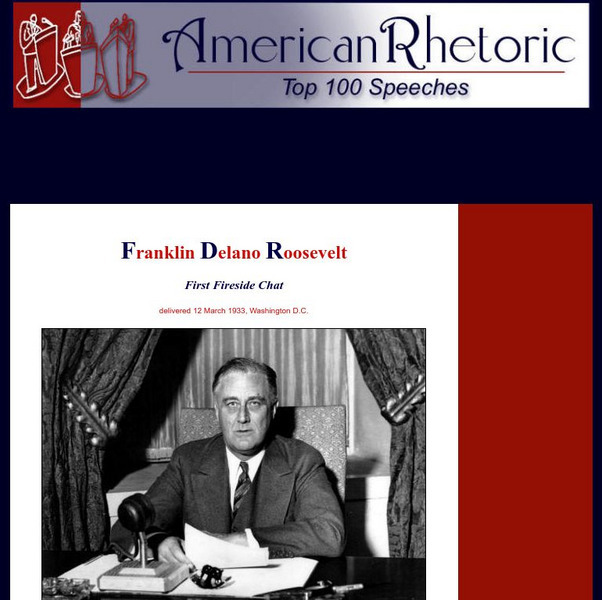
American Rhetoric: Franklin Delano Roosevelt: First Fireside Chat
This is the text and audio of President Franklin D. Roosevelt's first Fireside Chat "The Banking Crisis" on March 12, 1933, in Washington D.C.
CommonLit
Common Lit: "Day of Infamy" Speech
A learning module that begins with "'Day of Infamy' Speech" by President Franklin D. Roosevelt, accompanied by guided reading questions, assessment questions, and discussion questions. The text can be printed as a PDF or assigned online...
American Rhetoric
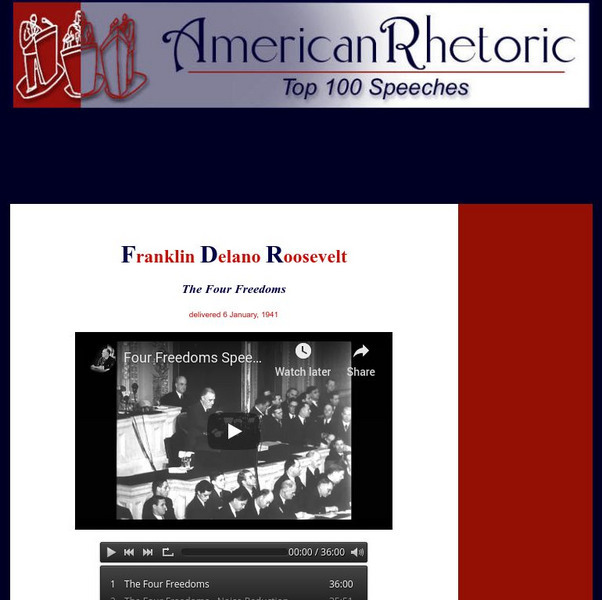
American Rhetoric: Franklin Delano Roosevelt: "The Four Freedoms"
This is the text and audio of President Franklin Roosevelt's speech to the 77th Congress entitled "The Four Freedoms" on January 6, 1941.

PBS
Pbs: American Experience: Primary Resources: Fireside Chat, May 7, 1933
President Franklin Roosevelt's Fireside Chat, the banking crisis address to the nation in May 1933. He presents his plans to end the trouble with the banks.