Hi, what do you want to do?





TeachEngineering
Teach Engineering: Air Pollution
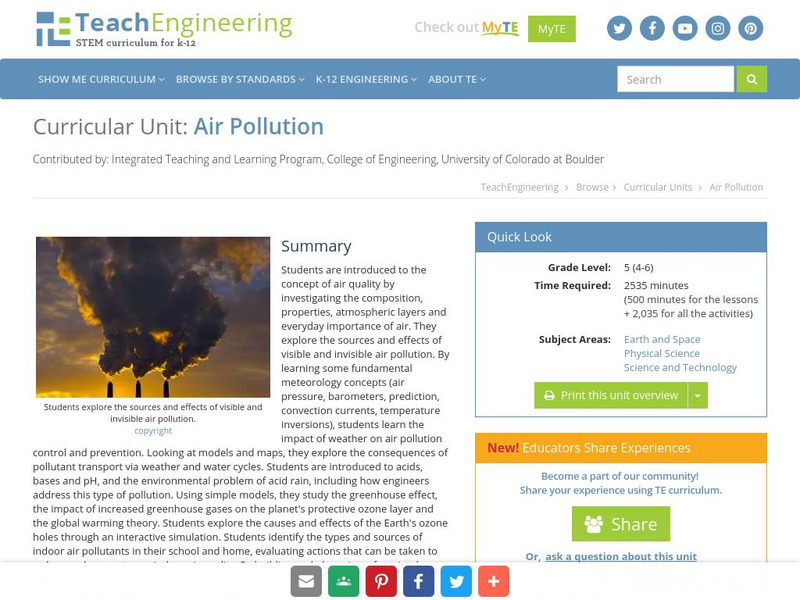
Students are introduced to the concept of air quality by investigating the composition, properties, atmospheric layers and everyday importance of air. They explore the sources and effects of visible and invisible air pollution. By...

University of Virginia
University of Virginia: Bell Jar Demonstration
A bell jar is evacuated to show the properties of a vacuum and air pressure. Pictures and a description of how to perform the demonstration are given.

American Chemical Society
Middle School Chemistry: Air, It's Really There
Explore the properties of air, and what happens to air when heated and cooled.
Science Museum of Minnesota
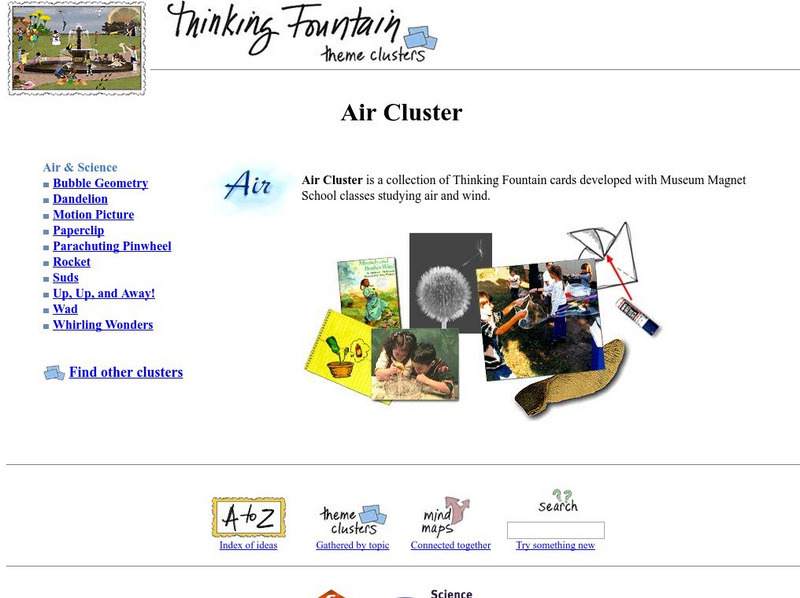
Science Museum of Minnesota: Air Cluster
Interesting site with links to activities about wind and air in many forms. Browse the different activities and investigations on the properties of air on the toolbar to the left of the page.
TeachEngineering
Teach Engineering: What's Air Got to Do With It?
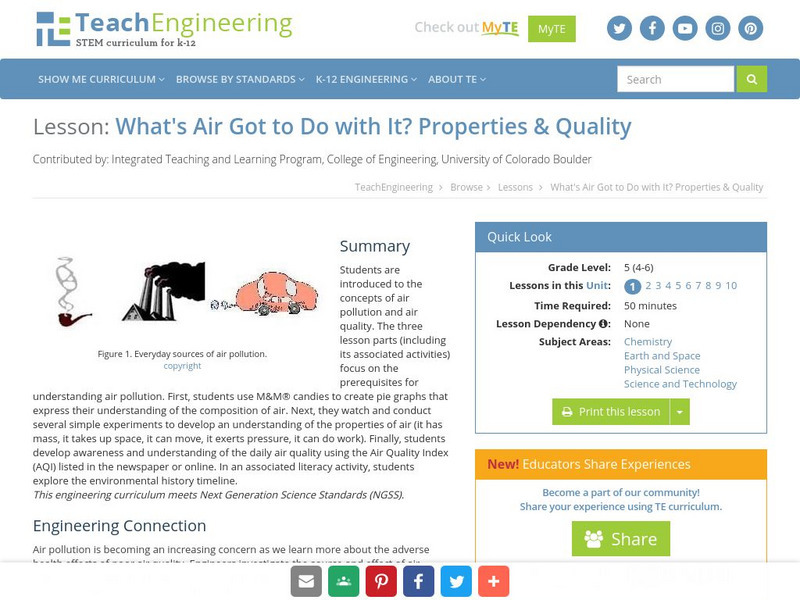
Students are introduced to the concepts of air pollution and air quality. The three lesson parts focus on the prerequisites for understanding air pollution. First, students use M&Ms to create a pie graph that expresses their...
Globe
The Globe Program: Air Quality Module
In this storybook, the GLOBE Kids investigate colors in the sky and learn how air pollution affects sky color and our health. Learning activities engage students in describing sky color and conditions in the atmosphere, creating a model...

PBS
Pbs Teachers: Hot Air Balloon Experiment
Explore how heat affects the density of air by building and flying a hot air balloon using large plastic bags and the hot air from an electric hairdryer.

US Environmental Protection Agency
Epa: Air Toxics Website Manganese Compounds
Very thorough information on manganese. Lists its uses, where it is found, physical properties, and potential health effects.

US Environmental Protection Agency
Epa: Air Toxics Website Nickel
Very detailed information on the chemical element Nickel. Discusses its uses, physical properties, and the potential effects of exposure.
Science and Mathematics Initiative for Learning Enhancement (SMILE)
Smile: Gases Lighter and Heavier That Air
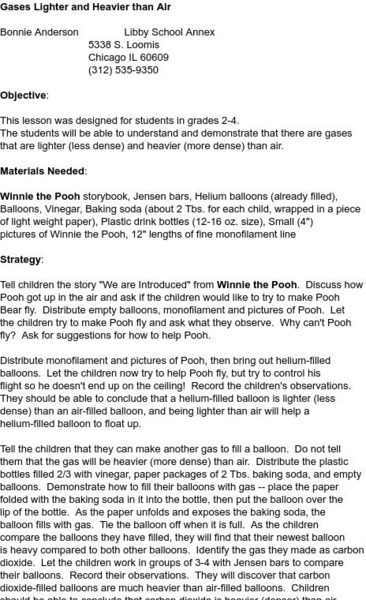
Teachers, to demonstrate to the elementary student that some gases are heavier than others, this experiment uses Winnie the Pooh and balloons to do just that.

Museum of Science
Museum of Science and Industry: Activities: Fly a Hot Air Balloon
Step-by-step instructions, with photos, of how to construct a hot-air balloon from tissue paper, to demonstrate that heated air expands, creating a convection current. This activity requires the use of a hot air gun and is labor-intensive.
New York University
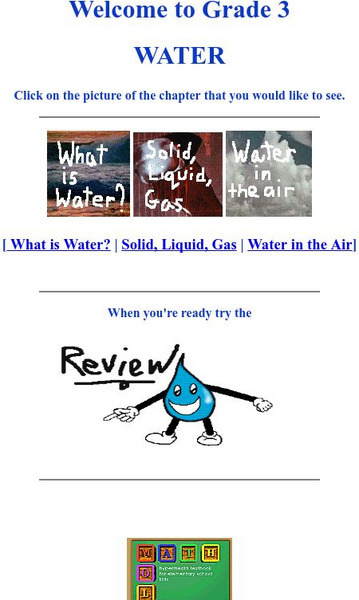
Nyu: Welcome to Water
Educational resource invites users to understand the properties of water by first examining what water is and how we use it and then leads users to further information on the three states that water can exist.
TeachEngineering
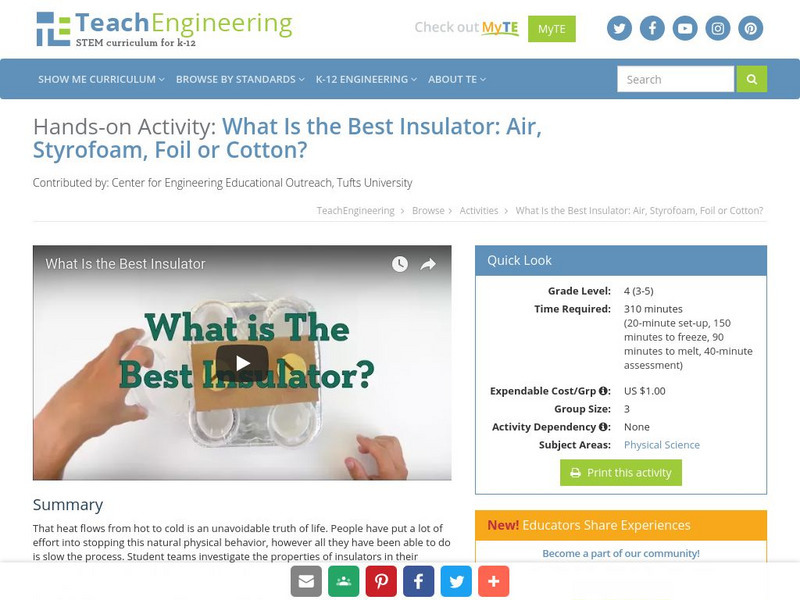
Teach Engineering: What Is the Best Insulator: Air, Styrofoam, Foil, or Cotton?
That heat flows from hot to cold is an unfortunate truth of life. People have put a lot of effort into stopping this fact, however all they have been able to do is slow the process. Working in groups of three to four, students will...
Other
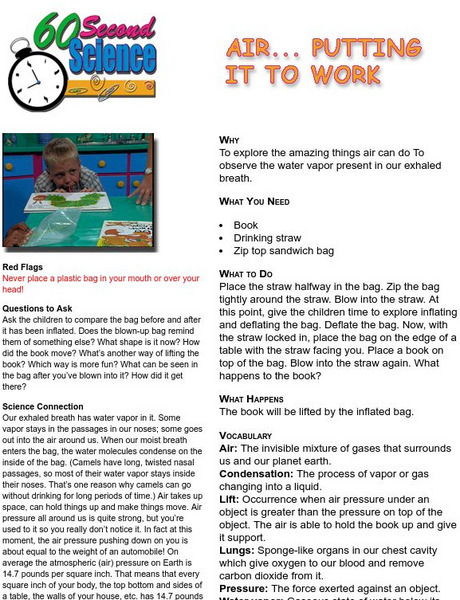
60 Second Science: Air Putting It to Work
Investigate the properties of air. Observe the water vapor present in our exhaled breath.
Science and Mathematics Initiative for Learning Enhancement (SMILE)
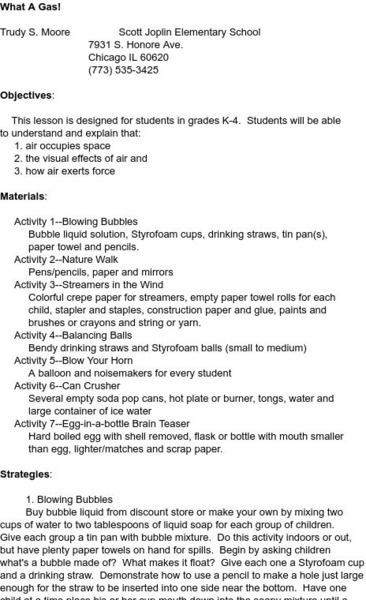
Smile: What a Gas!
In this lesson plan, students will understand and explain that air occupies space, visual effects of air and how air exerts force.
Science Education Resource Center at Carleton College
Serc: Air Is Matter
It's difficult at times for younger students to realize that air has mass. Matter is something that has volume (takes up space) and has mass (*can be weighed). Air does take up space, even if we can't see it, and air has weight, even if...
Utah STEM Foundation
Utah Stem Action Center: What's Up With Our Air?
Students will use modeling to understand inversions. Their models will evolve as they gather more information.
American Geosciences Institute
American Geosciences Institute: Wind: Background
A reference page on wind. Learn about the properties of air that allow wind to form as well as how wind is used to make energy. The page also describes the advantages and disadvantages to wind energy.

PBS
Pbs Teachers: Zoom Vehicle
Explore forces of motion and properties of gasses by building a vehicle that runs along a string track powered by air pressure.
US Geological Survey
U.s. Geological Survey: Greenhouse Gases [Pdf]
Lesson plan in which students observe and contrast thermal properties of three major greenhouse gases. Using simple, readily available materials, students collect temperature change over time for dry air, water-saturated air, carbon...
Physics Aviary
Physics Aviary: Capacitor Properties Lab
This lab is designed to have students investigate the different changes that could be made to an air filled capacitor and the results that occur because of these changes. Students can vary the gap between the plates, the size of the...

TeachEngineering
Teach Engineering: Environment
Through 10 lessons and more than 20 hands-on activities, students are introduced to the concept of an environment and the many interactions within it. As they learn about natural and human-made environments, as well as renewable and...
OpenStax
Open Stax: Projectile Motion
The following interactive helps students understan how to identify and xplain the properties of a projectile, such as acceleration due to gravity, range, maximum height, and trajectory. They will determine the location and velocity of a...
Curated OER
Cluster of Journey North Images (37K)
Interesting site with links to activities about wind and air in many forms. Browse the different activities and investigations on the properties of air on the toolbar to the left of the page.