Hi, what do you want to do?






National Institute of Open Schooling
Atomic Structure
Learners explain historical findings such as Rutherford and Bohr's contributions, explain wave particle duality, and formulate Heinsenberg's uncertainty principle. They also draw s, p, and d orbitals, explain more historical findings,...
Learning Wave Communications
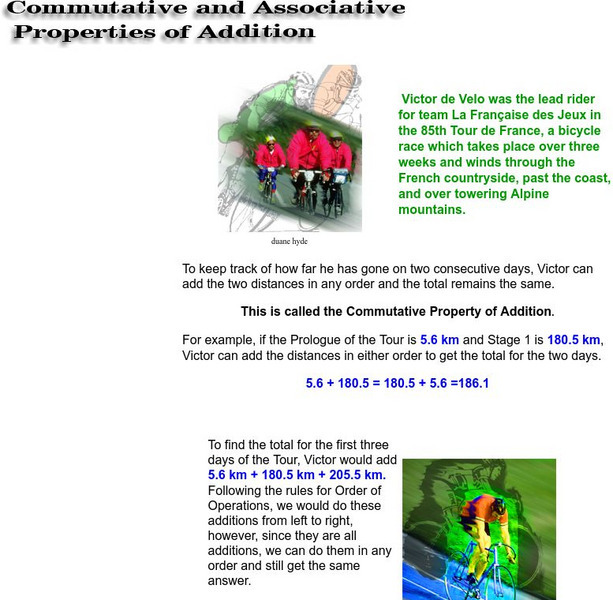
Learning Wave: Commutative & Associative Properties of Addition
This resource provides information about commutative and associative properties of addition.

Learning Wave Communications
Learning Wave: Commutative and Associative Properties of Multiplication
This resource provides information about the commutative and associative properties of multiplication.
Other
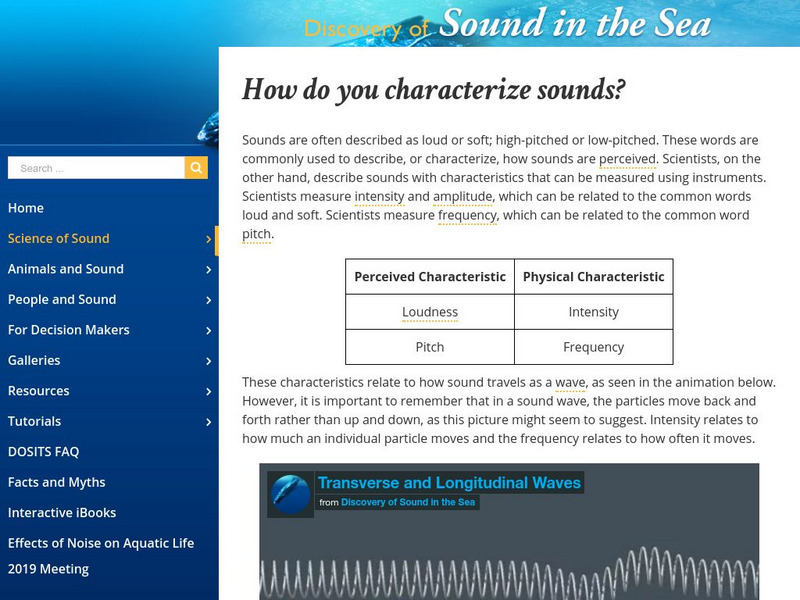
University of Rhode Island: How Sounds Are Characterized
This resource explains how sound is characterized. It provides links to sound properties and their perception as well as properties of waves.
Learning Wave Communications
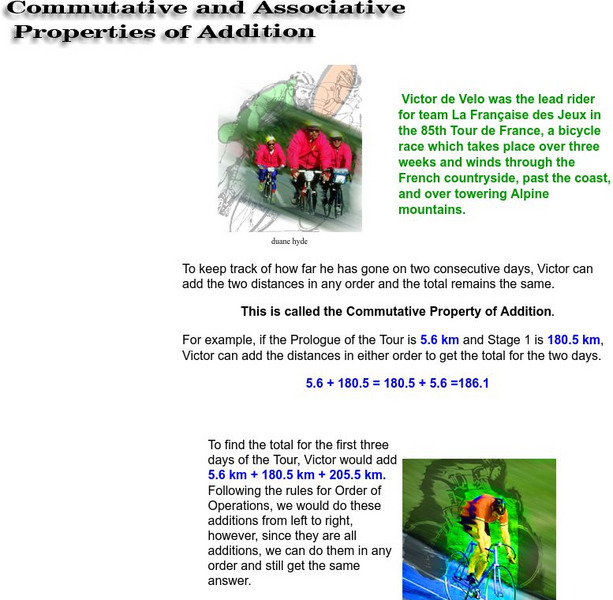
Learning Wave: Commutative and Associative Properties of Addition
A detailed example is used to demonstrate the difference between the commutative and associative properties of addition.
Georgia State University
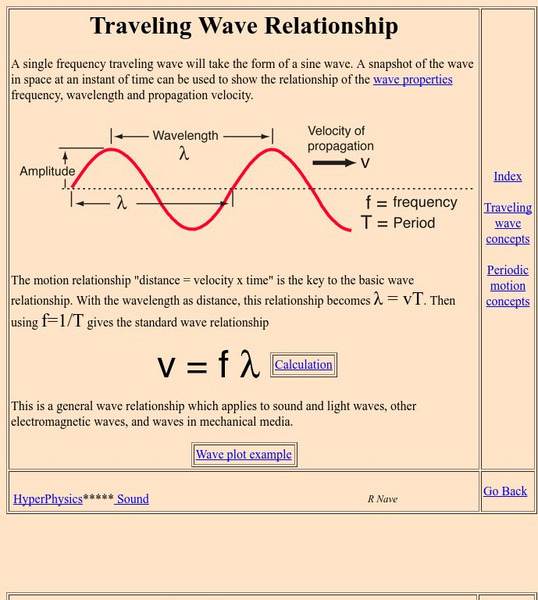
Georgia State University: Hyper Physics: Traveling Wave Relationship
Online physics text that illustrates and explains the various characteristics of waves such as amplitude, period, frequency, wavelength, and speed. Includes interactive exercises.
Oklahoma Mesonet
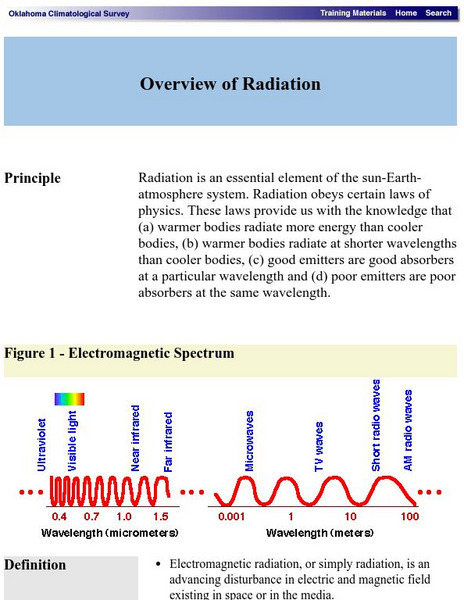
Oklahoma Climatological Survey: Overview of Radiation
This site details what radiation is, the physics of radiation, and radiative transfer as it occurs in nature. Content explores the electromagnetic spectrum, electromagnetic waves, properties of radiation, and solar radiation.
CK-12 Foundation
Ck 12: Physics: Wave Optics Study Guide
A study guide for concepts related to wave optics.
National High Magnetic Field Laboratory
Magnet Academy: Heinrich Hertz
The discovery of radio waves, which was widely seen as confirmation of James Clerk Maxwell's electromagnetic theory and paved the way for numerous advances in communication technology, was made by German physicist Heinrich Hertz. In the...
Georgia State University
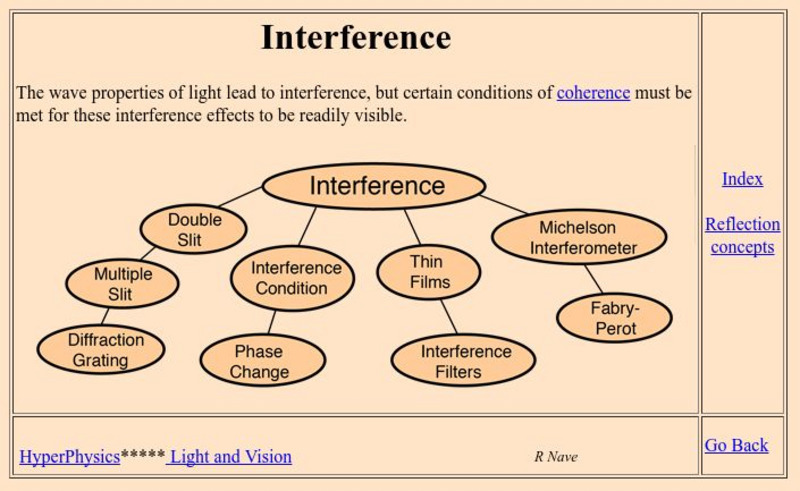
Georgia State University: Hyper Physics: Interference
An indexing page for a physics department site about the wave properties of light that lead to interference.
Nobel Media AB
The Nobel Prize: Otto Stern Biographical
This is a brief biography on the life and scientific work of Otto Stern, a physicist honored with the Nobel Prize in physics for his "development of the molecular ray method and his discovery of the magnetic moment of the proton."
Science Museum, London
Science Museum: Online Stuff: Atomic Firsts
Read about three famous British atomic physicists, each of whom won a Nobel Prize. J.J. Thompson discovered the electron, Ernest Rutherford successfully split an atom, and George Paget Thomson proved that electrons had wave-like properties.
Other
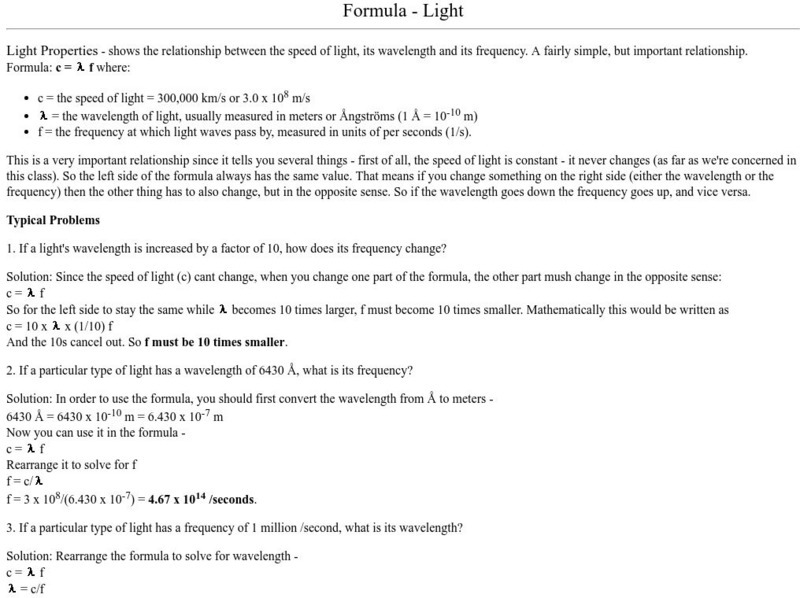
Uni: Astronomy: Formula Light
Learn about light properties through practice with formulas. This resource shows the relationship between the speed of light, its wavelength, and its frequency. A fairly simple, but important relationship.
Florida State University
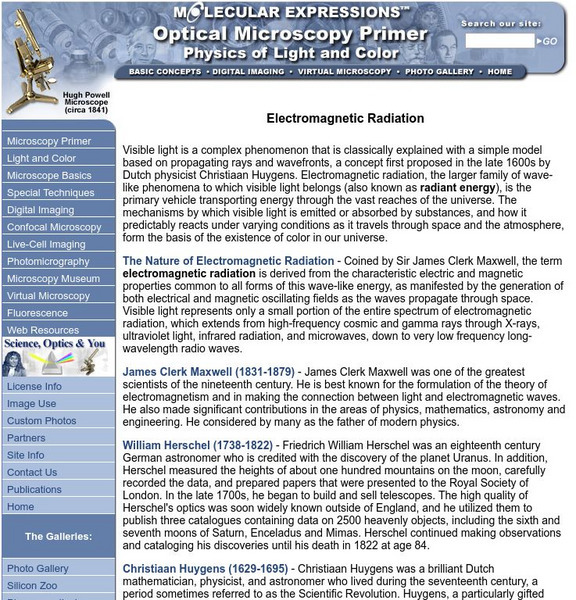
Florida State University: Molecular Expressions: Electromagnetic Radiation
This Florida State University page introduces light as an electromagnetic wave and discusses the frequency and wavelength range of the various regions of the electromagnetic spectrum. Includes links to some interactive Java applets.
Other
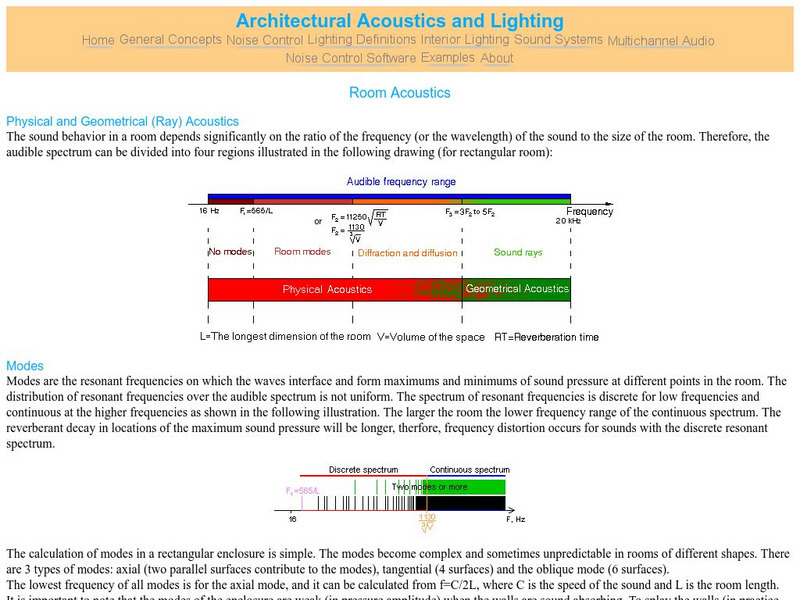
Architectural Acoustics and Lighting: Room Acoustics
This site from Architectural Acoustics and Lighting provides a discussion of various factors affecting the acoustics of a given room. Room dimensions, the wavelength of the sound wave, the physical characteristics of the walls, the...