Hi, what do you want to do?






Curated OER
Numerical Analysis/ Introduction to Algorithms and Pseudocode
In this math worksheet, students examine the concepts of algorithms and pseudocodes. Then they use the codes on a computer to execute the algorithms.

PBS
Code Creators
The lesson is real—even if the computer code isn't. Scholars learn about pseudocode, which simulates computer code using everyday language. They write pseudocode for simple actions, then have classmates guess the action from the written...

Curated OER
Stochastic and Deterministic Modeling
Explore the difference between stochastic and deterministic modeling through programming. First have the class write algorithms for relatively simple tasks using pseudocode. Use the Python 2.7 program app to simulate Mendel's Pea Pod...

Curated OER
Computers: Case Construct
Learners write a computer program that can receive two numbers and allows the user to decide to add, subtract, or multiply them together. Once solved, they discuss the sample solution using a case construct. Students discover when it is...

Drexel University
Learning Roomba Module 3: Controlling Movement
Look at it go. The resource, the third in a series of five using a Roomba, explains the different types of movements a Roomba makes, then challenges pupils to create computer codes that will cause the Roomba to travel specific paths.

Code.org
Algorithms Detour - Shortest Path
Young programmers investigate the Single Source Shortest Path problem by working in paris to devise their own algorithm. They then progress to using Dijkstra's Algorithm to solve the problem.

EngageNY
The Graph of the Equation y = f(x)
Math language? Set notation is used in mathematics to communicate a process and that the same process can be represented as computer code. The concept to the loop in computer code models the approach pupils take when creating a solution...

Code.org
Processing Arrays
Scholars use a playing card activity to help them develop a program to find the minimum value of a list. They learn to use for loops to write code that will process lists.

Curated OER
Numerical Analysis
In this math worksheet, students practice analyzing root finding algorithms, Newton-Raphson and secant. They use the examples to master the concepts.
Other
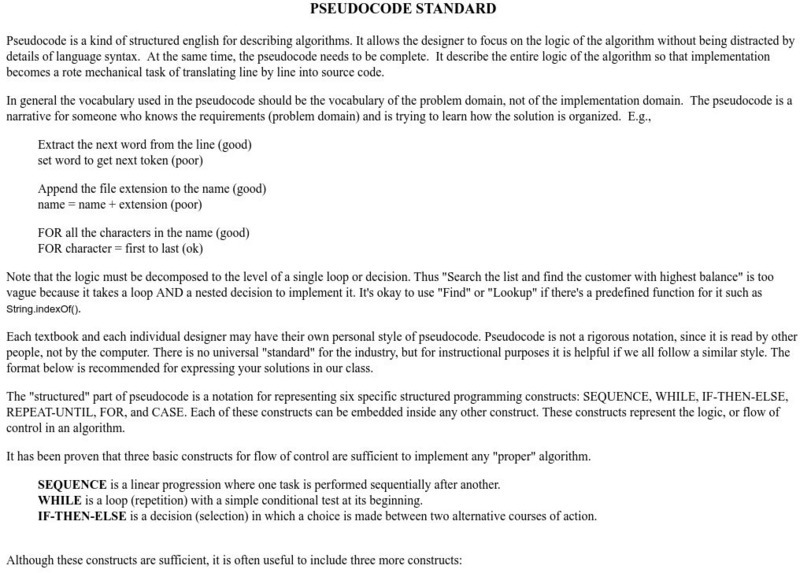
California Polytechnic State University: Pseudocode Standard
An in-depth discussion of the algorithm design language known as pseudocode.


Khan Academy
Khan Academy: Ap Csp Exam Pseudocode Reference
Since AP CS Principles is taught with a variety of programming languages, the AP CSP exam questions use a pseudocode that represents fundamental programming concepts. This overview will help with the basic understanding.

John Wiley & Sons
Wiley: Pseudocode Example: Game of Monopoly
An easy example of pseudocode, the language for designing algorithms, for playing the game of monopoly.
Other
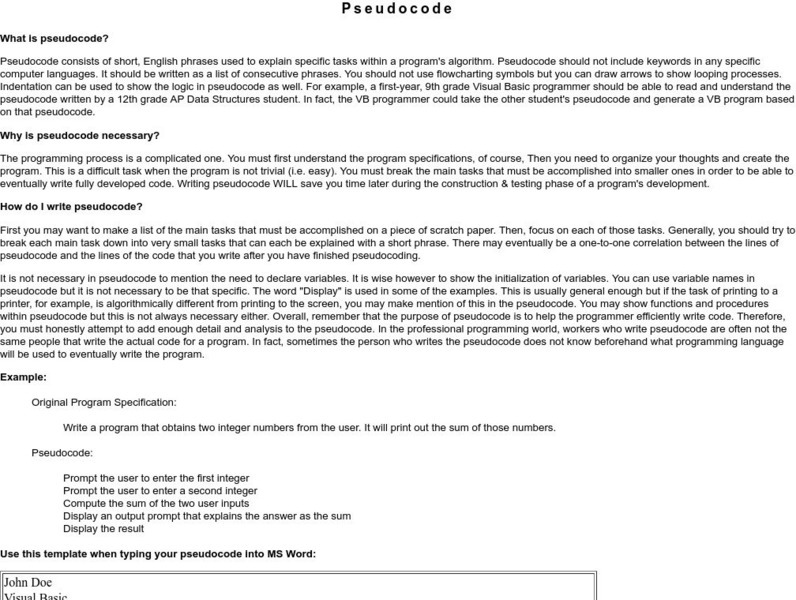
Minich: Pseudocode
A concise explanation of the algorithm design language known as pseudocode.

Wikimedia
Wikipedia: Pseudocode
A Wikipedia description of the algorithm design language known as pseudocode.
Other
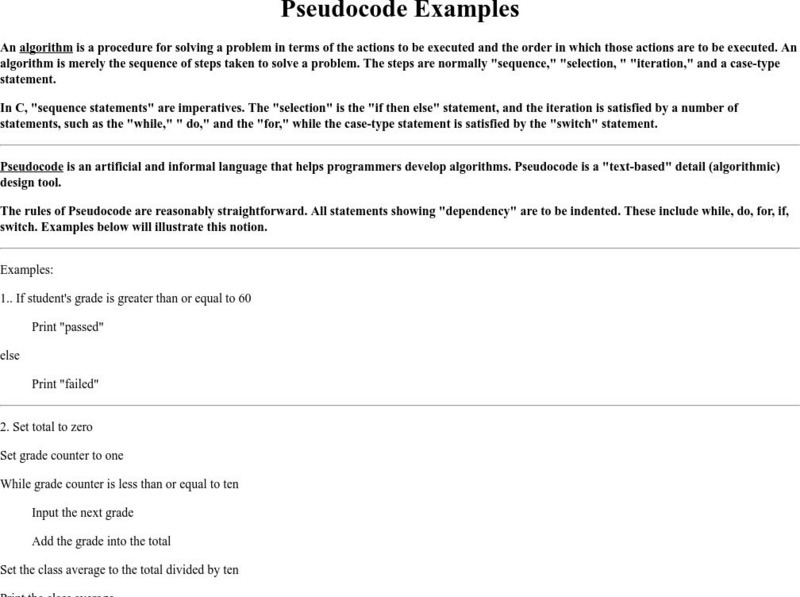
Unf: Pseudocode Examples
See some examples of pseudocode to help get started with computer programming.

Khan Academy
Khan Academy: Selection Sort Pseudocode
An overview of the algorithm selection sort is given.

Khan Academy
Khan Academy: Insertion Sort Pseudocode
An explanation of insertion sort into an algorithm.

Khan Academy
Khan Academy: Compound Booleans With Logical Operators
Practice using compound boolean expressions with AND/OR/NOT for programs in the AP CSP pseudocode, in this set of free practice questions designed for AP Computer Science Principles students.

Khan Academy
Khan Academy: Conditionals With If, Else, and Booleans
Practice using conditional statements (if/else) and boolean expressions in programs in the AP CSP pseudocode, in this set of free practice questions designed for AP Computer Science Principles students.

Khan Academy
Khan Academy: Conditional Repetition of Instructions
Practice using iteration in computer programs to repeat code until a boolean expression is true for programs written in the AP CSP pseudocode, in this set of practice questions designed for AP Computer Science Principles students.

Khan Academy
Khan Academy: Expressing an Algorithm
Check your understanding of expressing simple algorithms in flow charts, natural language, and pseudocode, in this set of free practice questions designed for AP Computer Science Principles students.

Khan Academy
Khan Academy: Iterating Over Lists With Loops
Practice using loops to iterate through lists in programs written in the AP CSP pseudocode.

Khan Academy
Khan Academy: Programming Basics
Practice programming statements, displaying output to the screen, and pseudocode.