Hi, what do you want to do?





ReadWriteThink
Read Write Think: Promote Deep Thinking! How to Choose a Complex Text
This is a strategy guide to determine if reading material is complex and therefore, worth a close reading. It offers a list of quantitative, qualitative, reader characteristics/task consideration measures of text complexity.
![Center for Assessment: Tools for Examining Text Complexity [Pdf] Professional Doc](https://statictemp.lp.lexp.cloud/images/attachment_defaults/resource/large/FPO-knovation.png "Center for Assessment: Tools for Examining Text Complexity [Pdf] Professional Doc")
Other
Center for Assessment: Tools for Examining Text Complexity [Pdf]
Learn how to use several tools to determine text complexity and readability of text for your students.
Other
Online Statistics Education: Graphing Distributions [Pdf]
This is the second chapter of a statistics e-text developed collaboratively by Rice University, University of Houston Clear Lake, and Tufts University. It looks at many different types of data displays and the advantages and...
Texas Education Agency
Texas Gateway: Measurement
Given investigation quantitative data, students will determine its degree of precision and/or accuracy and causes for uncertainties in measured data.
CK-12 Foundation
Ck 12: Scientific Method
[Free Registration/Login may be required to access all resource tools.] Describe how the Renaissance period in history changed the approach to science. Identify the steps of the scientific method. Differentiate between the independent...
Science Education Resource Center at Carleton College
Serc: Observations & Interpretations: Engaging Students in Classroom Experiments
Use this method to emphasize and clarify for students the importance of differentiating between observations and interpretations, and qualitative and quantitative observations. Students will learn how a hypothesis may change as new...
Science Struck
Science Struck: Interesting Philosophical Questions About Time
Discover some of the deep questions that scientists and philosophers ask about time and some of the ideas that emerge from each one.
Science Struck
Science Struck: What Is Experimenter Bias and How to Avoid It?
When doing research, it is important to be aware of one's biases and how to prevent them impacting on the design of an experiment or analysis of a research topic. Learn some techniques used to avoid bias in an experiment.
Other
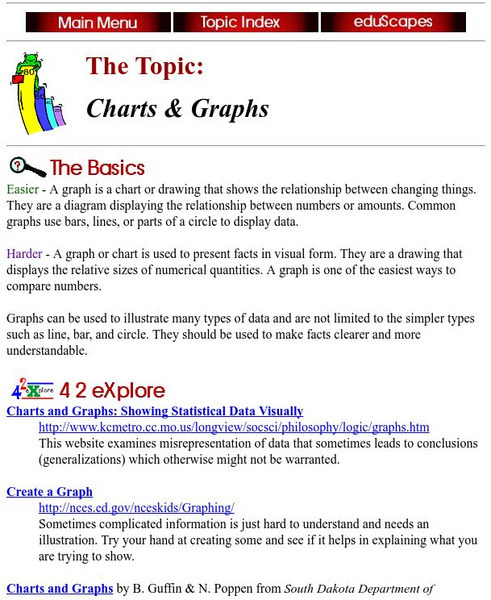
The Topic: Charts and Graphs
Brief descriptions of charts and graphs, followed by links to larger sites on the same subject.
University of Illinois
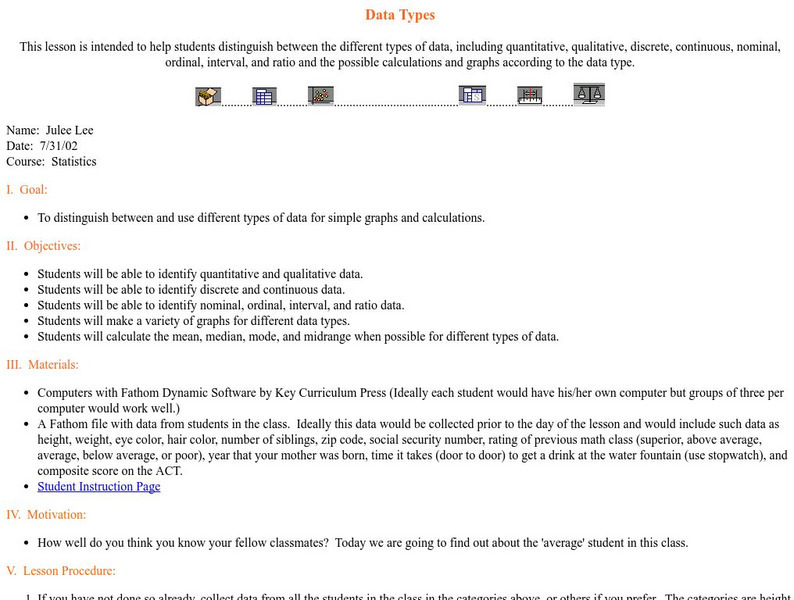
University of Illinois: Data Types
The University of Illinois provides this site that is helpful because of the various kinds of data that can be collected. This lesson plan helps learners differentiate between qualitative, quantitative, and many other types of data.
University of Georgia
University of Georgia: Inter Math: Types of Data
This site has a concise definition of "Data," plus examples of data types and collection methods.
University of Georgia
University of Georgia: Definitions in Statistics
This site contains definitions to use in statistics and ways to collect data.

Oswego City School District
Regents Exam Prep Center: Categorizing Data
Three lessons on different types of data (qualitative, quantitative, univariate, bivariate, biased data) as well as a practice activity and teacher resource.
Thinkport Education
Thinkport: Comparing the u.s., Soviet Union & China During Ww2
Students analyze both quantitative and qualitative forms of information in order to answer compelling questions about the impact of World War II on the military and civilian populations of the United States, the Soviet Union and China.
Lumen Learning
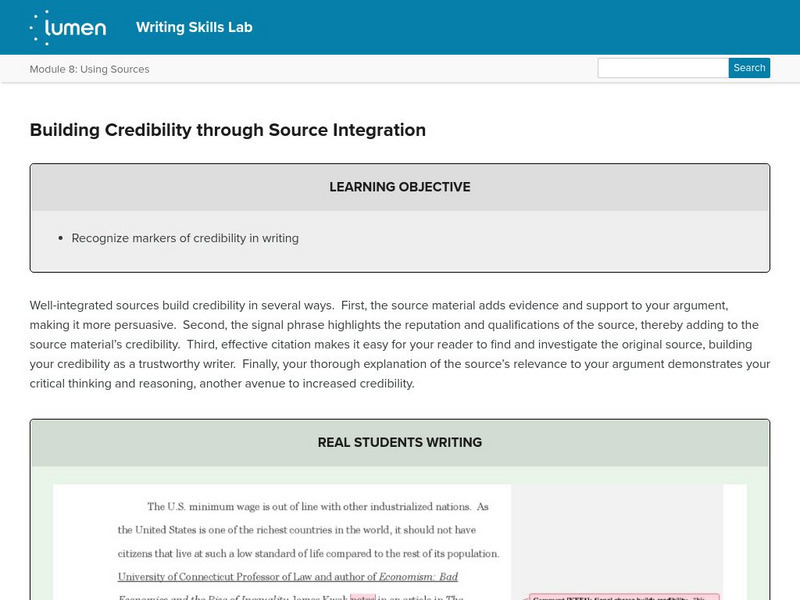
Lumen: Using Sources: Building Credibility Through Source Integration
This lesson plan focuses on building credibility by properly integrating source materials. It discusses three ways of improving credibility through integration, provides an example, and a practice exercise. SL.9-10.2 eval & integrate...
Other
Sprk: Macro Lab Lesson 4 Percentages: Teacher Guide [Pdf]
Learners will use Sphero to explore percentages using speed and color. The speed experiments are quantitative and the color experiments are qualitative. They will program the Sphero to move at 100% speed for a particular amount of time,...
The Tech Interactive
The Tech Interactive: Tech Tip: Data Collection: Reflecting on Your Design [Pdf]
This resource explains why data collection is a great way to make informed improvements to a design, and how to do it. Data can be quantitative - such as a measurement of distance or time - or qualitative, such as an observation of...
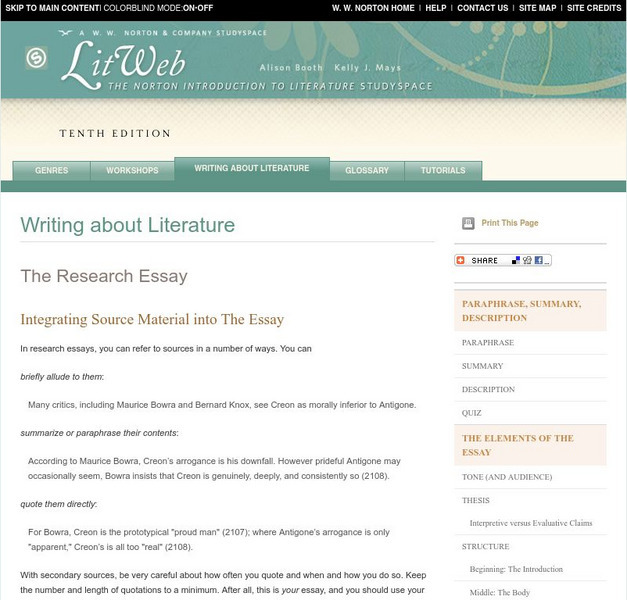
W. W. Norton
W. W. Norton: The Research Essay: Integrating Source Material Into the Essay
Information about integrating source material into an research essay. SL.11-12.2 Eval&Integrate sources