Hi, what do you want to do?






Curated OER
Summing Up "Penguins on Parade"
Students review the meaning of comprehension as it refers to what they have read and how they remember information. They discover the meaning of summarization including the steps they should follow. They then predict what an article...

Curated OER
Cause and Effect
Fourth graders use graphic organizers to differentiate between cause and effect. They read a story independently and write the cause and effects in the graphic organizer.

Curated OER
Choosing Where to Act
Students work together to reach a consensus about an issue. They examine a list of organizations and determine which ones meet a given set of criteria. They write supporting sentences for main ideas to end the lesson.

Curated OER
Have You had Your *5 a Day*?
Students examine *5 a Day* Dole program to reinforce facts learned about nutrition.

Curated OER
ILLUSTRATING TALES AND FOLKLORE
Seventh graders explore tales, stories and folklore while practicing creative illustration techniques.

Curated OER
Train Talk
First graders retell specific information. They listen and interpret train whistle signals and work cooperatively to play the game, I'm Going on a Train Trip.

Curated OER
Picasso; Comparing Blue and Rose Periods
Third graders research Picasso's art career. They use a word processor to create a Venn diagram which compares Picasso's Blue and Rose Periods.

Curated OER
Literature Review
Students review for a literature exam by answering knowledge question, interpretation questions and judgement questions about a novel or story they have just read.

Curated OER
Learning from Primary Source Documents One Day at a Time
Students differentiate between primary and secondary research sources before making a visual representation of their research into the colonist of Fort St. Louis. They write inquiry questions to guide their research.

Curated OER
"Almaden" by Kim Chi-won
Fourth graders read "Almaden" about a Korean woman living in New York. They give a brief background on Korean history and culture and discuss point of view. In groups, they work on discussions questions together.

Curated OER
Philanthropic Literature: Give a cookie
Students read a book to discover the importance of sharing. They predict what will happen in the story. Students use manipulatives to model the story problem. Students follow instructions, measure ingredients, and make cookies.

Curated OER
Visiting a Neighborhood Site
Students interview senior citizens about life in the old days. Sharing research with their classmates, they create their own database. They use technology to enhance the information they gathered from the senior citizens.

Curated OER
Clay Tiles: Family Mosaics
Second graders design and create a clay tile to represent their families. They research and discuss similarities and differences among families of different cultures, create a tile to represent their own and then compile the tiles in a...

Curated OER
France
Eighth graders visit two websites about France in order to take a virtual trip of France. They answer specific questions about France and state the similarities and differences between France and the U.S.

Curated OER
State the Facts
Students, while silently reading the book, "Mr. Pilling's Pond," by Patricia Nikolina Clark, and "One Good Turn," by Bette Anne Rieth, discuss how to summarize each book. They review the five steps to summarization and write them down.

Curated OER
Autobiography
High schoolers investigate the concept of an autobiography and use the teacher as an example of how one is developed. They ask the teacher questions and take notes while the answers are given. This activity can be carried over to student...

Curated OER
Build a Neighborhood
Students build a town out of boxes in this activity. They discuss what they know about a neighborhood. They each design a home or apartment building. The class then combines their homes paying special attention to arrangement to create...

Curated OER
Think of a Number
In this math activity, students engage in a mental math activity. Student think a number and follow several computations with that number and always come up with the answer 9. Students discuss why this happens.
Curated OER
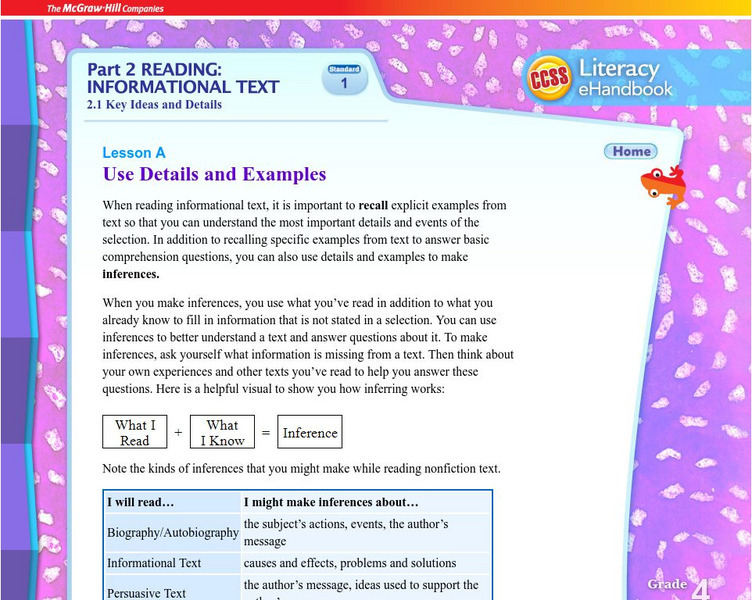
Mc Graw Hill: 4th Grade Use Details and Examples
This reference from the McGraw-Hill CCCS Literacy eHandbook discusses the importance of recalling explicit details. The importance of inferencing skills with a how-to graphic organizer for making inferences are included. Students may...
Curated OER
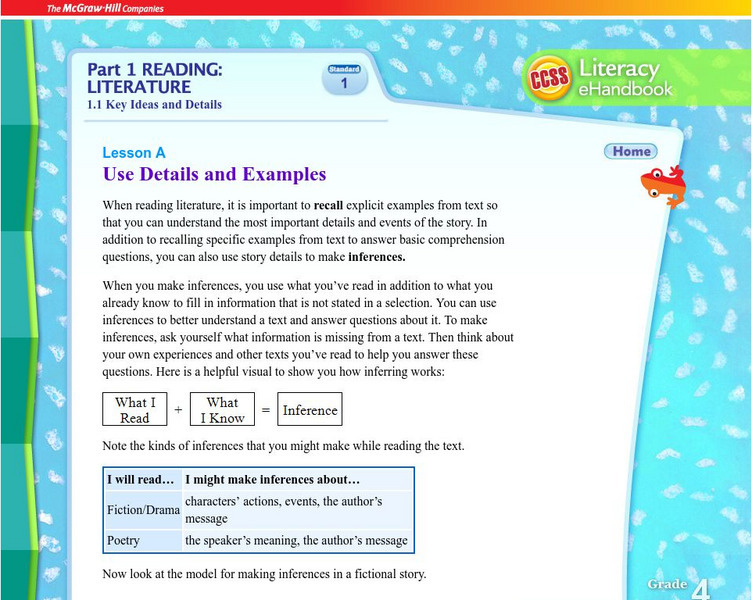
Mc Graw Hill: 4th Grade Use Details and Examples
When reading a story learn how to recall specific examples from the text to answer comprehension questions. In addition, you can also use story details to make inferences.

Other
Prezi: Recalling Facts and Details
Slideshow investigates how to identify facts or details in a story.
Scholastic
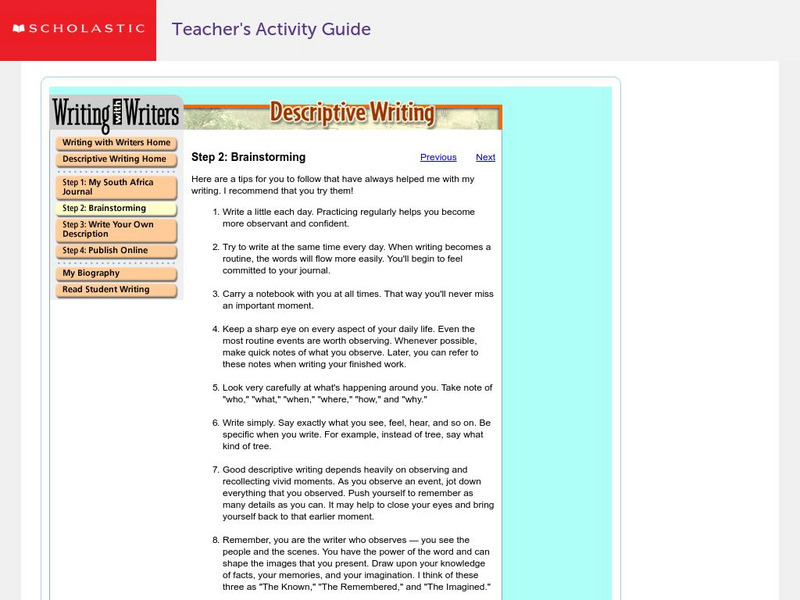
Scholastic: Writing With Writers: Descriptive Writing
Need help with doing a descriptive paper or personal narrative? Need a writing lesson plan? Meet Virginia Hamilton and follow her step-by-step guide to writing. When done, you are eligible for a certificate signed by this author.
Better Lesson
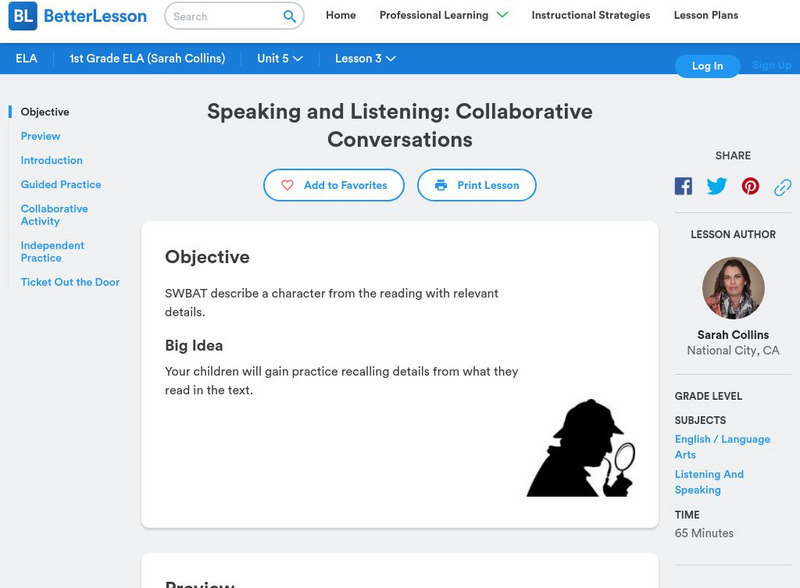
Better Lesson: Speaking and Listening: Collaborative Conversations
Your children will gain practice recalling details from what they read in the text.

ClassFlow
Class Flow: Seasons of an Apple Tree
[Free Registration/Login Required] This flipchart is a literature connection with The Seasons of Arnold's Apple Tree by Gail Gibbons. This activity will engage the students in recalling details from the book to illustrate an apple tree...