Hi, what do you want to do?






MENSA Education & Research Foundation
Roller Coaster Mania!
Raise the energy level of your physical science class with this exciting hands-on activity. Applying their knowledge of kinetic and potential energy and Newton's laws of motion, young engineers use foam tubing and marbles to create...

Anchorage School District
Roller Coaster Project
Emerging engineers work in teams to design pipe insulation roller coasters for marbles that meet specific parameters. They are required to label along the track the areas where kinetic and potential energy are highest and lowest, where...

Teach Engineering
Amusement Park Ride: The Ups and Downs in Design
Groups design the ultimate roller coaster by considering potential and kinetic energy. They test their designs using marbles and then go on to rate each group's design based on aesthetics, loop diameter, and cost.

Barnstable Public Schools
Math Relay Races
A plethora of activities make up a cross curricular choice page filled with math games—relay races, dice, and crossword puzzles—a survey challenge equipped with data organization, graphing, a quicksand recipe, Hula-Hoop activity to...

DiscoverE
Kicking Machine
Don't kick the resource to the curb; you'll definitely regret it. Future engineers devise a kicking machine that launches a ping-pong ball toward a target. They can use a pendulum, a rubber band, or both, depending on whether they want...
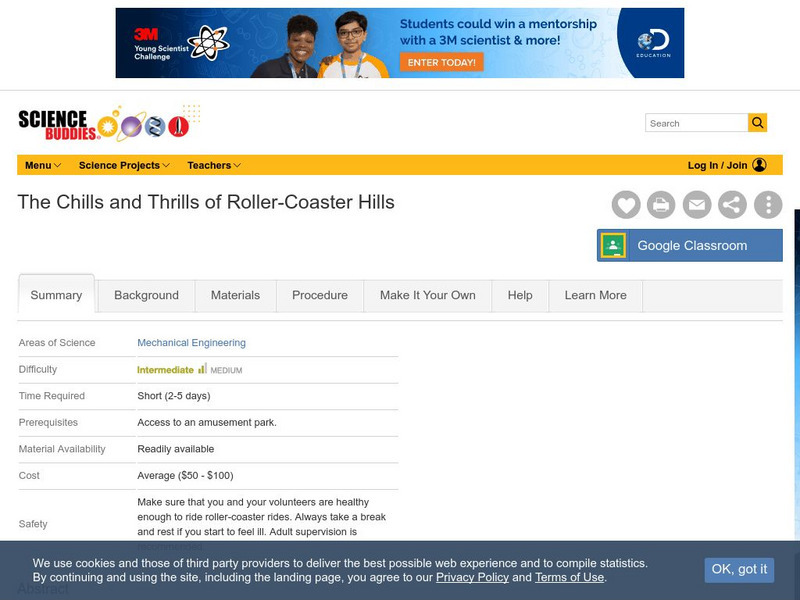
Science Buddies
Science Buddies: The Chills and Thrills of Roller Coaster Hills
Lots of people enjoy roller coasters, but not many understand why they feel the strange excitement they do when riding them. In this science fair project, you will build and use an accelerometer to figure out and measure gravity-induced...
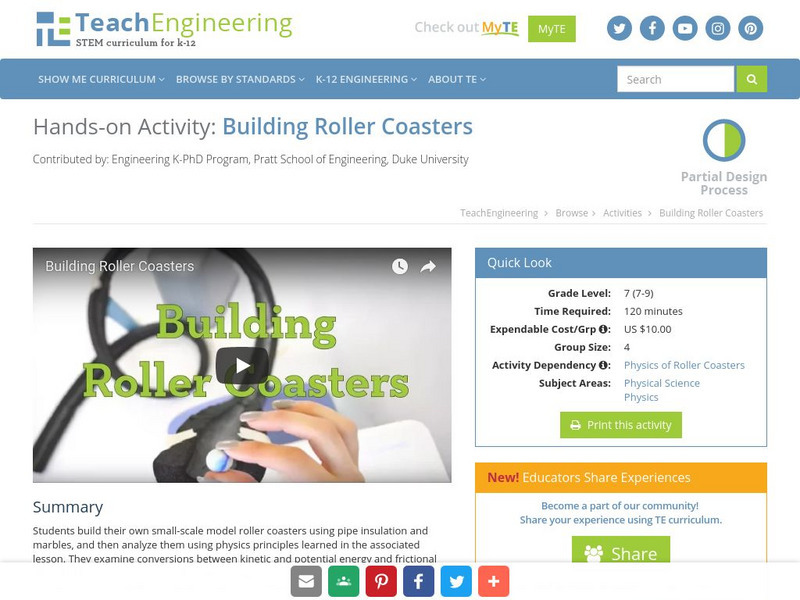
TeachEngineering
Teach Engineering: Building Roller Coasters
In this hands-on activity students learn about the laws of physics by creating a marble roller coaster.
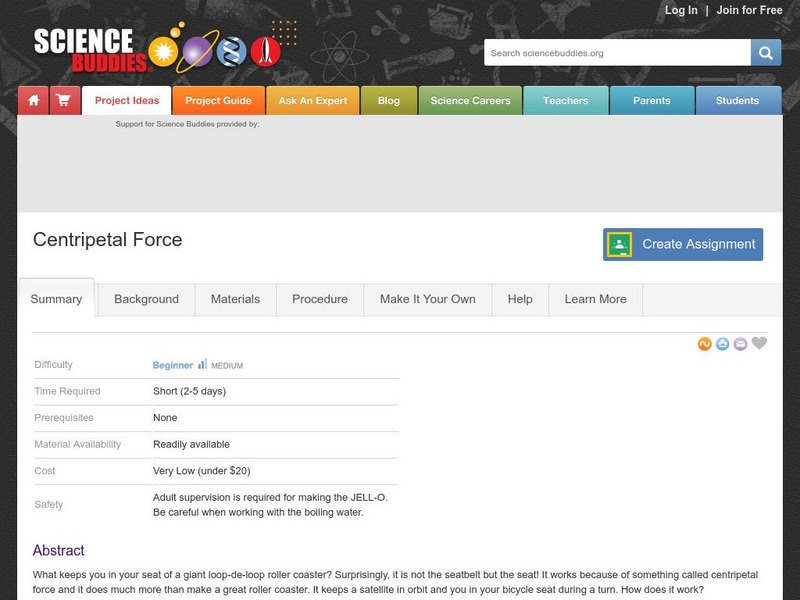
Science Buddies
Science Buddies: Centripetal Force
What keeps you in your seat of a giant loop-de-loop roller coaster? Surprisingly, it is not the seatbelt but the seat. It works because of something called centripetal force and it does much more than make a great roller coaster. In this...
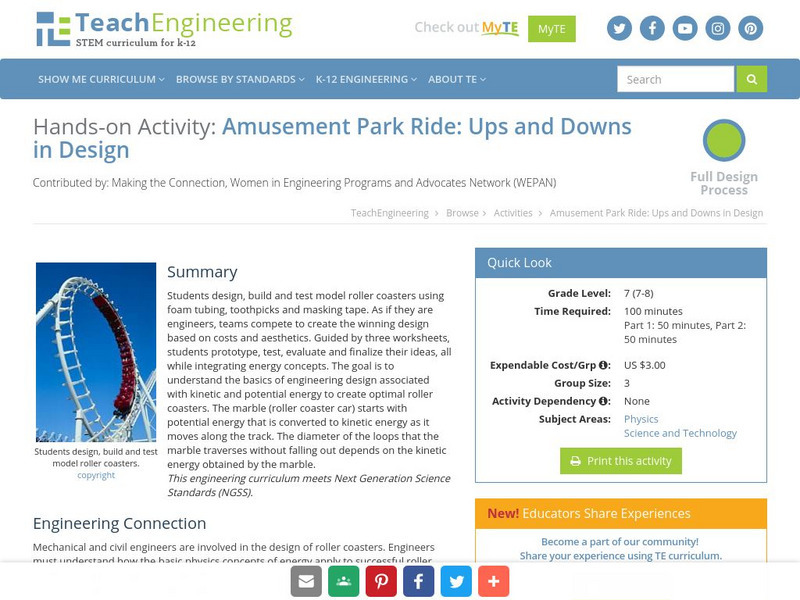
TeachEngineering
Teach Engineering: Amusement Park Ride: Ups and Downs in Design
This unit has students design and build foam tubing roller coasters. The design process integrates energy concepts as they test and evaluate their designs that address the task as an engineer would. The goal is for students to understand...