Hi, what do you want to do?






Curated OER
The Roman Calendar
In this calendar worksheet, students read about the characteristics of the Roman calendar. They write the names of the English months next to the names of the Roman months. They write down the name of the 2 months that are named after...

Student Handouts
What Year Is It?
This page includes a space to write in the date, but what does the date even mean? And where does it come from? Inform your class about the various calendars and how the Western calendar came into widespread use with an informational...

Curated OER
This July, Beware the Ides of March
A thematic unit on Julius Caesar is a great way to study ancient Rome.

Penn Museum
Maya Ball
Sure the ancient Mayan civilization had an advanced calendar and mathematical system, but did you know that they also played a great team sport like basketball? Invite your learners to discover the great ballcourt at Chichen Itza and...

Curated OER
Engaging Students with the History of Time
Researching the history of calendars and time-keeping devices can help students make sense of time measurement.

Curated OER
Good Timing
Learners investigate time, how people measure it, and how it influences our lives. They complete an online Webquest, analyze various calendars, answer discussion questions, and identify references to time in a newspaper article.

Curated OER
Happy April Fool's Day!
Grab students' attention with these lesson and activity ideas on April Fool's Day.

Curated OER
Delve into Mother's Day with Arts and Crafts
Mother's Day is right around the corner and these classroom-friendly activities will help you get ready.

Curated OER
ESL/ELD: Learning about Ash Wednesday
An overview of the history and tradition of Ash Wednesday in 2 paragraphs is accompanied by an array of language activities: cloze exercise, phrase matching, word jumble, multiple choice, sequencing, interview, group presentation,...

Curated OER
New Year's Etymology and Writing Activity
Students investigate the history and etymology of New Year's Day. They listen to a teacher-led lecture about the background of New Year's Day, design an image of Janus, and write a story in the first person telling what Janus might say...

Curated OER
Christmas Lesson Plans
Students learn about the Christmas season through music, research, and other activities.

Curated OER
What is Halloween?
In this Halloween learning exercise, learners listen to a description of the origins of Halloween. Students answer fifteen questions related to the history. One learning exercise has the story and questions. Another learning exercise...
Forum Romanum
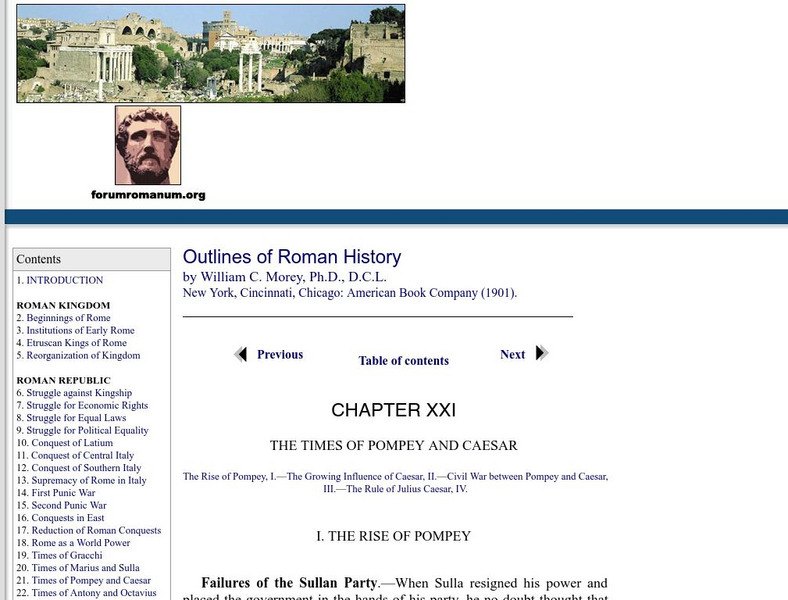
Outlines of Roman History: The Rule of Julius Caesar
Read about Julius Caesar's reforms of the Roman government in this passage from William Morey's 1901 textbook.
University of Chicago
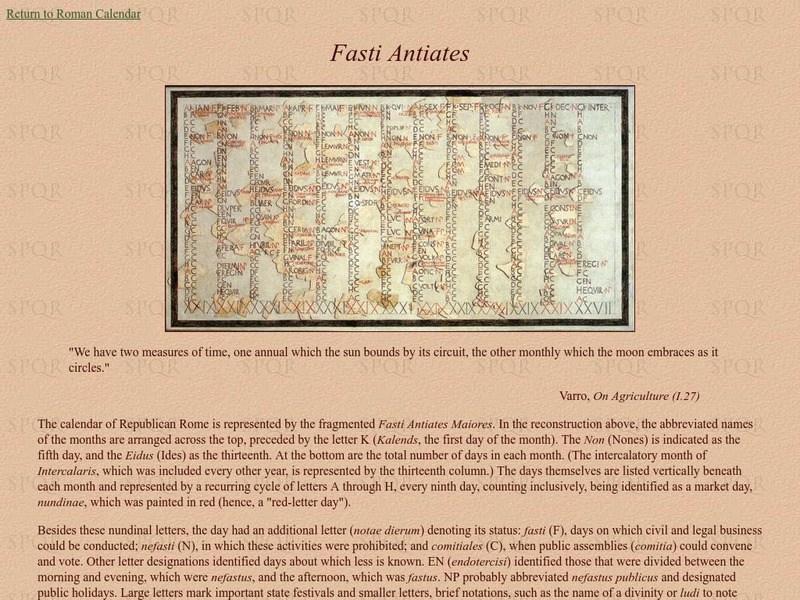
Encyclopedia Romana: Roman Calendar the Fasti Antiates
This site from the Encyclopedia Romana includes a picture of a reconstruction of the Fasti Antiates, along with an explanation of the calendar and its lettering. The information is not too in-depth, but informative and factual. A great...
Authors Calendar
Author's Calendar: Horace
This biography of Quintus Horatius Flaccus, better known as Horace, profiles the Roman lyric poet and satirist as well as feature quotes from his work and a bibliography.
Authors Calendar
Author's Calendar: Virgil
This biography of Virgil, author of the famous Roman epic The Aeneid, is complemented by selected quotes from his works and a detailed bibliography.

Other
Livius: Caesar's Calendar Reform
A selection from Plutarch that highlights Caesar's desire to reform the calendar and how he came about with the changes he enforced.
Wolfram Research
Wolfram Science World: The Julian Calendar
This site from Science World under Wolfram Research contains brief information about the Julian Calendar. The information is factual and interesting, and it also contains links for further information on the subjects.
Authors Calendar
Author's Calendar: Marcus Aurelius
Biography of Marcus Aurelius from the perspective of his writing career, rather than his work as an emperor. Uses his own words from "The Meditations" to provide insight into his character.