Hi, what do you want to do?






Curated OER
Credit Cards: Buy Now, Pay Later
Learners comprehend that when they use a credit card, they are taking out a loan from the issuer of the card. They access that if a card is paid in full each month, there is no cost for using the credit card. However, if the borrower is...

Curated OER
Where Do We Get the Money We Spend?
Students discuss the sources of income for people in their community. They examine why different jobs are paid different wages. They also classify productive resources in the economy.

Curated OER
What Are the Food Groups?
Students examine how eating a variety of foods keeps them healthy. They also explore how similar foods are grouped together in food groups.

Curated OER
Heart Message- Write the Word That Completes the Sentence
In this heart health fill in the blank worksheet, student use words from a word bank to complete sentences about heart health. They take a circled letter from each word to make a new word that is a "heart message."

Council for Economic Education
Econ Ed Link: Saving and Investing Blitz
Interactive activity-based resource on economic concepts of saving and investing.
Council for Economic Education
Econ Ed Link: Saving and Investing
Website with interactive activity and video teaches students about saving and investing.
Other
Securities and Exchange Commission: Saving and Investing for Students [Pdf]
Resource for high school students on the importance of saving and how to begin investing.
Consumer Financial Protection Bureau
Consumer Financial Protection Bureau: Comparing Saving and Investing
Students explore the differences between saving and investing and answer questions about which one they'd use to reach different financial goals.
Federal Reserve Bank
Federal Reserve Bank of Atlanta: Saving and Investing
Explains the Rule of 72 with examples of compound interest and its power to help grow students' money.
PBS
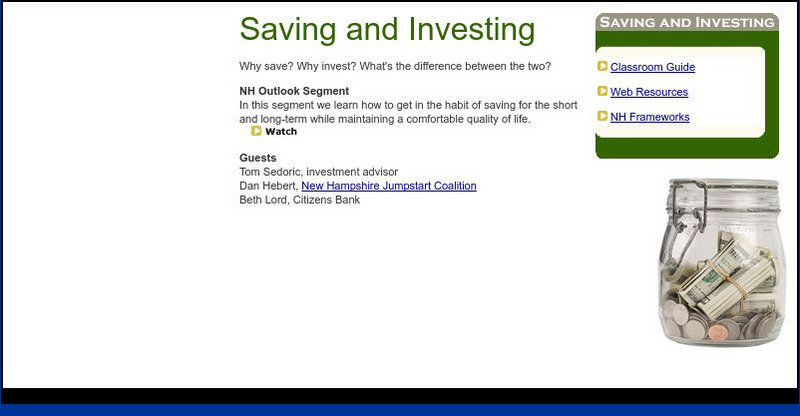
Nh Pbs: Outlook on Money: Saving and Investing
Learn how to get in the habit of saving for the short and long term while maintaining a comfortable quality of life. Explore the reasons for saving and investing and the difference between the two. Includes a classroom guide.
Other
Economic Awareness Council: Saving and Investing [Pdf]
Learn the advantages to saving money, some different types of savings plans, and some ways even people with small amounts of money can invest money to fund long-term goals.
Practical Money Skills
Practical Money Skills at Home: Saving and Investing
This collection of activities offers practical strategies to help parents teach teens the basics of saving and investing. Using the suggested activities, parents can share facts about direct investing, mutual funds, and investment clubs...
Practical Money Skills
Practical Money Skills at Home: Saving and Investing
Teach children the value of saving and investing their money using these suggested ideas. Activity offers real-world experiences that will help children better grasp these concepts. Links to related websites and worksheets are included.
ClassFlow
Class Flow: Savings and Investing
[Free Registration/Login Required] This flipchart provides a matching activity and Activote questions to examine saving and investing.
Council for Economic Education
Council for Economic Education: Learning, Earning, and Investing
This course is subtitled "Lessons for a New Generation." It includes twenty-one downloadable lessons with additional activities for each lesson. It covers a wide range of topics from basics such as "Why Save?" and "Invest In Yourself" to...
Practical Money Skills
Practical Money Skills: Lessons: College
Ten financial literacy lesson plans allow college students to build on their skills and cover topics such as budgeting, living on your own, managing credit cards, cars and loans, and saving and investing.
Other
Zona Hogar / Home Zone by Ginnie Mae
Mortgages made easy! Ginnie Mae and friends teach the basics of home ownership, mortgages, savings and investments, and interest ? all in Spanish! Excellent reading practice for intermediate Spanish learners and older ESL students ? and...

Scholastic
Scholastic: Adventures in Math: Lesson 3: Smart Saving
In this lesson, learners will define and identify the differences between saving and investing, evaluate the risks associated with investments, and explore the costs of using credit cards to make purchases.
Other
We the Savers: Young Savers
This resource introduces students to the world of money with this online tutorial. Each unit has its' own online quiz. Brave the desert, climb mountains and dodge alligators while you explore everything there is to know about earning,...
PBS
Pbs: Your Life Your Money
PBS presents an abundance of financial information and helpful tips; real stories from real people on managing your money. Some of the financial challenges include getting out of debt, saving money, insurance, and investments.
Consumer Financial Protection Bureau
Consumer Financial Protection Bureau:discovering the Benefits of Investing Early
Students use an online calculator and answer questions to learn about the value of investing early.
Consumer Financial Protection Bureau
Consumer Financial Protection Bureau: Setting a Smart Savings Goal
Learners discuss short-term and long-term goals and what makes a goal SMART. They then create their own short-term savings goal and make an action plan to meet that goal.
Thinkport Education
Maryland Public Television: Sense and Dollars
Engaging, fun tutorials and interactive games related to earning, spending, saving, and budgeting money.
Council for Economic Education
Econ Ed Link: We Are Consumers and Producers
This lesson plan is geared toward beginning economics concepts. "In this instructional activity you are going to learn more about how you and others are consumers and producers."
Other popular searches
- Saving and Investing Rubric
- Saving and Investing Money
- Saving and Investing Video
- Saving and Investing Pretest