Hi, what do you want to do?





Georgia Department of Education
Ga Virtual Learning: Physical Science: Light and Optics
Students will investigate the properties of light waves. They will learn about the different types of electromagnetic waves and mechanical waves, and investigate the phenomena of reflection, refraction, interference, and diffraction.
Exploratorium
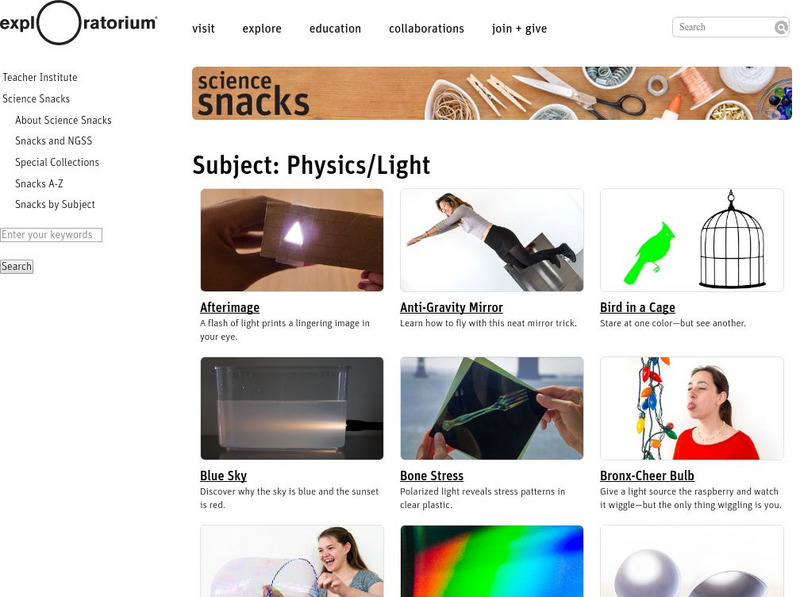
Exploratorium: Science Snacks: Physics/light
Here is a large collection of simple science class activities for understanding the physics of light.
Science Buddies
Science Buddies: Using Laser Pointer to Measure Data Track Spacing on C Ds, Dv Ds
You've probably noticed the colorful patterns "reflecting" from the shiny surface of a CD disk. What you are seeing is actually diffraction of white light, and the rainbows of color are diffraction patterns. In this project you'll learn...

American Association of Physics Teachers
Com Padre Digital Library: Open Source Physics: Multiple Slit Diffraction Model
Simulation that shows the diffraction of light through single or multiple slits. Simulation allows modification of the number of slits, slit width, slit separation, and the wavelength.

Science Buddies
Science Buddies: Rainbow Candy
Make your own rainbow candy in this fun STEM activity. You will do it without using any food coloring. Instead, you will use a light-bending phenomenon called diffraction.

Exploratorium
Exploratorium: Science Snacks: Diffraction
Demonstrate light bending called diffraction in this activity.
Optical Society
Optical Society of America: Optics for Kids: Diffraction Between Wax Blocks
An activity to demonstrate how light behaves when encountering an obstacle, in this case, wax blocks placed in a ripple tank. Includes an explanation of the diffraction that occurs.
Other
Siemens Science Day: Physical Science: Through the Looking Glass
Students will make their own spectroscope, learn how light is bent by a diffraction grating, and explore how various forms of light differ.
Vision Learning
Visionlearning: Earth Science: Minerals Iii: The Silicates
Instructional module focusing on the Silicate minerals. Discussion includes the most common minerals on Earth such as quartz, feldspar, mica, amphibole, pyroxene, and olivine. Site also includes an interactive practice quiz and links...

Exploratorium
Exploratorium: Science Snacks: Cd Spectroscope
Analyze light by creating a CD spectroscope in this activity. See the whole spectrum of light with the spectroscope.
Science Struck
Science Struck: A Comprehensive List of All the Physics Formulas
Provides a long list of physics formulas for easy reference.
My Science Site
My Science Site: World of Colours [Pdf]
This resource presents a cooperative learning activity where students can enhance their knowledge of light diffraction. This resource is in PDF form; requires Adobe Reader.
Other
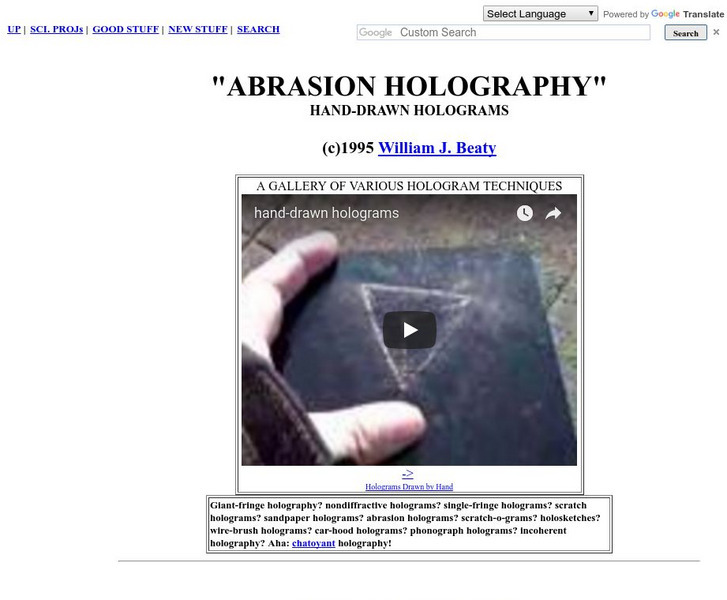
The Science Hobbyist: Hand Drawn Holograms
Instructions for making a scratch hologram. Includes interesting anecdotes, background information, and links to other holography sites.

Open Curriculum
Open Curriculum: Wave Optics
Learn about the diffraction of light using the wave model and Huygen's principle.
Florida State University
Florida State University: William Henry Bragg
A sound biography, focusing mainly on Bragg's science, what he discovered and what it's significance was. Lists many of his honors.
National High Magnetic Field Laboratory
Magnet Academy: Heinrich Hertz
The discovery of radio waves, which was widely seen as confirmation of James Clerk Maxwell's electromagnetic theory and paved the way for numerous advances in communication technology, was made by German physicist Heinrich Hertz. In the...
Science Struck
Science Struck: How Does Sound Travel?
Discusses the characteristics of sound waves and the conditions that affect the speed of sound.
Ducksters
Ducksters: Physics for Kids: Wave Behavior
Kids learn about the behavior of waves in the science of physics including reflection, refraction, diffraction, polarization, absorption, and interference.

Other
The University of Salford: Sounds Amazing
This site has several lessons all about sound. It introduces sound, then covers major principles of waves and the wave equation. Each lesson has interactive activities to keep you interested, and there are even some test questions.
Georgia Department of Education
Ga Virtual Learning: Astronomers' Tools
In this interactive tutorial students will learn about a few of the instruments used to further our knowledge of the Universe around us.
Other
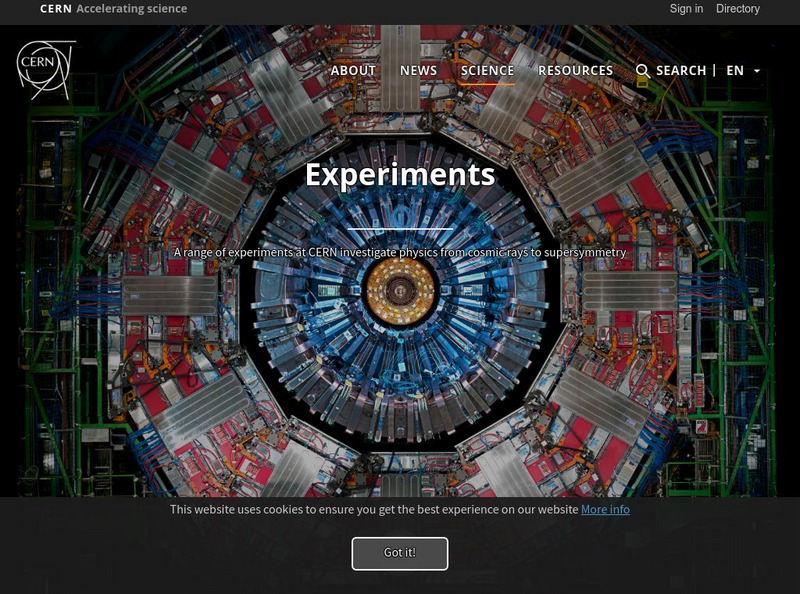
Cern: Experiments
Read about the six experiments at the Large Hadron Collider: ALICE (A Large Ion Collider Experiment), ATLAS (A Toroidal LHC ApparatuS), CMS (Compact Muon Solenoid), LHCb (Large Hadron Collider beauty), TOTEM (TOTal Elastic and...
Wolfram Research
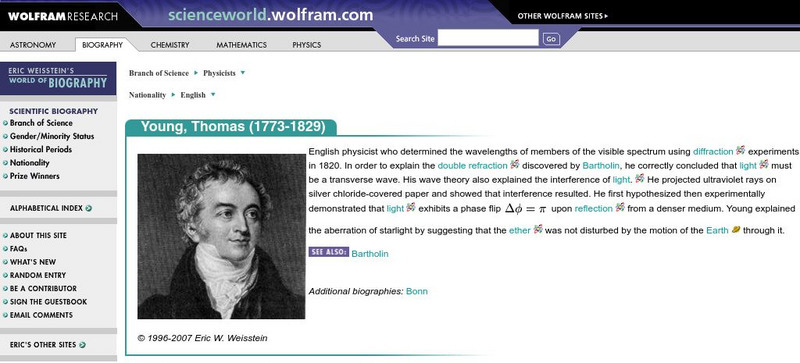
Wolfram Science World: Young, Thomas
This site from ScienceWorld provides a very short but factual biographical sketch of Thomas Young (1773-1829 CE) and describes his most notable scientific discoveries and contributions. Links are also provided throughout for additional...
Georgia Department of Education
Ga Virtual Learning: Electromagnetic Waves and the Wave Nature of Light
In this interactive lesson about electromagnetic waves students will explore what they can see, what they can't, and what they know about the wave nature of this thing called "light."
PBS
Pbs Teachers: Stellar Fingerprints: The Spectra of Stars
Identify the composition of stars by applying the ideas of quantum theory. Investigate the field of spectroscopy, and examine the spectra of stars to locate the emission and absorption lines of hydrogen.