Hi, what do you want to do?





Science Buddies
Science Buddies: A Magnetic Primer Designer
How do scientists "copy" DNA? They use a process called the Polymerase Chain Reaction, or PCR. The key to making this process work is having a primer that will stick to the piece of DNA you want to copy, called a template. In this...

Science Buddies
Science Buddies: What's the Point of Boiling?
You know that water can exist in three separate phases: solid (ice), liquid (water), and vapor (steam). To change from one phase to another, you simply add (or remove) heat. When water boils, what happens to molecules (for example sugar...
Science Buddies
Science Buddies: Bubble Ology
Making your own bubble solution is fun, but sometimes the bubbles don't seem to work as well as the solutions you buy in the store. In this experiment you can test if adding corn syrup or glycerin to your bubble solution will make it...
Science Buddies
Science Buddies: Rubber Band Elasticity and Temperature
Many materials expand when heated and contract when cooled. What do you think will happen to the elasticity (stretchiness) of a rubber band when it is heated or cooled to various temperatures?
Science Buddies
Science Buddies: Catching Stardust
How do astronomers collect stardust? They design and build satellites that are launched into space to collect particles on specially designed panels. Satellites can be sent to orbit around an object of interest: a planet, moon, or comet....
Science Buddies
Science Buddies: How Much Do Different Pet Species Eat?
How much food do you think your pet eats compared to other kinds of pets? In this experiment you will compare the food intake of your family pets to find out which pet eats more for its body weight.

Science Buddies
Science Buddies: Measuring the Amount of Acid in Vinegar by Titration
There are many different types of vinegar that you can buy to use around the kitchen for cooking and pickling. The chemical compound that gives vinegar its tart taste and pungent smell is acetic acid. In this experiment you will work to...
Science Buddies
Science Buddies: Crank Up the Music!
Cranked powered appliances and gadgets are becoming more and more prevalent. Items used in America such as flashlights and radios are one example. However, in third world countries, radios have many uses, some important and educational,...
Science Buddies
Science Buddies: Batteries: The Shocking Truth
Here you can find what you need to scientifically assess battery performance. In this exercise (that should take about one week) learn how batteries work, how they wear out and most importantly, how to make valid measurements to assess...
Science Buddies
Science Buddies: Measuring Your Taste Threshold
Some people are more susceptible to flavors than others. This experiment asks you to test your threshold for the three types of taste our tongues are capable of experiencing: salty, sweet, and sour.
Science Buddies
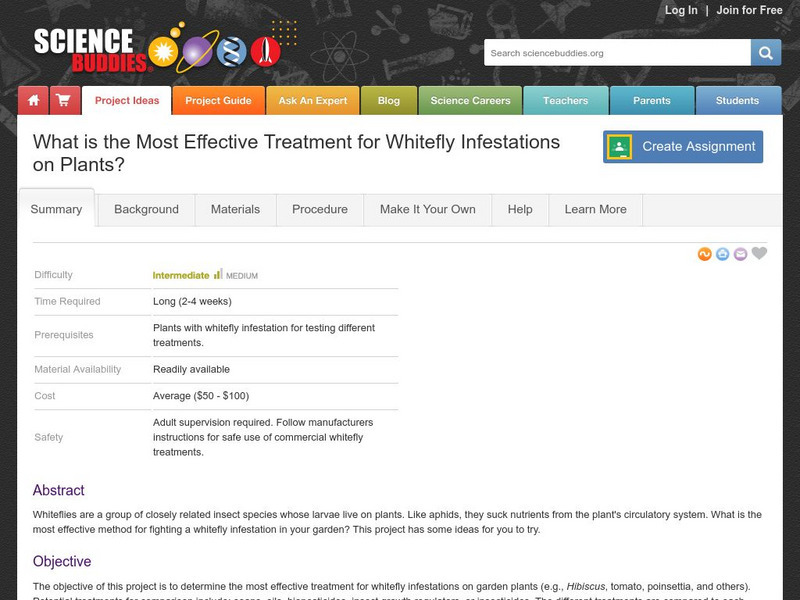
Science Buddies: Most Effective Treatment for Whitefly Infestations on Plants?
Whiteflies are a group of closely related insect species whose larvae live on plants. Like aphids, they suck nutrients from the plant's circulatory system. You will be asked to find the most effective method for fighting a whitefly...
Science Buddies
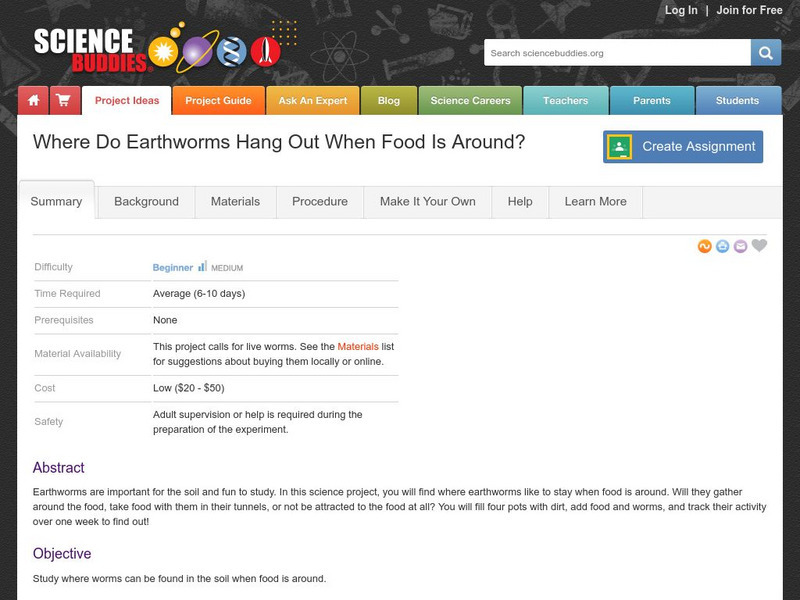
Science Buddies: Earthworms: Nature's Tiller?
Everybody knows that worms are good for the soil, but not everybody knows why. This lab shows you how to efficiently measure earthworms within units of soil to determine their affect on decomposition and reduction of surface residue.
Science Buddies
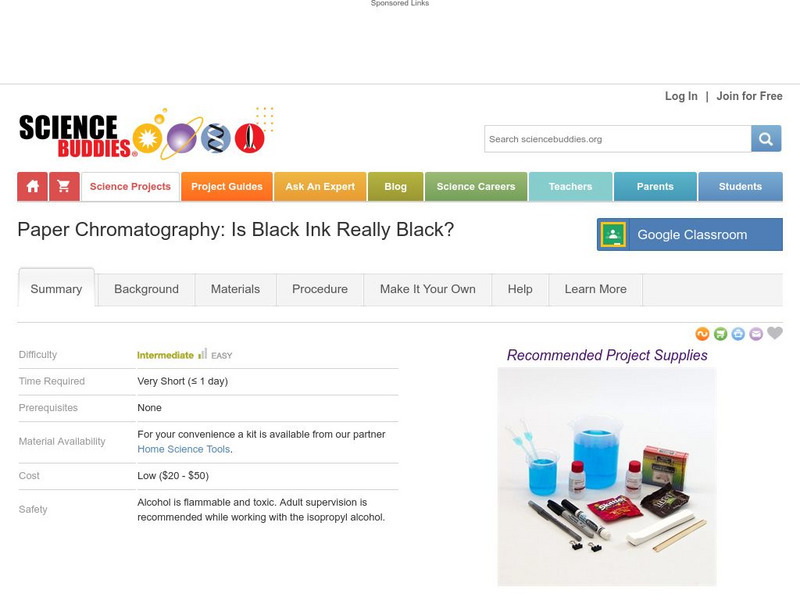
Science Buddies: Paper Chromatography: Basic Version
Many substances are actually mixtures of different things. For example, milk, which looks like it is one substance, is actually a mixture of many different solids and liquids. Chromatography is a technique that is used to separate...

Science Buddies
Science Buddies: Which Materials Are the Best Conductors?
There are two main types of materials when it comes to electricity, conductors, and insulators. What are they made of? Find out by testing different materials in a circuit to see which ones conduct the most electricity.
Science Buddies
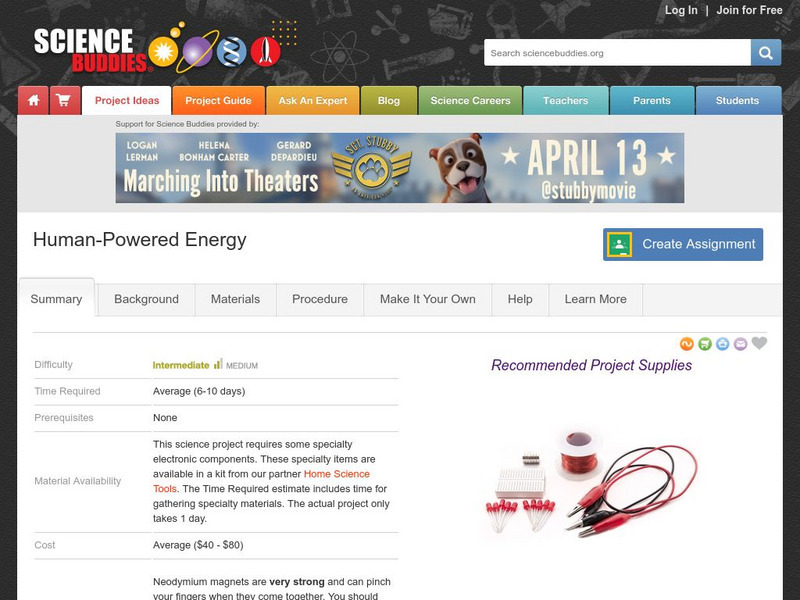
Science Buddies: Shaking Up Some Energy
Shake N' Light flashlights have been advertised on televisions across the nation in the recent year. But many do not understand just how they get energy to light up the bulb without using batteries. Do this experiment to make your own...

Science Buddies
Science Buddies: One Bad Apple Spoils the Whole Bunch: Plant Hormone Ethylene
We have all heard the old saying, "One bad apple spoils the whole bunch." Due to the production of the plant hormone ethylene during the ripening process, this saying proves true. This experiment will investigate the role of ethylene in...

Science Buddies
Science Buddies: What Makes the Rings of Saturn?
Saturn is a unique planet because of the many beautiful rings surrounding it. How are all of those rings made? Why is each ring unique?
Science Buddies
Science Buddies: Where Did All the Stars Go?
If you live in a big city or urban area it is hard to see many stars at night. In most urban areas only the most brilliant stars, planets and the moon can be seen. This is because of something called light pollution which is the...

Science Buddies
Science Buddies: The Moon and the Stars
When you are in the city, only a few of the brightest stars are visible. But when you are in the country, you can see many more stars than you can count. Sometimes you can even see the bright belt of our galaxy, the Milky Way. In this...

Science Buddies
Science Buddies: Sorting Out Sedimentation
Sedimentary rock forms in layers that are deposited one after the other over long periods of time. Oftentimes, sedimentary rock contains fossils and other debris that are deposited within the layers. Use this experiment to investigate...

Science Buddies
Science Buddies: Bottled Up Buoyancy
Sure you understand what makes submarines cool, they allow us go underwater and explore the sea! But understanding how they function is a completely different matter. This lab will help you investigate how submarines dive and surface by...
Science Buddies
Science Buddies: Worm Hunt: Isolating Soil Nematodes From Your Backyard
Nematodes, also called roundworms, are the most abundant animal on Earth and can be found in your back yard, playgrounds, and many other places. This lab involves isolating nematodes from several soil samples to discover the best...
Science Buddies
Science Buddies: Speleology: Counting Formations in a Local Cave
In the past caves have been used for shelter, for religious purposes, and for burial sites. They were even used for food storage before refrigeration, because they are cool and have constant high humidity. Get ready for an adventure as...
Science Buddies
Science Buddies: Are There Bugs Under Your Feet?
Within the grass there are millions of micro-invertebrates. Learn how to catch them by making a Berlese funnel in this fun project that will teach you about soil.