Hi, what do you want to do?





National High Magnetic Field Laboratory
Magnet Academy: Electric Range 1892
From the Stone Age to today, the search is constantly underway for better, more efficient ways to cook food. Reflecting many of the advances in science and technology, the electric range has become a popular choice for homes and businesses.

National High Magnetic Field Laboratory
Magnet Academy: Jean Charles Athanase Peltier (1785 1845)
Although he didn't start studying physics until he retired from the clock-making business at age 30, French native Jean Peltier made immense contributions to science that still reverberate today. Even with the primitive tools available...

CK-12 Foundation
Ck 12: Earth Science: Seafloor: Characteristics and Spreading Study Guide
[Free Registration/Login may be required to access all resource tools.] A brief overview of the methods scientists use to study the ocean seafloor and the features that can be found there. Discusses the magnetic polarity of the seafloor...
National High Magnetic Field Laboratory
Magnet Academy: Cryogenics for English Majors
Fear not, right-brained friends: Science and art intersect in plenty of places, and this is one of them. Samuel Taylor Coleridge lends a hand as we explore cryogenics - how to get things fantastically frigid - and the fascinating element...
National High Magnetic Field Laboratory
Magnet Academy: Transatlantic Telegraph Cable 1858
The main figure behind the first transatlantic telegraph knew very little about the science or engineering behind it, but was convinced that with it a fortune could be made. Read about these findings here.
Florida State University
Florida State University: Magnet Lab: Organic Superconductors
Organic superconductors, though still new to science, are lighter and more potentially versatile than inorganic superconductors and may have important applications in the future.

Khan Academy
Khan Academy: Experiment: What's the Shape of a Magnetic Field?
See drawing from Hans Christian Orsted's lab notebook showing an experiment in which an electric charge passing through a wire seemed to create a magnetic field!
CK-12 Foundation
Ck 12: Fifth Grade Science: Physical Science: Separating Mixtures
[Free Registration/Login may be required to access all resource tools.] Discusses how mixtures of solids can be separated based on observable properties of their parts such as particle size, shape, color, and magnetic attraction.
CK-12 Foundation
Ck 12: Earth Science: Earth's Interior
[Free Registration/Login may be required to access all resource tools.] Discover how scientists learn about Earth's interior using seismic waves, meteorites, density, and the magnetic field. Additional resources are available for download.
Florida State University
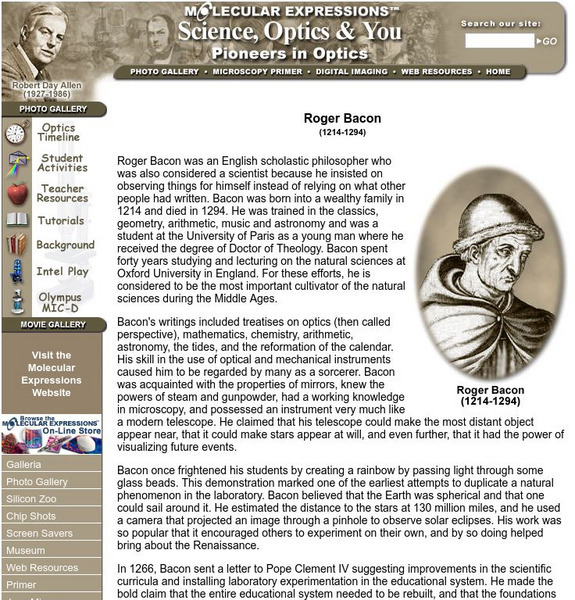
Florida State University: Science, Optics, and You: Roger Bacon
This Science, Optics, and You site offers a biography of Roger Bacon with focus on his treatises on optics.
Other
Stile: 2.1 Lesson: Electromagnetism (Part 1)
This is a sample lesson on electromagnetism. It includes animated diagrams, interactive exercises, an audio option for reading the text, and comprehension questions throughout where students can type their answers or pick from...
National High Magnetic Field Laboratory
Magnet Academy: Timeline of Electricity and Magnetism: 1880 1889
Nikola Tesla and Thomas Edison duke it out over the best way to transmit electricity and Heinrich Hertz is the first person (unbeknownst to him) to broadcast and receive radio waves.
National High Magnetic Field Laboratory
Magnet Academy: Timeline of Electricity and Magnetism: 1820 1829
Hans Christian Orsted's accidental discovery that an electrical current moves a compass needle rocks the scientific world; a spate of experiments follows, immediately leading to the first electromagnet and electric motor.
National High Magnetic Field Laboratory
Magnet Academy: Timeline of Electricity and Magnetism: 1930 1939
New tools such as special microscopes and the cyclotron take research to higher levels, while average citizens enjoy novel amenities such as the FM radio.
National High Magnetic Field Laboratory
Magnet Academy: Timeline of Electricity and Magnetism: 1910 1929
Scientists' understanding of the structure of the atom and of its component particles grows, the phone and radio become common, and the modern television is born.
National High Magnetic Field Laboratory
Magnet Academy: Timeline of Electricity and Magnetism: 1900 1909
Albert Einstein publishes his special theory of relativity and his theory on the quantum nature of light, which he identified as both a particle and a wave. With ever new appliances, electricity begins to transform everyday life.
National High Magnetic Field Laboratory
Magnet Academy: Timeline of Electricity and Magnetism: 1890 1899
Scientists discover and probe x-rays and radioactivity, while inventors compete to build the first radio.
National High Magnetic Field Laboratory
Magnet Academy: Electrocardiograph 1903
If TV medical dramas have taught us anything, it's how to recognize the heart's characteristic peaks and valleys crawling across monitors in emergency rooms. These images represent the electrical activity of the beating heart as recorded...
National High Magnetic Field Laboratory
Magnet Academy: Gerd Binnig
Gerd Binnig co-developed the scanning tunneling microscope (STM) with Heinrich Rohrer. The STM allowed scientists entry into the atomic world in a new way and was a major advance in the field of nanotechnology. For their achievement,...
National High Magnetic Field Laboratory
Magnet Academy: Heinrich Hertz
The discovery of radio waves, which was widely seen as confirmation of James Clerk Maxwell's electromagnetic theory and paved the way for numerous advances in communication technology, was made by German physicist Heinrich Hertz. In the...
University of Kentucky
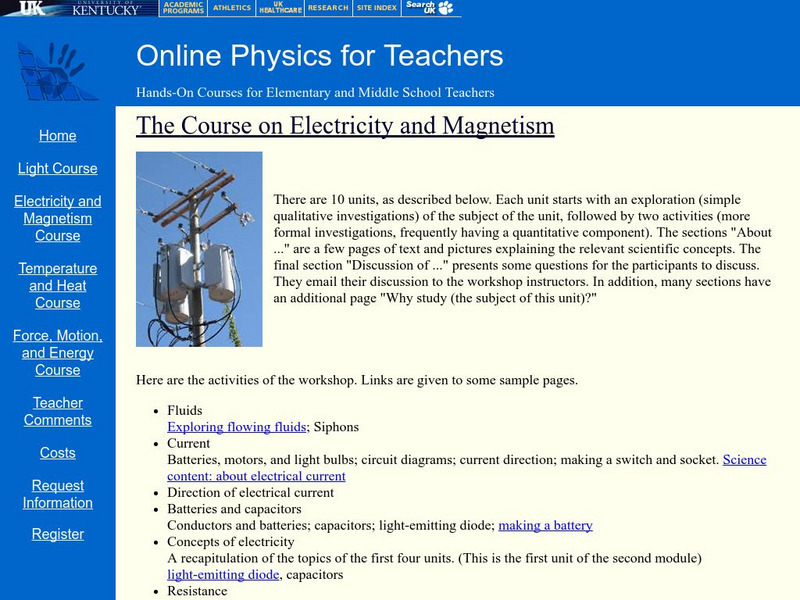
Virtual Workshop: The Course on Electricity & Magnetism
On line course on Electricity and Magnetism for graduate credit or professional development, that emphasizes hands on activities you can use in your classroom.
Exploratorium
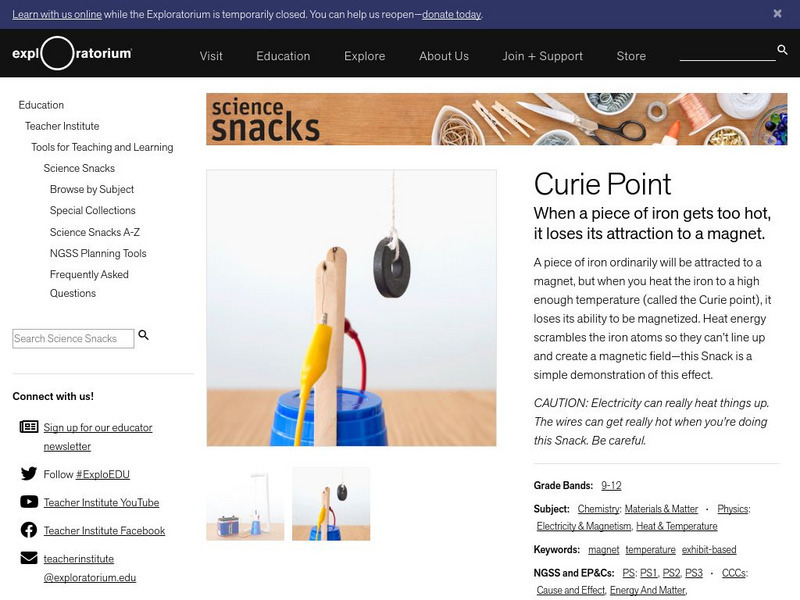
Exploratorium: Science Snacks: Curie Point
Did you know that a piece of iron can lose its magnetism if heated too high? There is a point called the Curie point when iron is heated to a high enough temperature that its iron atoms are scrambled and can't line up to form a magnetic...
National High Magnetic Field Laboratory
Magnet Academy: Mag Lab: Image Furnace
Scientists use image furnaces to grow crystals at very high temperatures. A built-in camera allows them to observe in action a delicate process that is equal parts art and science.
Exploratorium
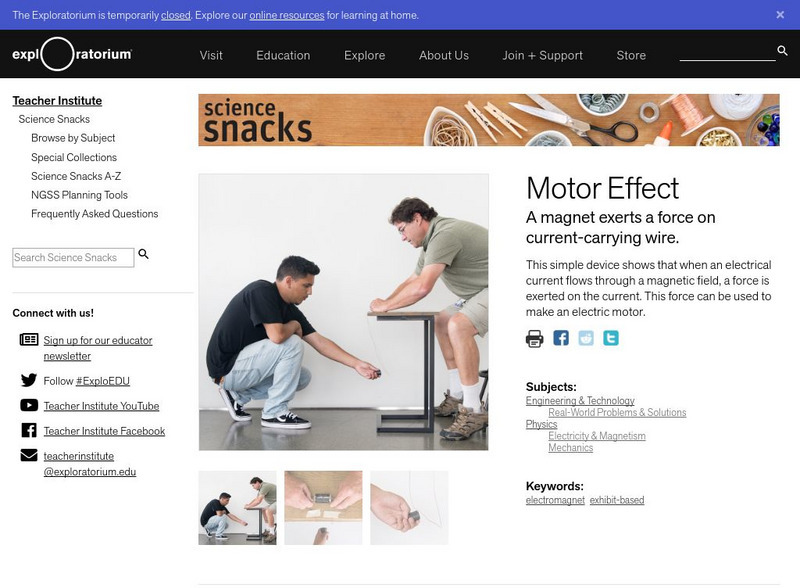
Exploratorium: Science Snacks: Motor Effect
"A magnet exerts a force on current-carrying wire." This simple device shows how magnets affect wires with current in them, the basis of the electric motor. If you see, feel and understand this, the electric motor becomes very clear.