Hi, what do you want to do?






Curated OER
Simple Machines and Modern Day Engineering Analogies
Learners apply the mechanical advantages and problem-solving capabilities of six types of simple machines (wedge, wheel and axle, lever, inclined plane, screw, pulley) as they discuss modern structures in the spirit of the engineers and...

Curated OER
Observing Motion
First graders explore movement and motion. In this motion lesson, 1st graders how objects can move as well as how the Earth is in constant motion and the force of gravity. Students complete a coloring sheet.

Curated OER
Ring Around the Rosie
Students work together to discover the concept of angular momentum. They participate in experiments in which they test rotation and relate it to an object's mass. They participate in a literacy activity in which they compare mythology...

Curated OER
Land Use Issues
Learners examine living and non-living things in their environment. They identify trees, plants, and grasses in their neighborhood and those that originate in Illinois in this unit of lessons.

Curated OER
Weightlessness Demonstration
Middle schoolers explore the concept that free-fall eliminates the local effects of gravity. They discuss what an Earth-orbiting spacecraft experience is like as well as the terminology of weightlessness. Their lab experiment commences.

Curated OER
Weightlessness
Students predict the behavior of coffee in a cup while it is dropped during a demonstration. They relate their observations to the weightless conditions that astronauts experience in space and discuss the concept of free-fall.

Teach Engineering
Edible Rovers
The good thing about building this rover is you get to eat it afterwards. Pairs determine rover parts they want to include in their design based upon their cost and usefulness. The teams design their rovers, build them from edible...

Teach Engineering
Accelerometer: Centripetal Acceleration
Scholars build robotic arms that swing back and forth and use them to collect velocity and acceleration data. To analyze the results, pupils compare data to the equations for angular velocity and centripetal acceleration.

Curated OER
May the Force Be With You
Young scholars read an article, brainstorm ideas and prepare journals investigating why people enjoy 'thrill' rides, what forces affect the body on these rides and how they can become dangerous.

Curated OER
Let's Outrage the Bull
Students study kinetic and potential energy. In this energy lesson, students in grades K-2 understand the differences between kinetic and potential energy. Students in grades 3-5 demonstrate that kinetic and potential energy. Students in...

Curated OER
Preferences
In this oral language worksheet, learners work in pairs to ask and answer questions. The first student asks 6 questions about the preferences of Leonardo di Caprio and Cameron Diaz. When the partner answers, it is checked and marked as...

Curated OER
Inequalities
Sixth graders explore the concept of inequalities and how to solve them in the realm of integers. The instructor would benefit from using a number line and reviewing integers before using this lesson plan.

Curated OER
Weightlessness Demonstration
Students investigate gravity. In this weightless lesson students complete a lab activity about how a free fall might effect how one perceives gravity.

Curated OER
Leveled Problem Solving Sampling Errors
In this sampling errors worksheet, students problem solve to find the sampling errors for each word problem. Students finish by finding a sampling method that might bias the last surveys.

TeachEngineering
Teach Engineering: The Science of Swinging
Young scholars learn what a pendulum is and how it works in the context of amusement park rides. While exploring the physics of pendulums, they are also introduced to Newton's first law of motion - about continuous motion and inertia.
Science Buddies
Science Buddies: Converting Potential Energy to Kinetic Energy
If you'd like to investigate the physics of amusement park rides, then this project is for you. You'll build a roller coaster track for marbles using foam pipe insulation and masking tape, and see how much the marble's potential energy...
Science Buddies
Science Buddies: The Chills and Thrills of Roller Coaster Hills
Lots of people enjoy roller coasters, but not many understand why they feel the strange excitement they do when riding them. In this science fair project, you will build and use an accelerometer to figure out and measure gravity-induced...
Physics World
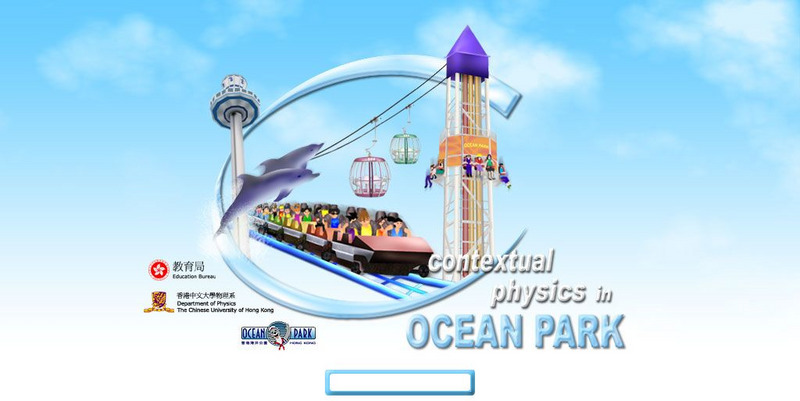
Physics World: Contextual Physics in Ocean Park
After downloading the "Motion Video Analysis" software, users can collect data about moving object's position from digital movie clips. This collection of data will allow them to plot motion graphs and draw conclusions about physics in...

Other
Hstry: Roller Coaster Design Brief Template
Interactive site by STEM teacher Mariana Garcia-Serrato in a lesson on physics in which students design, budget for and analyze their own roller coasters.
Other
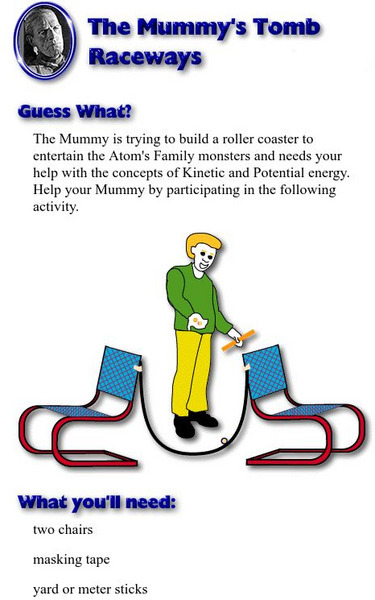
Puhinui School: The Atoms Family: The Mummy's Tomb: Raceways
Help the Mummy build a rollercoaster to entertain the Atoms Family monsters by investigating the concepts of kinetic and potential energy.
Curated OER
May the Force Be With You
Students explore the science behind thrill rides, including the physics of a roller coaster, human emotions, and physiological effects on the body. A related article is accessible through free registration.