Hi, what do you want to do?






Science Matters
Wave Watching
Seismologists use the direction and arrival times of p waves and s waves to determine the distance to the source of an earthquake. The engaging instructional activity has students line up to form human waves. Through different movements...

DiscoverE
Slinky® Science
Toys are great for learning about physics. Scholars use Slinky® toys to study Newton's laws of motion and types of energy. After a little play, they then model longitudinal and transverse waves with the Slinky® toys.

Teach Engineering
Earthquakes Living Lab: FAQs about P Waves, S Waves and More
Let's talk about earthquakes .... Using the Internet, pupils research what causes earthquakes, how scientists measure them, their locations, and their effects. The resource is not only informative, but it also builds crucial...

Teach Engineering
Earthquakes Living Lab: Finding Epicenters and Measuring Magnitudes
Pairs use an online simulation to determine the epicenter and magnitude of an earthquake. Using real data about the earthquake's maximum S wave amplitudes, they then determine the magnitude. The resource provides a great career...

California Academy of Science
What Kind of Geologist Am I?
Transform your class into young geologists as they learn about six different branches of geology. Using the included geology career descriptions and picture cards, learners work in small groups deciding which tools and locations fit...
Science Buddies
Science Buddies: How Fast Do Seismic Waves Travel?
Here's a geology project that uses historical seismograph data that you can collect from the comfort of your own computer. You'll use a web interface to a network of seismometers run by the Northern California Earthquake Data Center, at...
Exploratorium
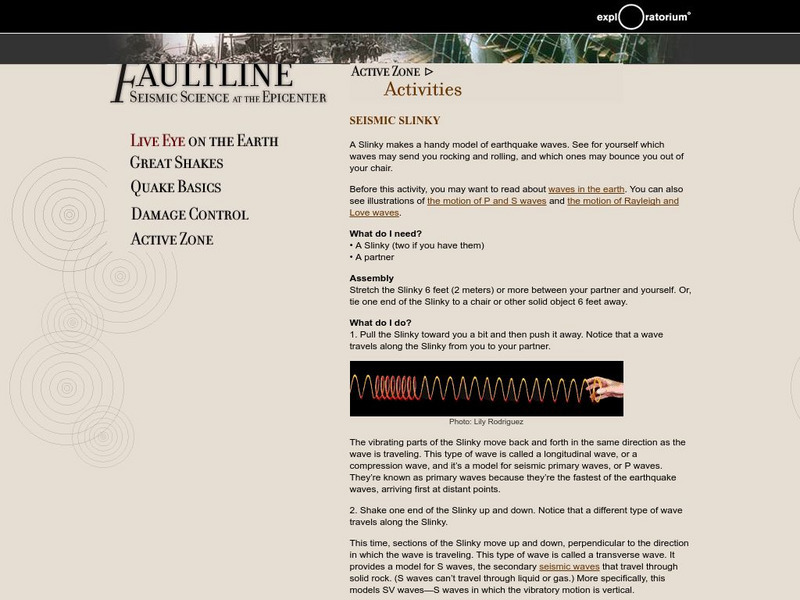
Exploratorium: The Faultline/seismic Slinky
A lesson plan for investigating longitudinal waves by use of a Slinky toy. Directions, questions, and applications to seismic waves are provided.
American Geosciences Institute
American Geosciences Institute: Earth Science Week: Earthquake on the Playground
In this experiment, students go outside and create a simulation of P and S waves traveling across a 30-meter span. This is repeated using a 30-meter square. They experiment with P and S wave behavior, record results, and use...
American Geosciences Institute
American Geosciences Institute: Earth Science Week: Take the Pulse of Your Classroom
In this activity, students leverage SeisMac technology to understand how a seismometer records ground motions.