Hi, what do you want to do?






Curated OER
The Great "What If" Question. How might American history have been different had Lincoln lived?
Eleventh graders study the Presidency of Abraham Lincoln. In this American History lesson plan, 11th graders analyze documents related to Reconstruction. Students participate in a debate on Reconstruction.

Shmoop
ELA.CCSS.ELA-Literacy.RI.9-10.9
With a nice description of what the standard means, an idea for a class activity, and a quiz with answers, this resource should deepen your (and your pupils') understanding of the targeted Common Core standard. The provided activity is...

Curated OER
Lincoln and the War’s Larger Meaning
Students analyze Abraham Lincoln's view of the Civil War. For this American Civil War lesson, students read excerpts of Lincoln's speeches to determine whether he had a dual view of the war. Students respond to discussion questions about...

Curated OER
Abraham Lincoln on the American Union: " A Word Fitly Spoken"
Students consider Lincoln's perspective. In this presidential perspectives lesson, students explore the political thoughts of Lincoln through a series of lessons that make use of primary source analysis. They hypothesize and take a...

Lessons on American Presidents
Abraham Lincoln
Honor Abe Lincoln with a set of activity-based worksheets that can be used independently and in collaborative groups. Young historians participate in a listening activity where they fill in the missing blanks in a passage while being...

Curated OER
Abraham Lincoln: The Face of War
Students compare life masks and photos of Abraham Lincoln that were made before and at the end of the Civil War. In this "Faces of War" lesson, students analyze images of Lincoln in a historical context and create a timeline of event.

Curated OER
The Great "What If" Question. How might American history have been different had Lincoln lived?
Students examine the impact of the assassination of President Lincoln. After researching the Republican positions on Reconstruction and analyzing documents related to the Reconstruction, students take a position and explain their...

Curated OER
Democracy in the Middle East
Students explain that President Bush's foreign policy to promote democracy is a departure from the Cold War policy of containment, and examine the reasons this policy has been proposed at this time.

Curated OER
I Have a Dream Podcasts
Students write dream speeches and record them as Mp3's. In this speech lesson, students watch Martin Luther King, Jr.'s, "I Have Dream Speech." They use the writing process to develop a dream speech which they rehearse. They record their...

PBS
Pbs Learning Media: American Exp:primary Resources: Second Inaugural Address 1937
President Franklin Roosevelt's second inaugural address delivered in 1937. In this speech FDR calls for the nation to accept and prepare to move forward.
University of Maryland
Voices of Democracy: George W. Bush, Second Inaugural Address (20 January 2005)
Complete text of the Second Inaugural Address by George W. Bush in 2005 along with an interpretive essay that examines the ways that President George W.Bush's Second Inaugural Address reflected the assumptions of the Bush Doctrine, ideas...
Henry J. Sage
Sage American History: Second Inaugural Address of Abraham Lincoln, March 1865
Text of President Abraham Lincoln's second inaugural address, delivered March, 4, 1865.
Other
Fdr Cartoon Archive: Franklin D. Roosevelt's Second Inaugural Address
Read Franklin Roosevelt's second inaugural address in which he assesses the previous four years and lays out his plan for the next.
American Rhetoric
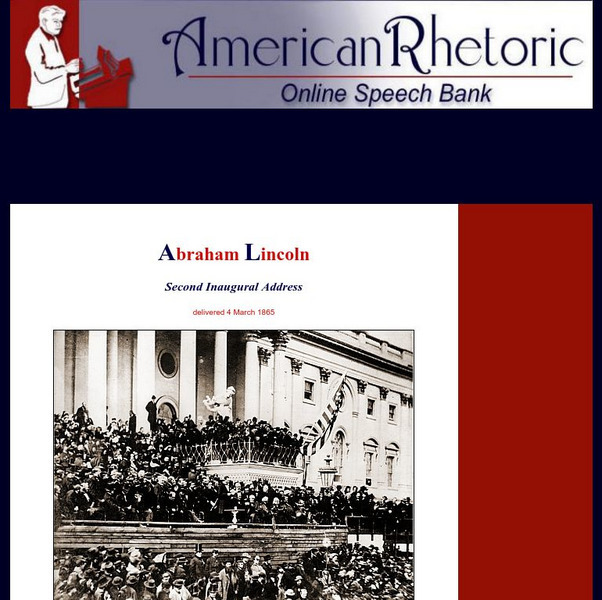
American Rhetoric: Abraham Lincoln: Second Inaugural Address
This is the text of Abraham Lincoln's Second Inaugural Address delivered March 4, 1865.

PBS
Pbs: American Experience: William Mc Kinley's Second Inaugural Address
Read the second inaugural address of William McKinley, just months before he was assassinated.
Curated OER
History Matters: "One Third of a Nation": Fdr's Second Inaugural Address
Read and listen to Franklin D. Roosevelt's second inaugural address where he points out the problems and progress made in his previous four years. He goes on to lay out his plans for his next term.
CommonLit
Common Lit: President Lincoln't Second Inaugural Address
A learning module that begins with "President Lincoln't Second Inaugural Address" by President Abraham Lincoln, accompanied by guided reading questions, assessment questions, and discussion questions. The text can be printed as a PDF or...
History Tools
History Tools: Abraham Lincoln, Second Inaugural Address 4 March 1865 [Pdf]
Complete text of Lincoln's second inaugural address delivered in March 1865 with introductory comments and discussion questions.

Bartleby
Bartleby.com: Presidential Inaugural Address: Franklin D Roosevelt: 2nd Address
This site provides the text of Franklin D. Roosevelt's second inaugural address.
US National Archives
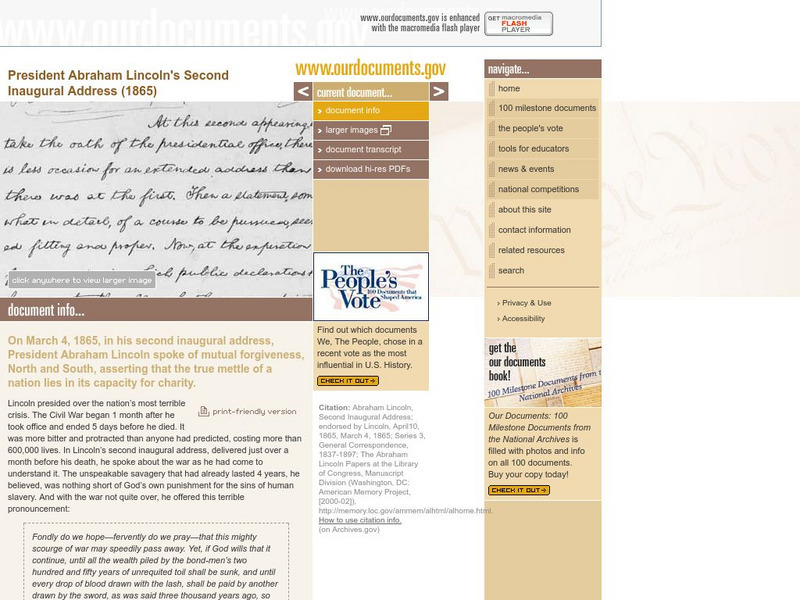
Our Documents: President Abraham Lincoln's Second Inaugural Address (1865)
Interactive image of the original handwritten copy of Abraham Lincoln's second inaugural address. Accompanied by document transcript and very brief overview of the document's contents with selected quotes.

University of Virginia Library
Prism: "Lincoln's Second Inaugural Address: Rhetorical Devices" Visualization
[Free Registration/Login Required] See the results of how users have Abraham Lincoln's second inaugural address. Details that show ethos are blue while details that show logos are red, and details that show pathos are green. Click on any...
Bartleby
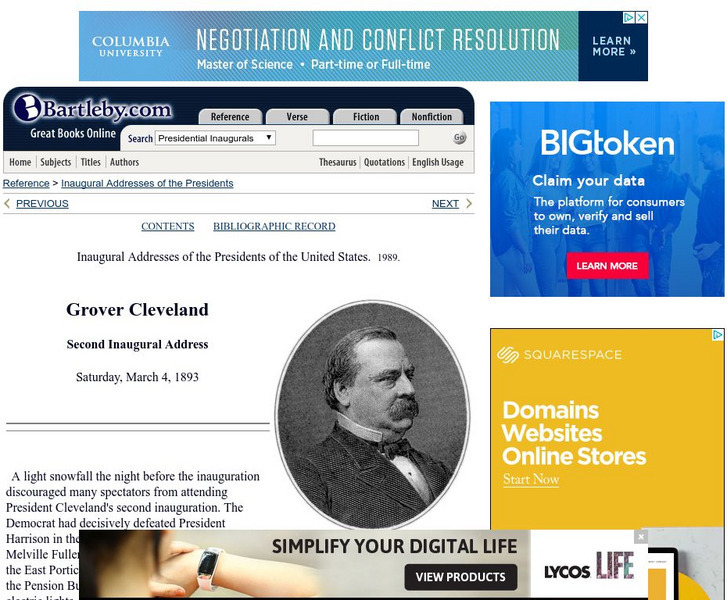
Bartleby.com: bartleby.com: Presidential Inaugural Address: Grover Cleveland 2nd
Includes the full text of President Cleveland's second inaugural address with a brief introduction included.
Other
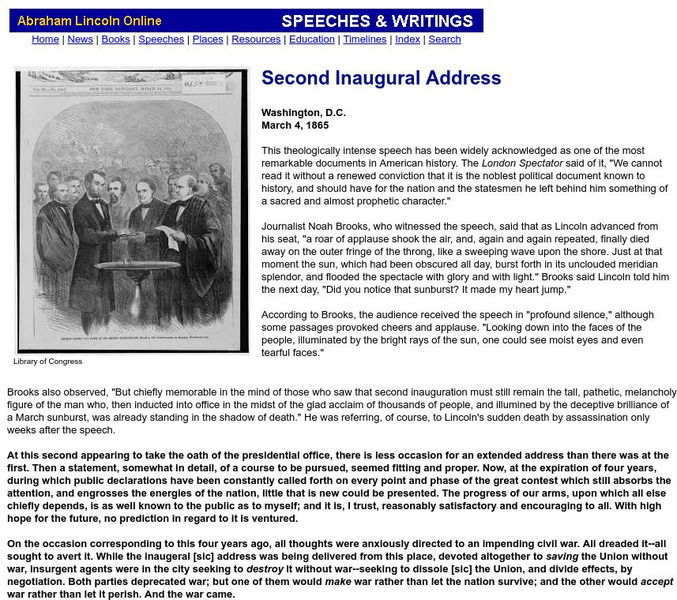
Abraham Lincoln Online: Lincoln's Second Inaugural Address
The text of Lincoln's speech on March 4, 1865. Includes commentary on the speech by famous journalists of the period. From "Collected Works of Abraham Lincoln" edited by Roy P. Basler.
Bartleby
Bartleby.com: bartleby.com: Presidential Inaugural Address: Abraham Lincoln: 2nd
Read the text of Lincoln's second inaugural address given on March 4, 1865.