Hi, what do you want to do?






Curated OER
Fractions Describe Parts of a Whole
Third graders represent fractions as part of a whole. In this fractions lesson, 3rd graders use manipulatives to show how a fraction is a part of a whole. This lesson includes individual practice and an assessment instead of direct...

Curated OER
Classifying Functions
Eleventh graders sort different types of functions including rational, periodic, exponential, polynomial, quadratic, logarithmic and linear using "function cards." The functions are displayed in multiple representations including...

Curated OER
Facts of Matter
Students make group decisions about matter as they explore and interpret many types.

Curated OER
What's Hatching in Kindergarten?
Students identify oviparous animals. They brainstorm a list of animals that lay eggs, read "Chickens Aren't The Only Ones" by Ruth Heller and then add to the list. Students complete a booklet that shows an egg and an oviparous animal.

Curated OER
Hands On Math Lessons with Technology
Young scholars explore a variety of math concepts. In this integrating technology lesson, students visit online webtools such as Max's Math Adventure, I Know That Math, Hands on Banking, and more. A description of each website is...

Curated OER
Comedia dell' Arte Paper Masks
Students create masks from the Italian Renaisance theatre and use them in one-act plays they write. they analyze the role and development of theatre in world cultures.

Curated OER
Science-Unit on Matter-Gases
First graders understand that gases take up space even though you can't see or smell it. This is done through many experiments like trapping air in different sized bags, using balloons and plastic bottles, and blowing bubbles. They...

Curated OER
Sweet or Sour, Like or Different
Students watch a video on comparisons and discuss ways in which objects can be sorted. They play an identification game with a lemon and discuss identification characteristics.

Curated OER
What Makes a Kite Fly?
Ninth graders compare the nature of forces of gravity, lift, thrust, and drag. They select proper materials for making a kite and attach a proper tail. Students interpret and summarize the observations made during the flight of the kites.

Curated OER
On Our Way to School
First graders create a class graph that illustrates how they get to school and interpret data from the graph. They complete an assessment worksheet independently and answer questions about the graph shown.

Curated OER
Why Is An Apple Like A Suitcase?
Students examine a variety of fruit to discover that each has seeds. Through experimentation, they discover the role that fruit and seeds play in a plant's life cycle.

Curated OER
Dolphin Brains
Students listen to an interview with Lori Marino regarding the development of dolphin brains and read a summarizing text. They conduct further research and participate in class discussion.

Curated OER
Roman Archy
Third graders use Google Earth to examine Roman architecture. For this ancient Rome lesson, 3rd graders visit the noted URLs to look at examples of Roman architecture. Students work in teams to examine data about the structures.

Noyce Foundation
Boxes
Teach your class to think outside the box. Scholars use the concept of equality to solve a problem in the assessment task. They determine how to use a scale to identify the one box out of a set of nine boxes that is heavier than the others.


Curated OER
Geometry Assessment: Solid Figures
For this geometry assessment worksheet, students match the drawing of two faces of the solid to the name of the solid for six geometric figures.

Curated OER
Processing the Future: Innovations in Computer Technology
Students visit a website that takes them inside of a computer to see how it works. They investigate the people who contributed to computer technology.

ABCya
Ab Cya: Same and Different
The Same and Different Donut Game is a pre-school activity to practice identifying objects that are the alike and not alike. Kids compare donuts based on shape, color and combinations of shape and color. After all rounds have been...
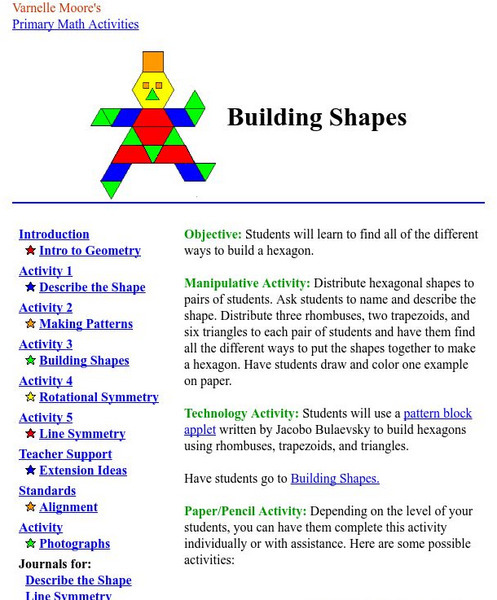
National Council of Teachers of Mathematics
The Math Forum: Building Shapes
Based on building a hexagon, this activity from the Math Forum collection focuses on using different combinations of pattern blocks to create a hexagon. An online activity, pencil and paper method, literature connections, and a...

Science Buddies
Science Buddies: Sorting Out Sedimentation
Sedimentary rock forms in layers that are deposited one after the other over long periods of time. Oftentimes, sedimentary rock contains fossils and other debris that are deposited within the layers. Use this experiment to investigate...
NumberNut
Number Nut: Shapes, Symbols, and Colors: Identifying Traits
Explains how traits are used in Math and in Science to sort and compare the properties of objects and substances.
Better Lesson
Better Lesson: Sorting by Shape
Sorting is an important foundational skills for kindergarten students to learn. Using attribute blocks to sort by shape helps students practice comparing objects and prepares them to sort measurable attributes.
ReadWriteThink
Read Write Think: Book Sorting: Using Observation and Comprehension
Critical thinking, comprehension and analysis skills are the focus of this physical activity. Good beginning to teaching different ways of looking at things.
Other
Kinderweb: Educational Children's Games
Use this site to practice identifying shapes, colors, and animals with these interactive games.