Hi, what do you want to do?






Curated OER
Tic Tac Know Kingdoms
In this PowerPoint, students participate in a variation of tic tac toe in which questions about the animal and plant kingdom are presented and students move to various locations on the game board.

Curated OER
Ferns and Gymnosperms
In this fern and gymnosperm worksheet, high schoolers will read about two types of vascular tissue: xylem and phloem. Then students will read about the difference between sporophytes and gametophytes. Using this information high...

Curated OER
Conserving Resources by Watering Efficiently
Students determine a watering schedule that promotes healthy grass growth. In this plants and natural resource conservation lesson, students plant grass seed in liter bottles and follow two different schedules that include "more...

Curated OER
The Ancient Cycads
For this cycads worksheet, students will read a short essay on the cycad tree, including it's reproductive strategies and it's general characteristics. Then students will complete 2 short answer questions based on what they read.

Curated OER
Fungus
Students study fungus, its reproduction and uses. In this eukaryote lesson students complete several fungal experiments.

Curated OER
Practice with Ions
In this ions worksheet, students answer questions about atoms that have gained or lost electrons, they find the number of electrons atoms tend to gain or lose and they answer questions about bonding in atoms. They answer 6 questions...

Curated OER
Plant Propagation
Students successfully start a new plant by any means of vegetative propagation. They select a propagation method which is appropriate for the plant and keep a laboratory journal of the treatment and progress of the new plant.

Curated OER
Earth's Recyclers
Students work together in groups to report on different topics related to decomposition. They answer questions and share their answers with the class. They discuss any topic that is unclear.

Curated OER
The Plant Restoration Project
Students discuss Restoration Ecology. They see that restoration can mean removing invasive, non-native plants and replacing them with native plants grown by Students.

Curated OER
Microorganism Multiplication
Seventh graders complete two experiments to learn about harmful and helpful microorganisms. In this microorganisms lesson, 7th graders read background information about fungi, yeast, and club fungi. Students then complete two experiments...

Curated OER
Kingdom: Fungi
The general characteristics of fungus types are presented here. Your class will love the pictures of the amazing features found on these strange living things. The internal and external structures and their functions are highlighted. By...

Curated OER
Aerosol Lesson: Science - Graphing SAGE II Data
Learners examine and plot atmospheric data on bar graphs.

Curated OER
Yeast: A Dihybrid Cross
Learners create a yeast dihybrid cross and follow two forms of each of two traits: red growth versus cream color, and tryptophan-dependent versus tryptophan-independent. They complete diagrams to represent the alleles, predict the...

Curated OER
Forest Management ~ Diseases and Pests that Effect a Good Harvest Stand
The forestry presentation found here lists and describes a variety of tree diseases. A few unappetizing photos are included to show symptoms of some of these diseases, or the insects and fungi that cause them. If you have a class that is...

Curated OER
Yeast - A Dihybrid Cross
Learners make a yeast dihybrid cross and follow two forms of each of two traits: red growth versus cream color, and tryptophan-dependent versus tryptophan-independent.

Curated OER
Fossil Impressions of Ancient Life
Pupils make a mold using Plaster of Paris and then make a cast using that same mold. They pick a fossil and describe how it looks. They write a fictionalized story about its life, or burial. (

Curated OER
Water Molds (Oomycetes)
Students explore a group of fungus-like organisms; the Oomycetes, by baiting them from natural sources (water and soil) and observing them.
Other
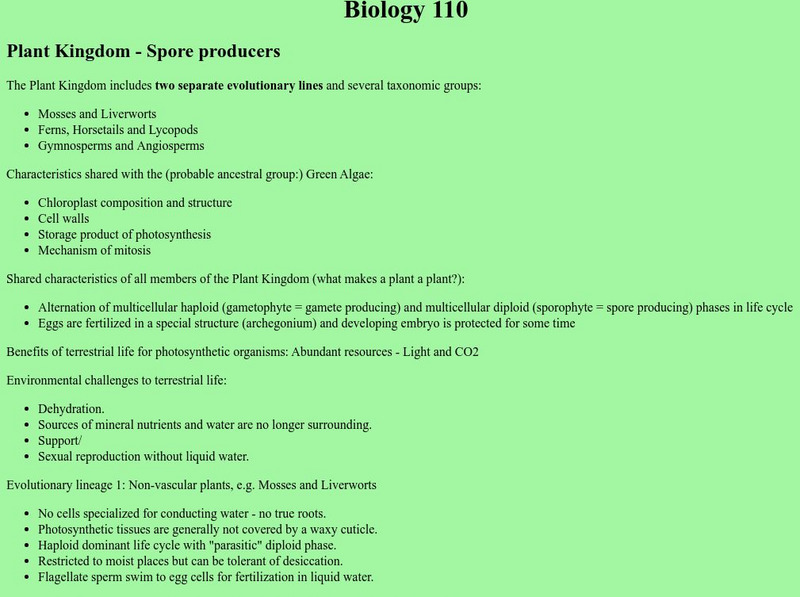
Hamilton College: Plant Kingdom Spore Producers
A solid overview of the few plants that reproduce by spore production. Includes examples and an explanation of the early evolution of these plants.

CK-12 Foundation
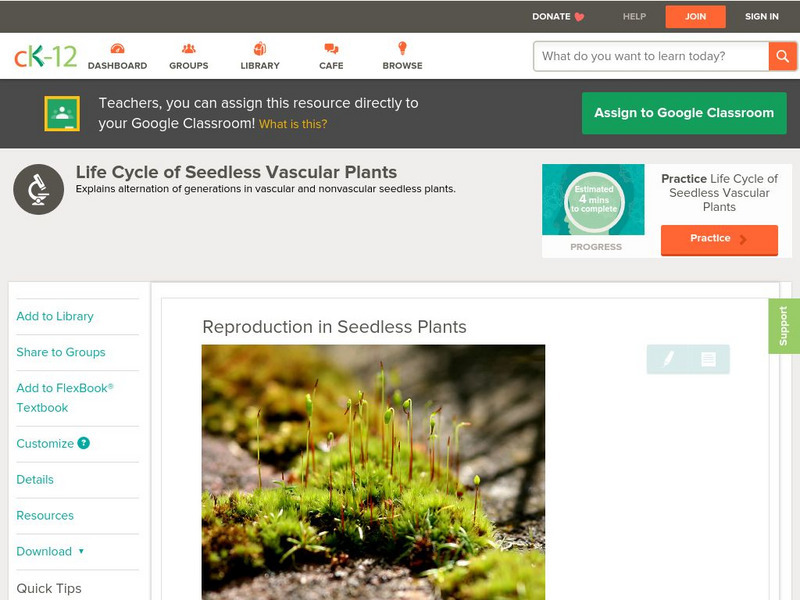
Ck 12: Life Science: 7.7 Life Cycle of Seedless Vascular Plants
Discover the life cycle of seedless vascular plants.
CK-12 Foundation
Ck 12: Life Science: Reproduction in Seedless Plants
[Free Registration/Login may be required to access all resource tools.] Seedless plants can reproduce asexually or sexually. Some seedless plants, like hornworts and liverworts, can reproduce asexually through fragmentation. When a small...
Curated Video
How Do Plants Grow? | Knowsy Nina Wants to Know
Knowsy Nina discovers what food plants need in order to grow in this episode! [5:00]
University of Hawai'i
University of Hawaii: Bryophyte Reproductive Cycle
An explanation of the plants that reproduce by the production of spores. Includes extensive graphics.

E-learning for Kids
E Learning for Kids: Science: Crab Boat: Why Do Plants Reproduce?
Help Carla take care of her green plants in her plant nursery, and learn about plant reproduction.
Estrella Mountain Community College
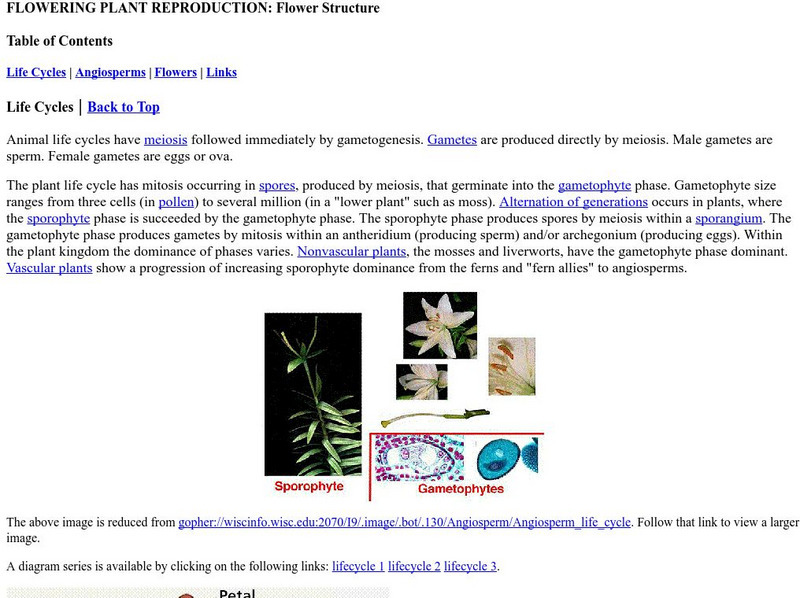
Estrella Mountain Community College: Flower Structure
Site covers all aspects of plant reproduction such as life cycles, angiosperms and flowers. Provides links to other sites to aide in research.