Hi, what do you want to do?






Curated OER
Carnivorous Plants: A Bugs Nightmare!
Students research carnivorous plants and how they trap insects. They role play as botanists to write a research field guide about a newly discovered imaginary carnivorous plant.

Curated OER
Note Taking
Second graders work in groups to gather information from a factual paragraph on the topic of ants. They demonstrate taking notes by selecting 3 or 4 important key words in each sentence and write it on a note card to compile summary...

Curated OER
My Own Backyard
Scholars create a drawing of their own backyards. They will use a visualization technique to sketch their own backyard onto construction paper using oil pastels. Guiding questions are given along with materials for the project....

Curated OER
How Does the Rice Farmer Help Birds When They Fly South in the Winter Time?
Students draw a picture of a bird in a rice field. In this social studies lesson, students then fold a piece of paper so that there are 4 spaces. Students then draw one thing in each square that birds get from the rice field.

Curated OER
Macroinvertebrate Sampling
Students identify macroinvertebrate species to investigate ecological systems and the relationship between humans and the environment.

Curated OER
Complete Metamorphosis
Students use a map and colored pins to plot the migration path of Monarch butterflies. They use data found at the Journey North website. Commas are also used in the activity to show how they are put in a series of words using butterfly...

Curated OER
The Schoolyard Safari
Young scholars engage in a lesson to find out more information about insects. They collect and observe different insects found on school property. They research the insects once they have been classified. Also a video is used to create a...

Curated OER
What are rice farmers doing to help the environment with their water-filled rice fields?
Third graders research rice fields. In this rice fields lesson, 3rd graders discuss how fields contribute to the environment by providing an important food source for birds. They find the benefits of rice fields to water and soil as...

Curated OER
Mock Fly-Tying
Students make their own fly-fishing flies. In this aquatic macroinvertebrates lesson, students look at images of different species of aquatic macroinvertebrates. Students compare the similarities and differences among the...

Curated OER
Arthropod Data Collection
Students describe the life cycle of various bugs as well as their predators and feeding habits. The class participates in a discussion of the various methods scientists use to gather data including research and experiment. After...

Curated OER
Aquatic Life
Students explore aquatic life. In this science activity, students visit an aquatic ecosystem and collect animals found there. Students create a food chain for the aquatic ecosystem.

Smithsonian Institution
Smithsonian Learning Lab: The Greatest Show on Earth (Starring Some of the World's Smallest Animals)
Teachers can download this teaching package that discusses insects and insect adaptations. Students will enjoy the hands-on activities described in the lessons. Teachers will appreciate the student handouts provided, as well as the list...
Natural History Museum
Natural History Museum: Insects and Spiders
As an online exhibit from the Natural History Museum, this site examines many different subtopics stemming from a study on both insects and spiders. Several of the subtopics include spider bites, bumblebees, moths, edible insects,...
EL Education
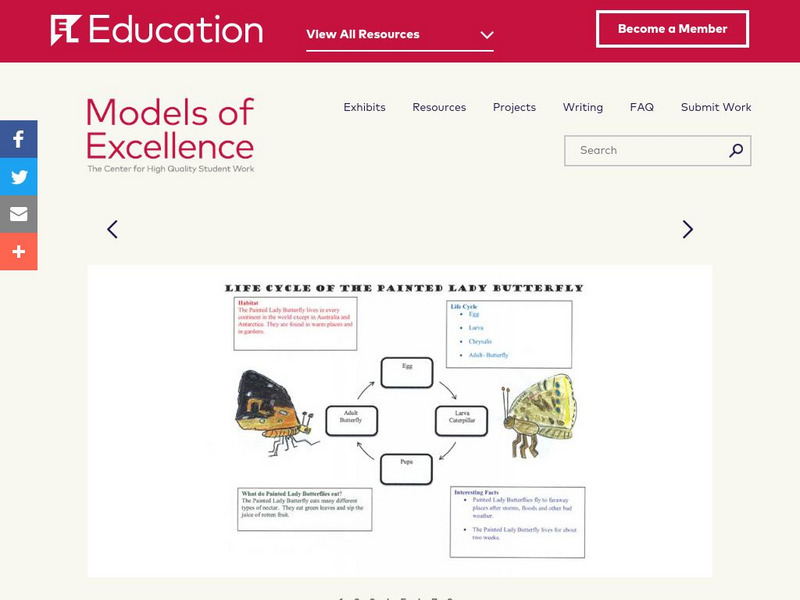
El Education: The Study of Life Cycles
Students learn about various insects and use original text and illustrations to create a book including information such as habitat, life cycle, diet, behavior, predators, and other interesting facts.
Other
Bugbios: Entophiles
Students can see pictures and descriptions of 14 different orders of insects.
Other
Bugbios: Class Insecta
See pictures of many different butterfly wing patterns and read about the individual butterflies.
Other
Cindy Mark: What's Bug'n You
Students will enjoy learning more about bugs in this engaging resource. Allows users to draw a picture of a spider, create an insect information book, discover how insects move and be able to tell where insects live.
University of Oxford (UK)
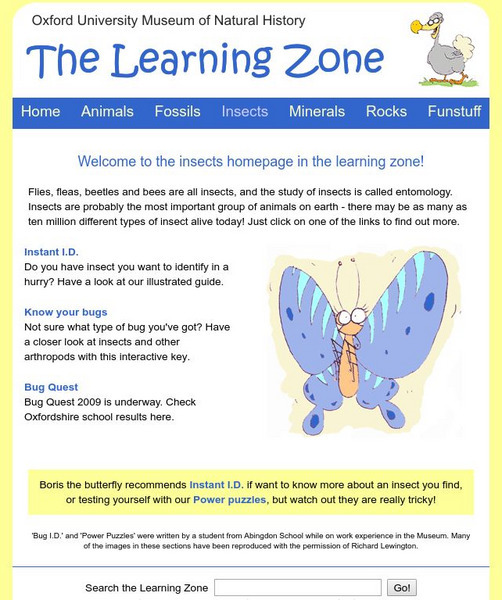
Oxford University Museum of Natural History: Insects
Flies, fleas, beetles and bees are all insects, and the study of insects is called entomology. Insects are probably the most important group of animals on earth - there may be as many as ten million different types of insect alive today!...
Ohio State University
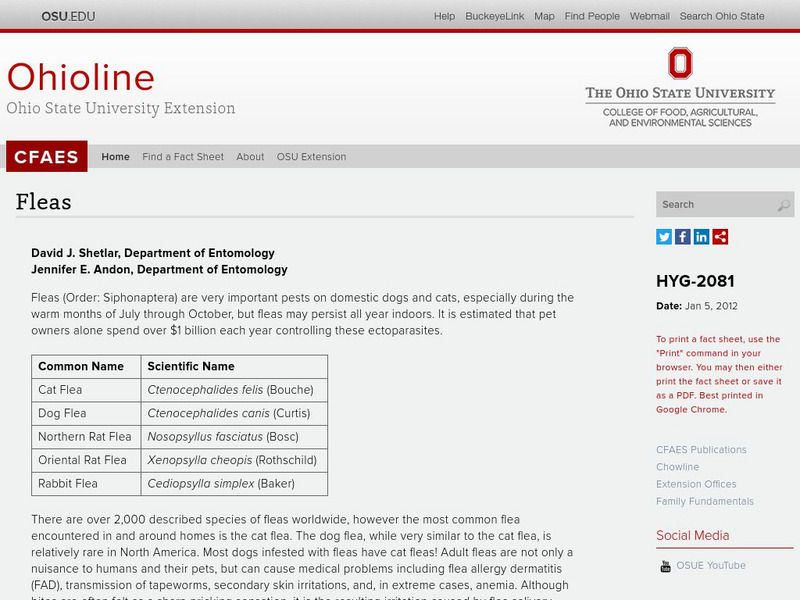
Osu: Flea Fact Sheet
A fact sheet on fleas from the Ohio State University Extension lists scientific names, identifying characteristics, and pictures.

My Learning
My Learning: Minibeasts
All you need for an in-depth study of invertebrates is here on this site. Includes worksheets, quiz, useful information, and a fun interactive section where you can build your own super bug!
Books in the Classroom
Carol Hurst's Children's Literature Site: Eric Carle
What do you know about Eric Carle, the author? This Carol Hurst site highlights some interesting facts about this author's life and refers to some of his books.