Hi, what do you want to do?






PBS
Pbs Learning Media: How Technology Changed the Way Candidates Run for President?
This lesson plan focuses on how technology has changed Presidential election campaigns. It includes reading articles and conducting research.
Other
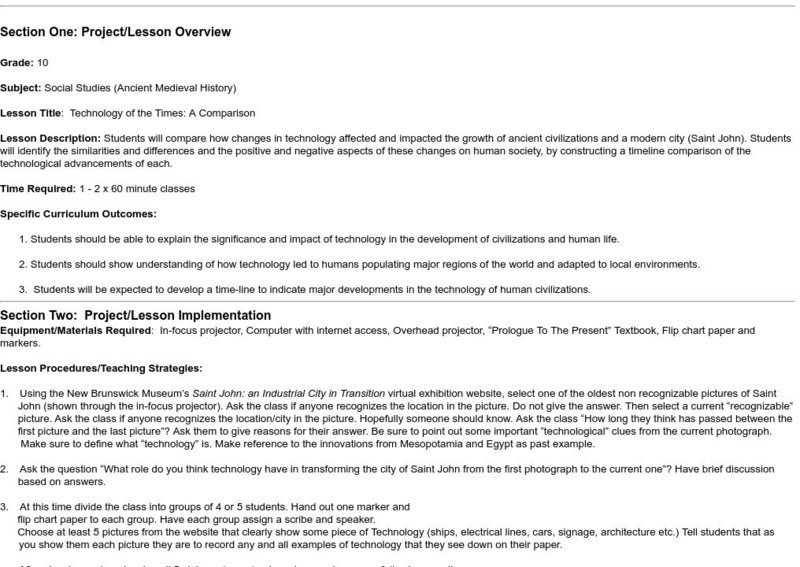
New Brunswick Museum: Technology of the Times: A Comparison
In this lesson, students will compare the impact of technology on an ancient civilization with the impact on Saint John and create a timeline.

Alabama Learning Exchange
Alex: Researching Hurricanes With Technology
This lesson will help students to understand the formation, power, and history of hurricanes. Students will do this using a combination of technological skills. Examples of technology used include: PowerPoint, Word, Netscape Composer,...
Common Sense Media
Common Sense Media: Education: Lesson: How Technology Makes You Feel
[Free Registration/Login Required] This lesson challenges kids to pay attention to their feelings while using tech. With an engaging emoji game, 1st graders learn practical strategies for managing their feelings - good, bad, and...
National Women’s History Museum
National Women's History Museum: Hedy Lamarr
Hedy Lamarr was an Austrian-American actress and inventor who pioneered the technology that would one day form the basis for today's WiFi, GPS, and Bluetooth.
Science and Mathematics Initiative for Learning Enhancement (SMILE)
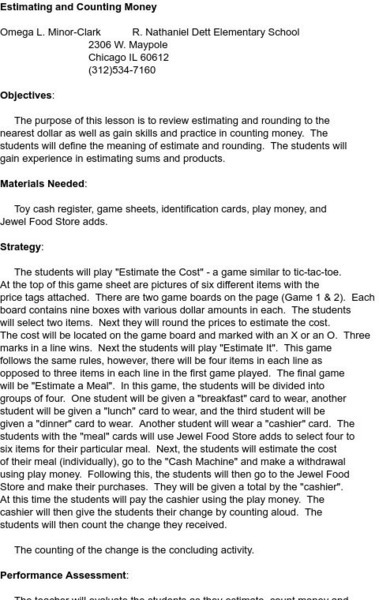
Smile: Estimating and Counting Money
The purpose of this lesson from the Illinois Institute of Technology is to review estimating and rounding to the nearest dollar as well as gain skills and practice in counting money. The students will define the meaning of estimate and...

Science and Mathematics Initiative for Learning Enhancement (SMILE)
Smile: Four Air Pressure Labs
Four lab exercises from the Illinois Institute of Technology demonstrating air pressure are given.
Alabama Learning Exchange
Alex: My Book of Seasons
During this technology based lesson, students produce a book of the four seasons that relates to their everyday life. They learn many facts about seasons by navigating the Internet.
Alabama Learning Exchange
Alex: Organism Power Points/ Booklets
This lesson requires young scholars to use technology to research information on any organism from one of the six kingdoms. Students use the information to produce a PowerPoint presentation or booklet to present to their classmates. This...
Lumen Learning
Lumen: Critical Reading: Reading Strategies
This instructional activity focuses on reading strategies including scanning, skimming, SQ3R, High-5 Reading Strategies, technology, and rhetorical context. It includes text information and videos.
Science and Mathematics Initiative for Learning Enhancement (SMILE)
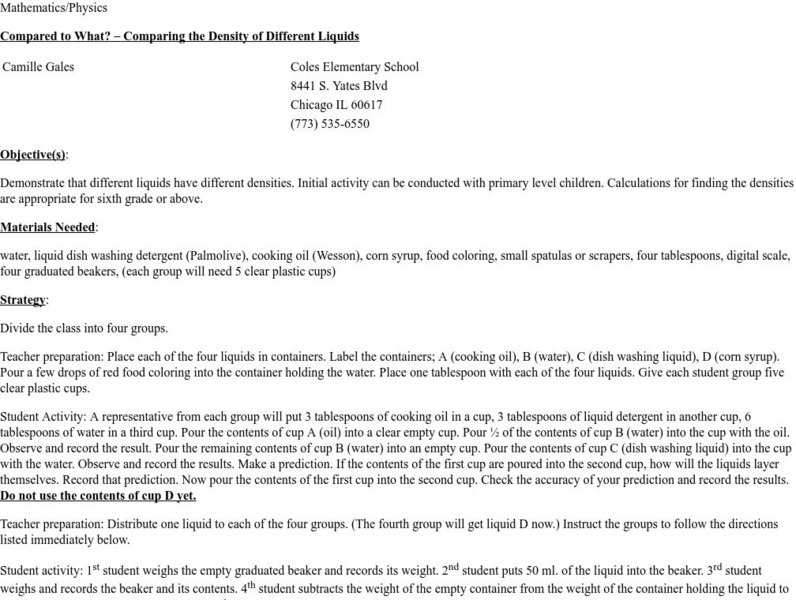
Smile: Comparing Liquid Density
Because different liquids have different properties, density also differs. In this lesson plan from the Illinois Institute of Technology, students will calculate densities of water, dish-washing detergent, cooking oil, and other liquids.
Science and Mathematics Initiative for Learning Enhancement (SMILE)
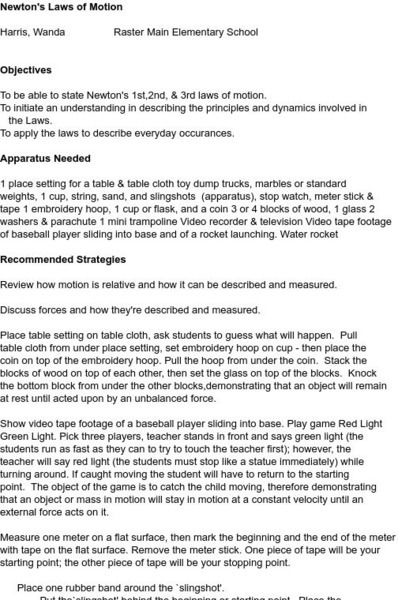
Smile: Newton's Laws of Motion
Lesson plan from the Illinois Institute of Technology that incorporates many demonstrations like pulling a tablecloth from under a place setting, or launching a rocket to show Newton's laws.
Science Buddies
Science Buddies: A Puzzling Parallax
Did you know that ancient astronomers could measure the distance to other stars? They could also distinguish between stars and planets. How could they do that without modern technology of telescopes? See if you can discover the link...
Library of Virginia
Virginia Memory: Blank Space: Mapping the Unknown
How did early maps show the mapmakers' perception of the known world? Early mapmakers used maps drawn from coastal explorations, land travels, and even information heard word of mouth from American Indians or from colonists or traders....
Better Lesson
Better Lesson: Circle Graph Activity
This lesson plan will allow the student to work through three stations. The stations will focus on creating and analyzing circle graphs. The students will be using technology to create their graphs along with a hands-on activity using...
Science and Mathematics Initiative for Learning Enhancement (SMILE)
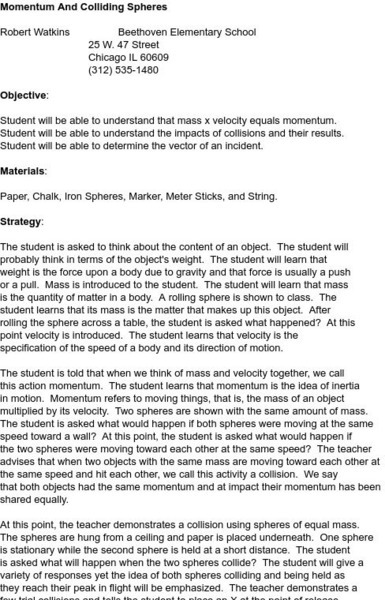
Smile: Colliding Spheres
This lab activity from the Illinois Institute of Technology lets students investigate the impact of collisions upon the velocity and momentum of the colliding objects. Requires understanding of vectors.
Science and Mathematics Initiative for Learning Enhancement (SMILE)
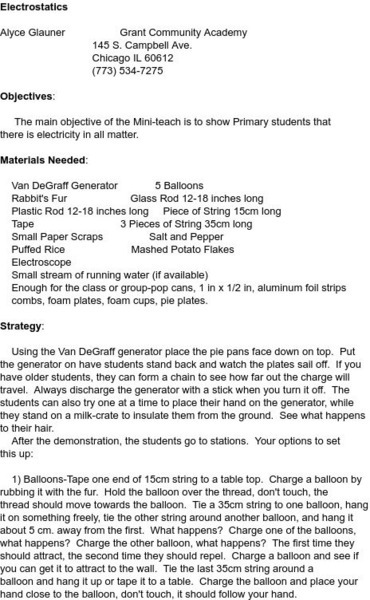
Smile: Electrostatics
From the Science and Mathematics Initiative for Learning Enhancement project at the Illinois Institute of Technology. A teacher lesson plan which includes several Van de Graaff generator demonstrations and some station-style labs....
Common Sense Media
Common Sense Media: Finding My Media Balance
Helping kids learn what makes different media choices healthy or not is a good start. But how do we help them actually make responsible choices in the real world? Help your students create a personalized media plan. Students will reflect...
Science and Mathematics Initiative for Learning Enhancement (SMILE)
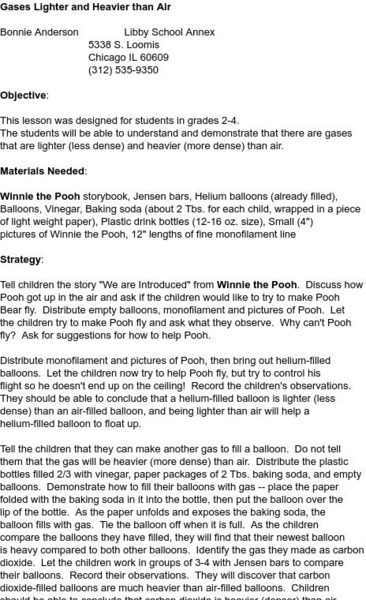
Smile: Gases Lighter and Heavier That Air
Teachers, to demonstrate to the elementary student that some gases are heavier than others, this experiment uses Winnie the Pooh and balloons to do just that.
Common Sense Media
Common Sense Media: Education: Lesson: Who Is in Your Online Community?
[Free Registration/Login Required] By learning the Rings of Responsibility, 2nd graders explore how the Internet connects us to people in our community and throughout the world. Help students to think critically about the different ways...
Common Sense Media
Common Sense Media: Education: Lesson: That's Private!
[Free Registration/Login Required] Staying safe online is a lot like staying safe in the real world. By helping a Digital Citizen sign up for a new app, 2nd graders learn about the kinds of information they should keep to themselves when...

PBS
Pbs: Scientific American: Coordinated Control Exercise
PBS's Scientific American series sponsors this learning exercise designed to simulate functional electrical stimulation (FES), a technology which allows the recovery of control of paralyzed muscles.

PBS
Pbs Teachers: Scientific American: The Intimate Machine: Weighing In
Explore the "intelligent floor," which contains sensors that can track movements, and emulate the weighing technique associated with this technology. Explore the relationship between volume and mass and the difference between accuracy...

PBS
Pbs Teachers: Scientific American: Future Car: Fuel Cells
Investigate the innovations surrounding fuel cell technology and the potential use of hydrogen as an automobile power source. Generate hydrogen gas by splitting water in a process called electrolysis.
Other popular searches
- Educational Technology
- Assistive Technology
- Education and Technology
- Technology Resources
- Technology Plans
- Technology in the Classroom
- Engineering and Technology
- Medical Technology
- Technology Education
- Computer Technology
- Assertive Technology
- Computer Lab