Hi, what do you want to do?






Field Museum
The Case of Darwin's Finches
One of the most striking pieces of evidence for Darwin's Evolution of Species was his observations of finches and how their beaks differed from island to island, depending on their primary food sources. So what would happen to the theory...

Curated OER
Adaptation Investigation - Extreme Beaks
Find photos of bird beaks or show a prepared four slide PowerPoint, "Extreme Beaks" to introduce your class to this special animal adaptation. Provide them with a data table and supplies to try gathering food with tools that each...

Curated OER
Changing Planet: Adaptation of Species (Birds and Butterflies)
A video about the impact of climate change on butterfly populations and a PowerPoint about butterfly and bird adaptations warm science learners up for the activity to follow. Using a variety of tools that reprsent unique styles of bird...

New York State Education Department
Regents High School Exam: Living Environment 2008
The New York Regents High School Examinations are comprehensive and include various question formats, including multiple choice and graph analysis. This particular version, the 2008 Living Environment exam, surveys a variety of topics....

New York State Education Department
Regents High School Examination: Living Environment 2005
The 2005 version of the Regents High School Examination in ecology is as comprehensive as previous years' exams. It consists of 40 multiple-choice questions on topics ranging from the structure of DNA to interactions within an ecosystem....

New York State Education Department
Regents High School Examination: Living Environment 2003
The living environment, from the interior of a cell to the complex relationships among populations, is queried in this final examination. Learners examine air pollution maps, cell diagrams, population graphs, and drawings of cells. They...

Curated OER
The Beaks of the Finches
Young scholars become birds and are given "beak-types". After completing the simulation, students relate results to adaptations and natural selection. Extensions of the simulation allow for comparative results and include population...

New York State Education Department
Regents High School Examination: Living Environment 2007
Environmental science enthusiasts show what they know at the end of the year by taking this full-fledged final exam. They answer multiple-choice, graph interpretation, and essay-analysis questions, 73 of them in all. Topics range from...

ARKive
Biodiversity and Evolution – Darwin’s Finches
Teens experience natural selection firsthand (or first beak) in an activity that has them act as finches foraging for food. Using different household items to act as different beak styles, your little finches will collect as much...

Curated OER
The Birds and the Beaks
Students explore the adaptations that birds have. In this adaptations instructional activity students view a video and create a concept map of birds and their adaptive traits.

New York State Education Department
Regents High School Examination: Living Environment 2009
Emerging ecologists need a full understanding of life, from the inner workings of a cell to the complex relationships among organisms. This examination is meant to assess high schoolers after an entire year of courses on the living...

Curated OER
The Beaks of Finches
Students study finches and how they have evolved over time. In this finch review instructional activity students fill out a key points worksheet then divide into teams and complete an activity.

Curated OER
The Beaks of Finches
Learners examine how species evolve over time and how this can change a population. In this environment instructional activity students complete a worksheet on finches.

Curated OER
WHAT DARWIN NEVER SAW: Evolution, Science, Biology, Natural Selection
Students view video showing recent field work on a twenty two-year study of finch beaks on a small island in the Galapagos, showing natural selection clearly operating in the wild.

Curated OER
How Evolution Works
Young scholars discuss the evolution of the eye and how a complex organ can evolve through natural selection. They research genetic variation, adaptation, and sexual selection. They analyze data to determine how beak length of Gal??pagos...

Curated OER
The Key To Classifying Animals
Explorers of the environment construct a dichotomous key for a variety of organisms and design a key to classify Galapagos animals based on descriptions and images. The lesson includes a link to an animal gallery and the worksheet for...

Curated OER
How Evolution Works
Students work in groups to investigate and present genetic variation, adaptation, and sexual selection as it relates to evolution. In this evolution lesson plan, students watch a video discuss how the human eye could evolve due to...

Berkeley Engineering and Mentors
Darwin's Finches
Try a twist on the old finch beak and chopsticks activity by using M&Ms on a Twister mat. Spoons, knives, forks, and chopsticks represent beaks and are randomly assigned to your little birds, who must collect as much food as possible...
Howard Hughes Medical Institute
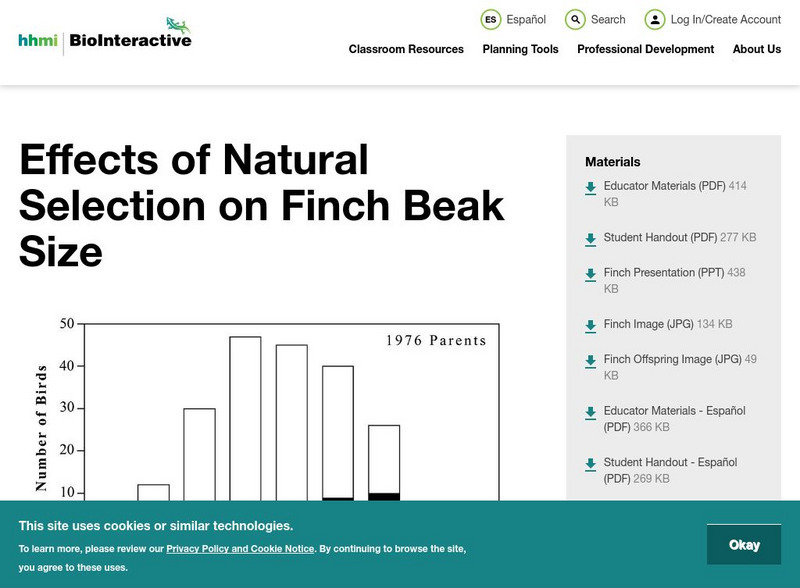
Hhmi: Bio Interactive: Effects of Natural Selection on Finch Beak Size
In this activity, students examine research on finches on the island of Daphne Major in the Galapagos Islands. The depth of the finches' beaks was measured before and after a drought. This data is displayed in graphs and students are...
Science Education Resource Center at Carleton College
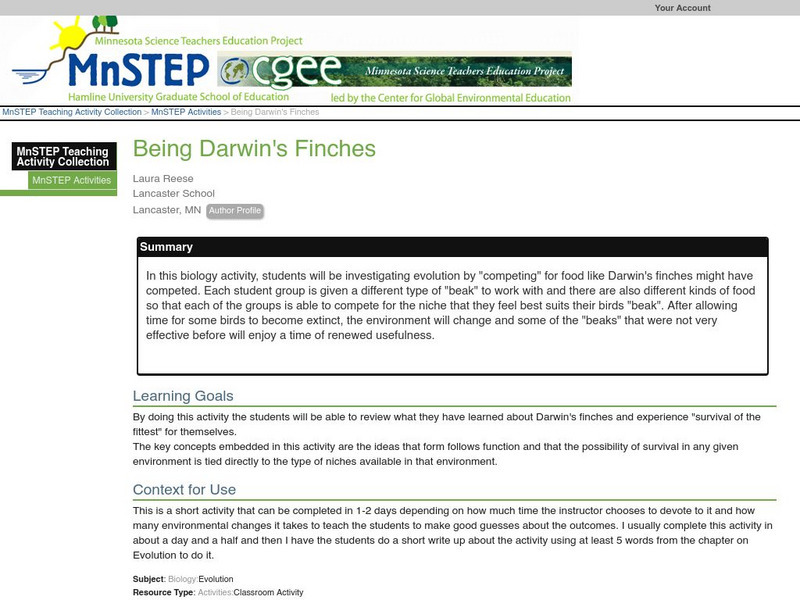
Serc: Being Darwin's Finches
In this biology activity, students will be investigating evolution by "competing" for food like Darwin's finches might have competed. Each student group is given a different type of "beak" to work with and there are also different kinds...