Hi, what do you want to do?






Kenan Fellows
Unit 4: The Brain
Drugs interact with the brain to alter moods, emotions, and behaviors by changing the brain's chemistry, perceptions, and interactions. The final lesson in the Pharmacology unit shows scholars experiments, has them complete four labs,...

Curated OER
The Human Brain's Capacity for Language
Incorporate this slide show into your lecture about speech, language, psychology, or physiology. Addressing the structure of the brain as well as handedness and aphasia, the presentation could fit the needs of many different lecturers....

Curated OER
The Brain’s Inner Workings
Do you want to learn about how you learn? Help pupils become the best learners they can be by teaching them how their brain works. The resources available include videos about brain structure and a study guide full of activities that...

Curated OER
The Man Who Mistook His Wife for a Hat
Four scenarios of unusual human behaviors are given to your psychology class. Based on their knowledge of brain anatomy and function, they consider what parts of the brain might be affected in order to result in the behaviors. This case...

University of Minnesota
Mirroring Emotions
Do you ever give your class the "teacher look"? Without saying a word, they become silent and engaged (hopefully). How do they know what you're thinking? Explore the concept of nonverbal communication and how it relates to our...

Curated OER
The Psychology Teacher's Resource Guide
The activities in a comprehensive teacher's resource guide provides budding psychologists with opportunities to design experiments to study behavior, apply their knowledge of research variables, critique online behavior surveys, and much...

Curated OER
Thought Log: Correcting Harmful Thoughts
A thought log helps people track daily events, their (possibly harmful) internal reactions, and the consequences and behaviors they experience in response to their own thoughts. The last column of the chart provides space to conceive...

Curated OER
Student Opinion: How Impulsive Are You?
Sure to spark lively discussion in any Language Arts classroom, this article from The York Times asks the question, 'How much self-control do you have?'. Pupils begin by reading a short passage about a study on delayed gratification and...

Curated OER
Mirror Image
Why does practice make perfect? Give your class insight into procedural memory, where we learn to do new things — then continue to improve through repetition. By attempting to draw shapes while looking in a mirror,...

Curated OER
Welcome to the First Day of School!
Classmates participate in a variety of getting-to-know-you activities for the first day of school. They make resolutions, become detectives about their fellow classmates, learn about each other by playing switch, and make...

Curated OER
In Their Own Words
Students watch a video of people telling about their experiences with a mental illness. They compare and contrast the life stories they saw to reinforce how mental illnesses are biological illnesses that affect a person's thoughts,...

Curated OER
Latent Learning
Students discuss childhood psychology by viewing a YouTube video. In this human behavior lesson, students identify latent learners and discuss reasons why some people fail to conform to society while others are quick to please everyone...

Curated OER
Stress, Coping and Health
In this psychology instructional activity, students complete 5 short answer questions on possible reasons for stress and how to cope with it.

Curated OER
Everything You Know Is Wrong 1: Us and Them
Students explore rational, irrational, analytical and non-analytical methods of reasoning. They participate in numerous exercises and hands-on activities to understand assumptions and how most people think. Students establish the...

Curated OER
Parents are unawareof Ecstasy risk:Anti-drug Education
Students read an article on parents unawareness of Ecstasy use. In this current events lesson, students infer issues related to teen drug use and parent prevention and engage in a class discussion. Students give a quiz related to Ecstasy...

Curated OER
Writing Exercise: How to Spot a Loser Sentence
In this writing skills worksheet, class members read sentences about developmental psychology that need revisions and then revise them in order to make them better. The 11 sentences range from the humorous to the incomprehensible.

Curated OER
Moral Development: Lawrence Kohlberg
Students study the stages of moral development. In this psychology lesson, students explore Lawrence Kohlberg's stages of moral development as they read, respond to, and evaluate a moral development scenario.

Curated OER
Owen
Pupils discuss items they may have wanted to bring to school, but were not allowed to. (Example: Blanket). Their responses are listed on chart paper. They listen to the teacher read "Owen" by Kevin Henkes. Students discuss appropriate...
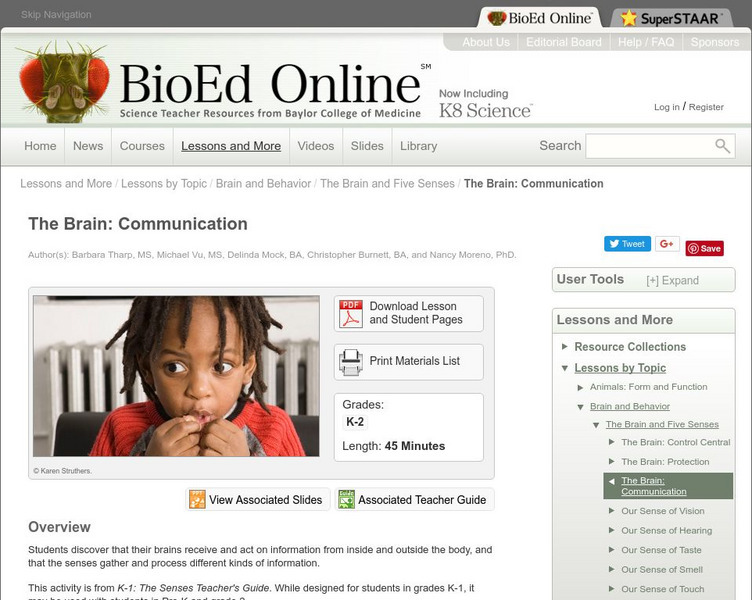
BioEd Online
Bio Ed Online: The Brain: Communication
How does information from different parts of the body reach the brain? In this instructional activity learners discover that their brains receive and act on information from inside and outside the body, and that the senses gather and...
Science Buddies
Science Buddies: The Brains Behind 'Where's Waldo?'
What makes you notice someone in a crowd? Why do some things stand out, while others melt into the background? In this experiment you can investigate the psychology of how things get noticed, by studying how our brains perform a visual...

BSCS Science Learning
Bscs: Drug Abuse and the Adolescent Brain
This module focuses on the science that explains the effects that drugs have on the brain and, by extension, a person's thoughts, feelings, and behaviors. Specifically, it focuses on the adolescent brain. Adolescents may be more...
CommonLit
Common Lit: Text Sets: Psychology and the Mind
The mind has fascinated and mystified humans for millennia. Delve into the science behind the brain with these works on philosophy, foundational psychology, and scientific studies. This collection includes 61 Grade-Leveled texts (6-12)...

TED Talks
Ted: Ted Ed: The Difference Between Classical and Operant Conditioning
Peggy Andover explains how the brain can associate unrelated stimuli and responses, proved by Ivan Pavlov's famous 1890 experiments, and how reinforcement and punishment can result in changed behavior. [4:13]
Science Buddies
Science Buddies: Tail Wagging and Brain Lateralization
The left brain is supposed to be better at language, and organizing sequential actions, the right brain is supposed to be better at visualizing orientations in space, making and listening to music, and deciphering the emotions of others....