Hi, what do you want to do?






School District of Palm Beach County
Egyptian Hieroglyphs
Humans have been developing number systems for thousands of years, and while they can be very different from one another, they can also share surprising similarities. Take your young mathematicians on a journey through the history...

Old Dominion University
Introduction to Calculus
This heady calculus text covers the subjects of differential and integral calculus with rigorous detail, culminating in a chapter of physics and engineering applications. A particular emphasis on classic proof meshes with modern graphs,...

Penn Museum
Penn Museum: China Gallery
Invite your learners to take a closer look at the art and mathematical function of dome buildings as designed by the ancient Romans. In the next segment of this attractive worksheet set, your young historians will then learn about...

Whitman College
Calculus
Everything you wanted to know about calculus—and more! The resource is a complete Calculus textbook with explanations, examples, and practice problems.

Whitman College
Calculus - Early Transcendentals
This textbook takes the learner from the basic definition of slope through derivatives, integrals, and vector multivariable calculus. Each section is composed primarily of examples, with theoretical introductions and explanations in...

Penn Museum
Maya Ball
Sure the ancient Mayan civilization had an advanced calendar and mathematical system, but did you know that they also played a great team sport like basketball? Invite your learners to discover the great ballcourt at Chichen Itza and...
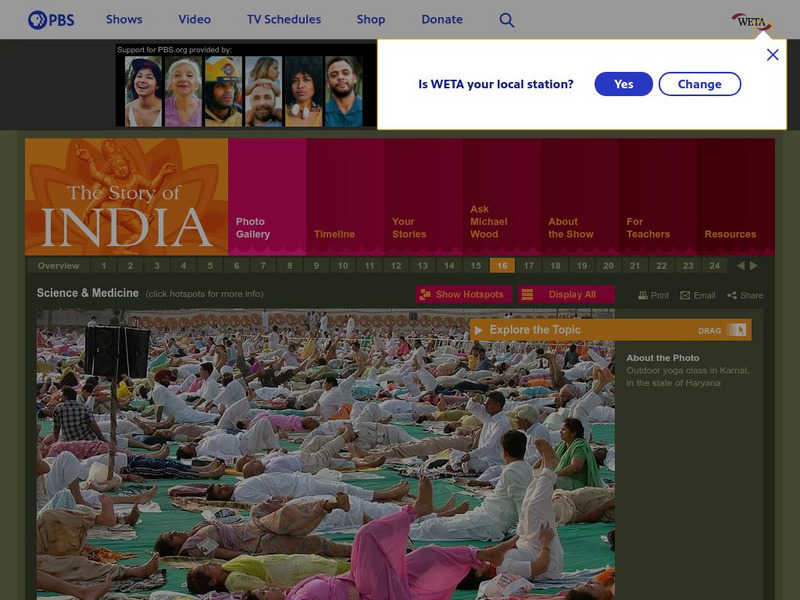
PBS
Pbs: The Story of India: Ancient and Medieval Mathematics in India
Describes India's contribution to mathematics.
Other
St. Lawrence University: Brief History of Mesopotamia
A paper which discusses the accomplishments of early Mesopotamian society in the fields of mathematics, astronomy, and literature.

University of St. Andrews (UK)
University of St. Andrews: History of Set Theory
This page, which is provided for by the University of St. Andrews, traces the history of Set Theory as well as the concept of infinity and the infinite set.
Cut the Knot
Cut the Knot!: Fundamental Theorem of Algebra
Contains detailed historical information regarding the Fundamental Theorem of Algebra and the various proofs that were developed. Click on the links at the bottom of the page to access all the information.
Trinity College Dublin
The History of Mathematics: Young
A short sketch of the life and work of Thomas Young (1773-1829 CE). Traces early upbringing and education and his scientific discoveries and contributions.

Math Is Fun
Math Is Fun: The Evolution of Numbers
Discusses what numbers are and how our understanding of them has evolved over thousands of years, from simple counting to negative numbers and irrational numbers, for example. Includes a set of practice questions where students identify...

University of St. Andrews (UK)
University of St. Andrews: Al Karaji
This mathematician contributed to many areas of mathematics, but most importantly he developed the formula to multiply exponents.

University of St. Andrews (UK)
University of St. Andrews: Hypsicles of Alexandria
This mathematician is remembered for his work on regular polyhedra. You can find more about the works of Hypsicles and other mathematicians at this site.

Smithsonian Institution
National Museum of American History: Slates, Slide Rules and Software
Did you learn to calculate using a 7-foot-long slide rule? Did you learn about the properties of numbers using brightly colored Cuisenaire rods? Ever wonder who invented the graph paper you used in geometry class? Go back to the...

University of St. Andrews (UK)
University of St. Andrews: Emmy Amalie Noether
The School of Mathematics and Statistics of St. Andrew's University provides biographical information on the mathematical career of Emmy Noether. Included are links to other famous individuals with whom she worked and links to her topics...

University of St. Andrews (UK)
University of St. Andrews: Biography of Thomas Muir
The School of Mathematics and Statistics of St. Andrew's University provides biographical information on the mathematical career of Thomas Muir. Included are links to other famous individuals with whom he worked and links to his topics...

University of St. Andrews (UK)
University of St. Andrews: Biography of Jacob Bernoulli
The School of Mathematics and Statistics of St. Andrew's University provides biographical information on the mathematical career of Jacob Bernoulli. Included are links to other famous individuals with whom he worked and links to his...

University of St. Andrews (UK)
University of St. Andrews: Eudoxus of Cnidus
This page provides an excellent biography of Eudoxus of Cnidus, an ancient Greek astronomer and mathematician. Discusses his life, travels, and contributions to the field of mathematics. Includes special links.
Wikimedia
Wikipedia: Timeline of Mathematics
Wikipedia gives a timeline of all of the important mathematical accomplishments from 2400 BC to 2002. Most names and concepts are linked to further information specific to that person or idea.
World History Encyclopedia
World History Encyclopedia: Greek Mathematics
Discusses the major cultural influences on the development of mathematics in ancient Greece, and how the Greeks went on to surpass those cultures. The work of the Pythagoreans and of Euclid are described, along with some famous...

University of St. Andrews (UK)
University of St. Andrews: Albert Girard
In trigonometry today, we use the abbreviations sin, cosine and tan. Girard was the first mathematician to use these abbreviations in his work.
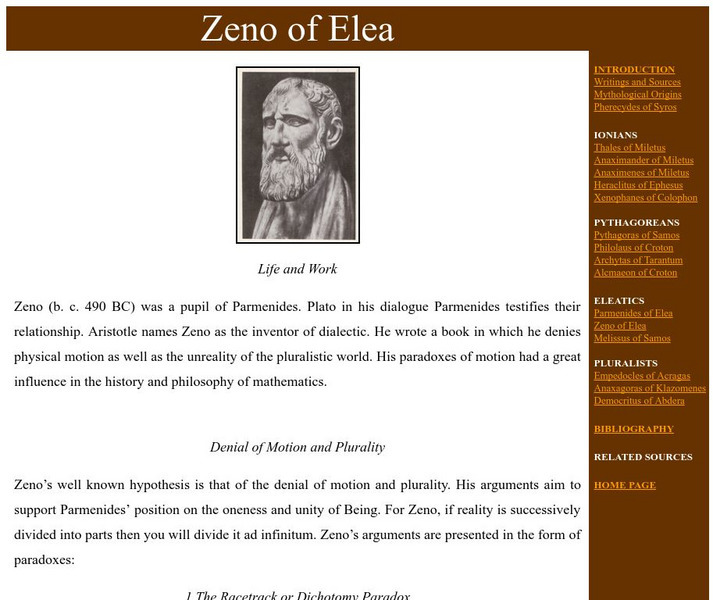
Other
Ancient Greek Philosophy: Zeno of Elea
Describes the little that is known of Zeno of Elea's life. Also discusses his denial of motion and plurality hypothesis. He explained his ideas using paradoxes that continue to challenge intellectual minds today, and that have had a big...
Science Struck
Science Struck: Father of Calculus Newton or Leibniz?
Discusses the continuing debate over who was the founder of calculus, Sir Isaac Newton or Gottfried Wilhelm von Leibniz.