Hi, what do you want to do?






Curated OER
Shadow Puppetry in South India
Students read a variety of literature from India, including folktales and fables. They then select a scene or story to script, work together to design and craft shadow puppets of characters and scenery, narrate a story, manipulate the...

Curated OER
Mineral Properties
In this earth science worksheet, students look at the properties that are common to identifying minerals and the types of observations one can make.

Curated OER
Using Microscopes
Students do an experiment using a microscope. In this lesson, about cells, students examine different slides using a microscope. Students look at an onion skin, cheek cells, and potato cells. In each of these, students find cell walls,...

Curated OER
Makeup-- A Wealth of Minerals
Students examine how a variety of minerals are used in make-up. They discuss the minerals that are found in things like make-up, soap, shampoo, and toothpaste and determine where the minerals come from.

Curated OER
Chinese New Year: Paper Lanterns Lesson Plan
First graders examine a typical Chinese New Year celebration. As a class, they identify the traditions and values used and discuss how they are unique to China. To end the lesson plan, they take measurements to make their own paper...

Curated OER
A Deeper Shade of Purple
Third graders explore the color purple. In this visual arts lesson, 3rd graders sort purple objects in various ways and create the color purple by mixing paint. Students create a purple portrait of a character from the play, Lost and Found.

Curated OER
Collage Butterflies
Students make their own butterfly on contact paper. In this art lesson, students cut or tear small pieces of tissue paper to put on their butterfly. Students place another piece of contact paper over the tissue paper pieces and cut the...

Curated OER
How Could You Visualize the Importance of Education
Students view different pieces of art from artist Candida Alvarez. They discuss what the art means to them. They create their own mobiles showing what they would like out of their education.

Curated OER
Chinese New Year: Paper Lanterns
First graders study the celebrations of Chinese New Year. They practice measuring and cutting to make paper lanterns.

Curated OER
Ground Level Ozone Testing
Students prepare Shoenbein Paper to test the ground level of ozone. They dip a strip of their test paper in distilled water and hang it at a data collection site. They determine the relative humidity of the data collection site. Using a...
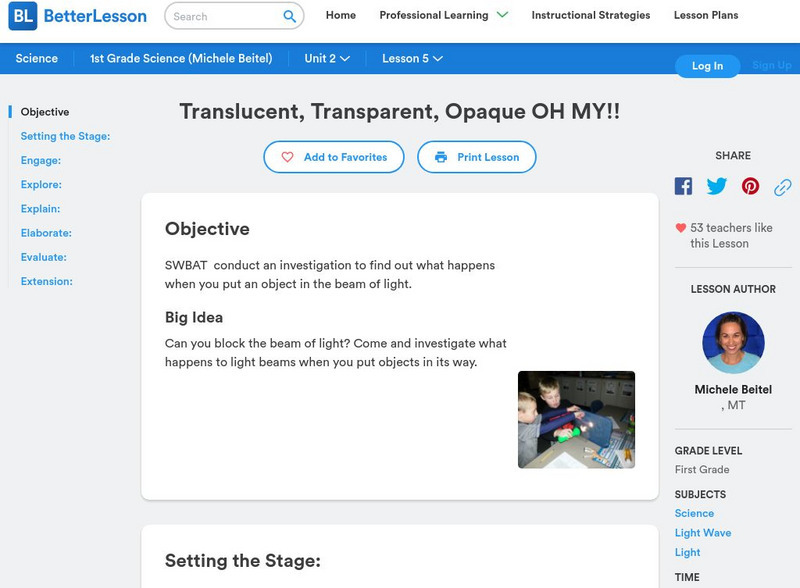
Better Lesson
Better Lesson: Translucent, Transparent, Opaque Oh My!!
Can you block the beam of light? Students will investigate what happens to light beams when you put objects in its way. These tests will allow them to learn new vocabulary (translucent, transparent, opaque) and discover how these terms...

ClassFlow
Class Flow: What Is Light?
[Free Registration/Login Required] This flipchart reviews the characteristics of light and its properties. Students are given examples of reflection, refraction, and lens types. An assessment component is included.
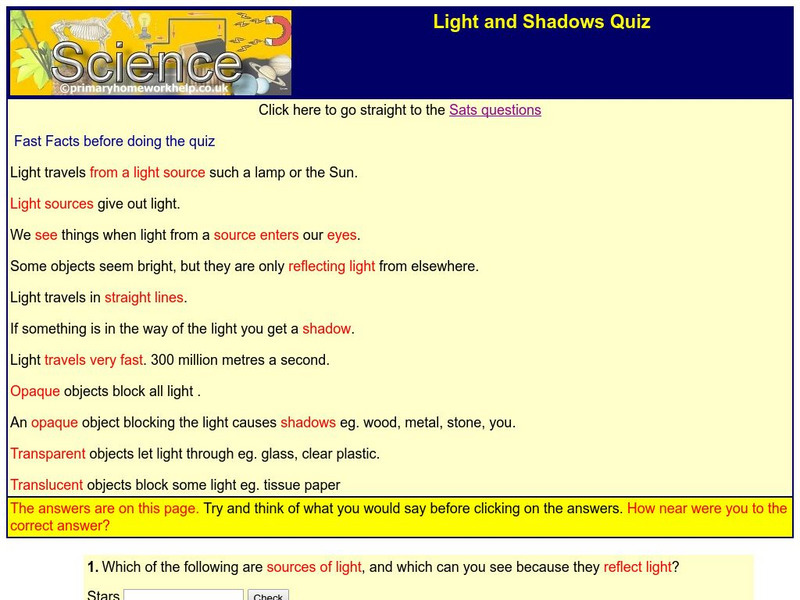
Project Britain
Primary Homework Help: Light and Shadows Quiz
This resource provides information about light and shadows. In addition, there is a short quiz that can be taken.
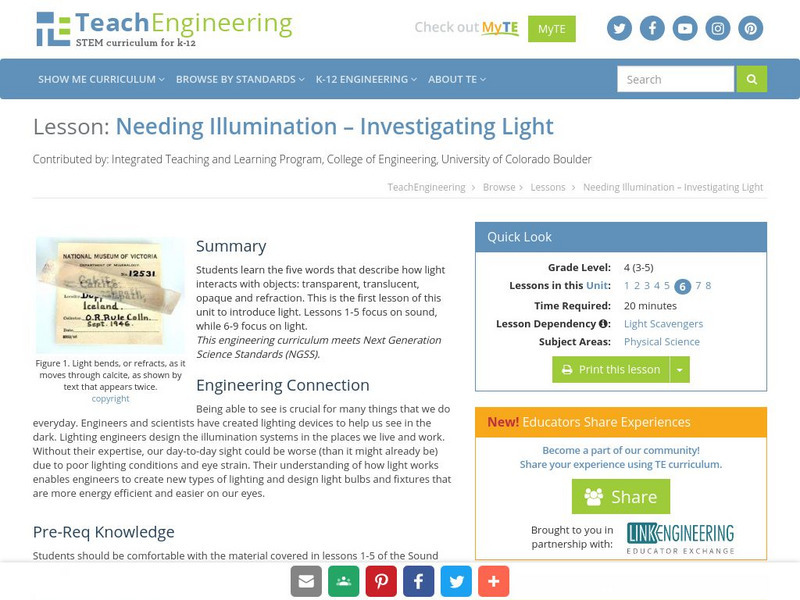
TeachEngineering
Teach Engineering: Needing Illumination: Investigating Light
This is the first lesson of this unit to introduce light. In this lesson, students learn the five words that describe how light interacts with objects: "transparent," "translucent," "opaque," "reflection" and "refraction."
Ducksters
Ducksters: Physics for Kids: Light
Kids learn about the science of light. Energy made of waves and particles called photons traveling at the top speed in the universe. What is refraction? The difference between transparent, translucent, and opaque.
ClassFlow
Class Flow: Light and Shadows
[Free Registration/Login Required] This unit introduces the relationship between light, an object and the formation of shadows.
TeachEngineering
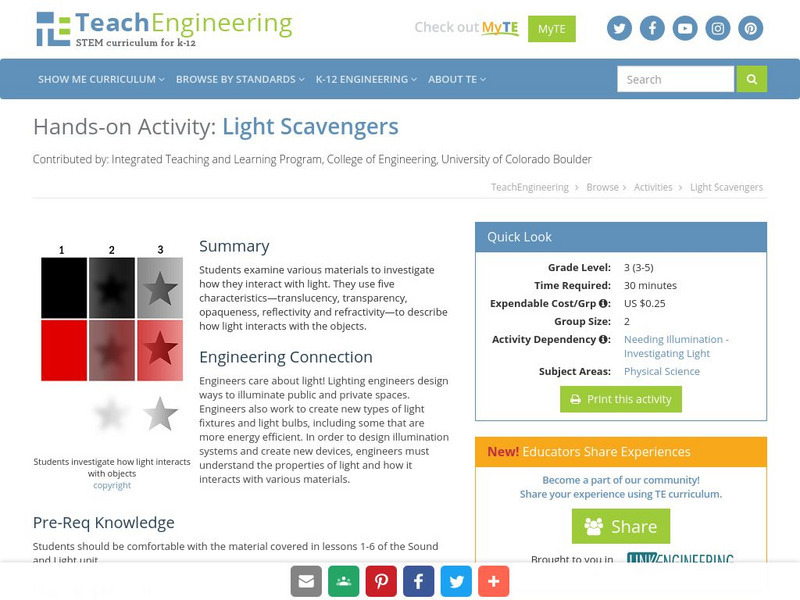
Teach Engineering: Light Scavengers
In this activity, students examine various materials and investigate how they interact with light. Students use five new vocabulary words (translucent, transparent, opaque, reflection and refraction) to describe how light interacts with...

Science Struck
Science Struck: Translucent, Transparent, and Opaque Materials
The definitions of transparent, translucent, and opaque can be found here. The article explains how the density of a material and its ability to absorb light determine which of these three properties it has. A list of examples is given...
E-learning for Kids
E Learning for Kids: Science: Winery: Why Can We See Through Some Objects but Not Others?
Learn about the properties of materials in their interactions with light, including whether they are opaque, transparent, or translucent, and which of these produce shadows.
Better Lesson
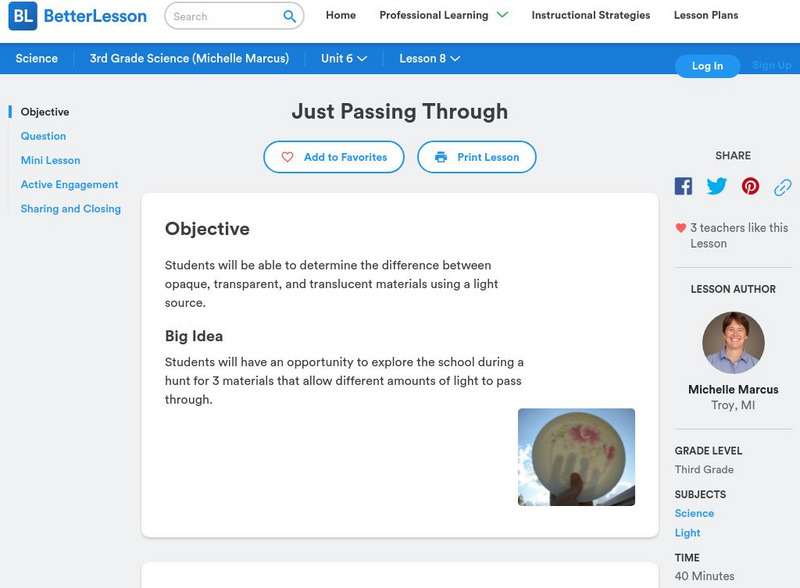
Better Lesson: Just Passing Through
Students will have an opportunity to explore the school during a hunt for 3 materials that allow different amounts of light to pass through. Included in this lesson are videos showing the lesson in progress, examples of students' work,...
ClassFlow
Class Flow: Introduction to Light
[Free Registration/Login Required] This flipchart introduces fifth graders to the science of light. Principles such as transparent, translucent, opaque, reflection, and refraction are covered. Concave and convex mirrors and lenses are...
TeachEngineering
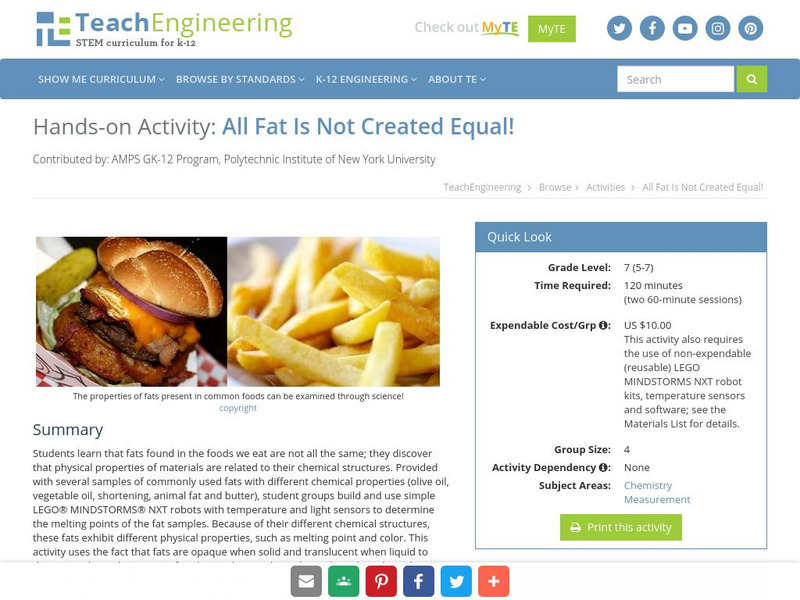
Teach Engineering: All Fat Is Not Created Equally!
Students learn that fats found in the foods we eat are not all the same; they discover that physical properties of materials are related to their chemical structures. Provided with several samples of commonly used fats with different...