Hi, what do you want to do?






Crash Course
The Atomic Bomb: Crash Course History of Science
The story picks up where we left off last time, with Einstein writing the president of his new homeland, the United States, urging him to build a nuclear weapon before Hitler. This is the tale of the most destructive force humans have...
One Minute History
051 Truman and the Atomic Bomb - One Minute History
The use of atomic weapons forced the Japanese to surrender. Many argue that the bombings were unnecessary, stating that more conventional methods may have been as effective. Casualty estimates for an invasion of mainland Japan were in...
Hip Hughes History
The Decision to Drop the Atomic Bomb on Hiroshima and Nagasaki
The decision to drop the Atomic bomb in Japan to end WWII are controversial to this day. Explore the decision that Harry Truman had to make and then make up your own mind.
One Minute History
President Truman and the Decision to Drop the Atomic Bomb - World War II - One Minute History
The history behind President Truman and his decision to use atomic weapons at the end of World War II
Professor Dave Explains
Harry Truman: Dropping Bombs (1945 – 1953)
Harry Truman ascended to the presidency upon the death of Franklin Delano Roosevelt. He had to wrap up World War II, which involved his controversial decision to drop atomic bombs on the Japanese cities of Hiroshima and Nagasaki. Truman...
Espresso Media
Garwin: Inside the Historic Site of Nuclear Weapon Assembly
Garwin part 4/11: This video provides a glimpse into the historical significance of Los Alamos, the site where the first atomic bomb was assembled during the Manhattan Project. The video also touches on the transition from the Manhattan...
Espresso Media
Garwin: The History of Los Alamos
Garwin part 2/11: This video explores the history of Los Alamos and its role in the development of the atomic bomb during World War II. It highlights the isolation and secrecy of the Los Alamos Laboratory, as well as the experiences of...
Espresso Media
Garwin: The Importance of Science and Education in a Complex World
Garwin part 1/11: In this video, Richard Garwin reflects on the significant events and challenges of the atomic age, including the Cuban Missile Crisis and the threat of nuclear proliferation. He emphasizes the importance of education...
Curated Video
Election of 1948: The Underdog
The suspenseful 1948 presidential election exposed the consequences of flawed polls, as Truman's astonishing victory upended expectations and forever changed how pollsters make predictions.
Mr. Beat
The American Presidential Election of 1948
The 41st Presidential election in American history took place on November 2, 1948. After Franklin Roosevelt died, Harry Truman took over, and soon after Nazi Germany surrendered to the Allied forces. Now, all eyes were on the Pacific...
Cerebellum
American Presidents - 33rd-37th Presidents
The Presidency of the United States is the most powerful position in the nation, and is often referred to as the “leader of the free world”. Their power is only equaled by the massive responsibility they hold. They are not always...

Curated OER
From World War to Cold War
From peace at the end of World War II, straight back to war. This resource details the changes in leadership in the Soviet Union post World War II. From the brief attempt at democracy, to the Bolshevik Revolution, and finally to Vladimir...

PBS
Pbs: The American Experience: Harry S. Truman
PBS offers a comprehensive look at the presidency of Harry S. Truman. Content includes a very detailed biography, a look at his domestic and foreign politics, enduring legacy, and more. Primary sources supplement the content, and a...
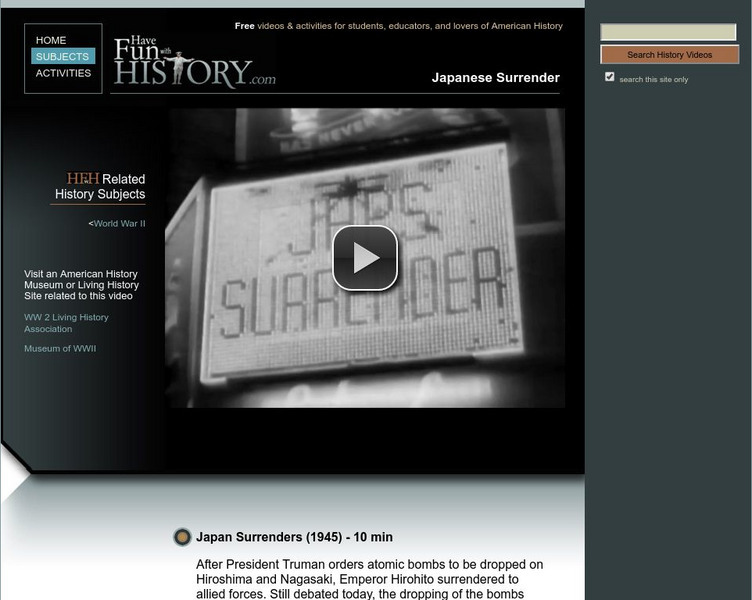
Have Fun With History
Have Fun With History: Japan Surrenders!
After President Truman orders atomic bombs to be dropped on Hiroshima and Nagasaki, Emporer Hirohito surrendered to Allied Forces. Still debated today, the dropping of the bombs brought a swift end to the war.

Khan Academy
Khan Academy: Strobe Talbott on the Beginning of the Cold War
Former Deputy Secretary of State Strobe Talbott discusses how the Cold War developed after post WWII peace summits and the strategic patience that stopped the expansion of Soviet communism. [6:36]