Hi, what do you want to do?






Illustrative Mathematics
3-D Shape Sort
From the apple on your desk and the coffee cup in your hand, to the cabinets along the classroom wall, basic three-dimensional shapes are found everywhere in the world around us. Introduce young mathematicians to the these common figures...

Mathed Up!
2D and 3D Shapes
What a great assessment to give young mathematicians in order to test their knowledge on two- and three-dimensional shapes. Learners name various shapes, identify the number of edges, faces, and vertices, match an unfolded version of a...

Mathed Up!
3-D Pythagoras
Apply the Pythagorean Theorem in three-dimensional shapes. Young mathematicians watch a video that takes them through several examples of using the Pythagorean Theorem to solve problems involving lengths in three-dimensional figures. A...

Mathed Up!
Nets, Plans, and Elevations
A dimensional resource teaches viewers to recognize 2-D views of 3-D objects and how to match nets with their 3-D figures. Individuals draw different views of three-dimensional objects including views from the front, side...

National Security Agency
Classifying Triangles
Building on young mathematicians' prior knowledge of three-sided shapes, this lesson plan series explores the defining characteristics of different types of triangles. Starting with a shared reading of the children's book The Greedy...

Balanced Assessment
Plenty of Pentagons
Why are only four colors needed to color webs from regular pentagons, not five? An assessment task requires young mathematicians to first construct regular pentagons using a compass and straightedge, then has them consider a shape...

Illustrative Mathematics
Overlapping Squares
The objective of this activity is to find the percent of the area of a two squares overlapping. Mathematicians find the ratio of area for the part that overlaps to the rectangle formed. The final answer is a percent as a rate per 100....

Concord Consortium
The Six Faces of Amzora
Here's a task that is out of this world! Given a description of a fictional cube-shaped planet, scholars answer a set of questions about the planet. They create a two-dimensional map and consider the distances between locations on the map.

Noyce Foundation
Pizza Crusts
Enough stuffed crust to go around. Pupils calculate the area and perimeter of a variety of pizza shapes, including rectangular and circular. Individuals design rectangular pizzas with a given area to maximize the amount of crust and do...

Noyce Foundation
Building Blocks
Building blocks have more uses than simply entertaining children. Young mathematicians calculate the volume of a given cube, and then calculate the volume and surface area of a prism formed from multiple cubes.

Noyce Foundation
Which is Bigger?
To take the longest path, go around—or was that go over? Class members measure scale drawings of a cylindrical vase to find the height and diameter. They calculate the actual height and circumference and determine which is larger.

Noyce Foundation
Parallelogram
Parallelograms are pairs of triangles all the way around. Pupils measure to determine the area and perimeter of a parallelogram. They then find the area of the tirangles formed by drawing a diagonal of the parallelogram and compare their...
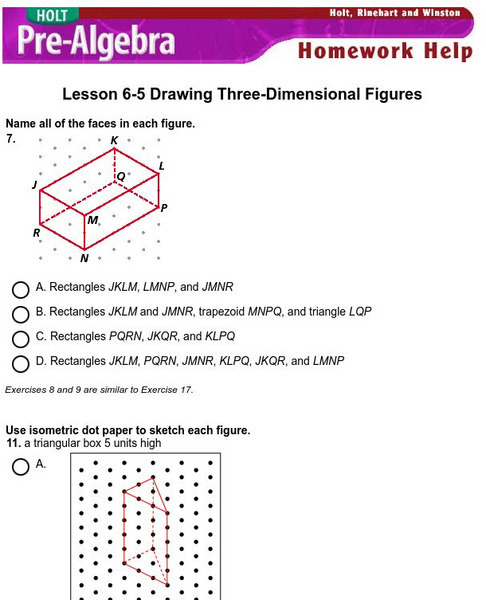
Houghton Mifflin Harcourt
Holt, Rinehart and Winston: Homework Help Independent Practice: Drawing Three Dimensional Figures
Get independent practice drawing three-dimensional figures. Each incorrect response gets a text box explanation and another try. Correct responses are confirmed.
abcteach
Abcteach: Geometry
[Free Registration/Login Required] This resource has an assortment of teacher-created geometry activities for elementary and primary students. Printable two-dimensional shapes, area and perimeter worksheets, board games, rules and...