Hi, what do you want to do?






Curated OER
Let's Get Moving
Students participate in sports activities that relate to motion, velocity and momentum. They produce a PowerPoint presentation after researching the activities.

Curated OER
Science- Unit on Matter- Solids
Second graders identify and describe properties of matter.
They identify three forms of matter- solids, liquids, and gases with 100% accuracy. The student describes the properties of solid objects.

Curated OER
Science: Solids
Second graders investigate the properties of solids and discover how to classify them. Using rulers, they measure various solids on display. In groups, they play an identification game where one students names a location, such as the...
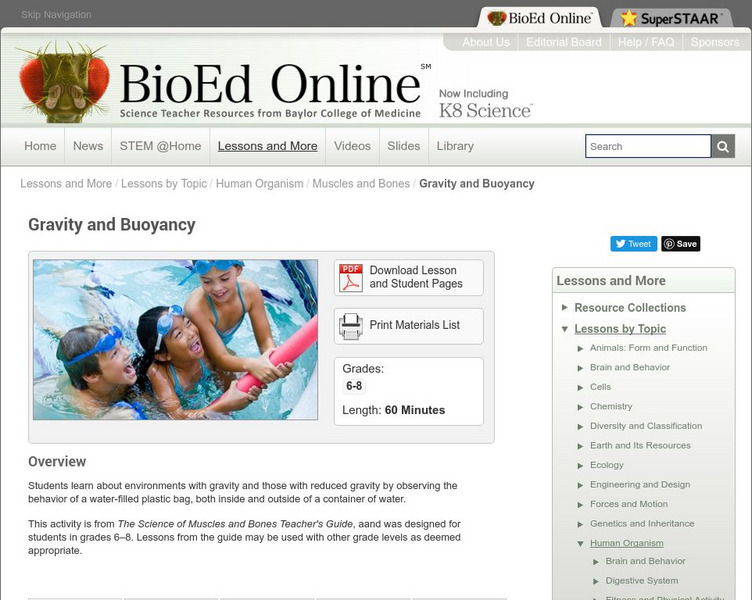
BioEd Online
Bio Ed Online: Gravity and Buoyancy
In the following lesson for grades 6-8, learners learn about environments with gravity and those with reduced gravity by observing the behavior of a water-filled plastic bag, both inside and outside of a container of water.

Science Struck
Science Struck: How to Find Volume With Water Displacement Method
Tells the story of how Archimedes discovered the Archimedes Principle and his water displacement method for determining the volume and density of an object. Provides an explanation and several examples of how it is done.
Science Buddies
Science Buddies: Buoyancy of Floating Cylinders
This project presents an interesting puzzle. A disk of wood will float face-up, that is, with its circular cross-section parallel to the surface of the water. A long log of wood, however, floats with the circular cross-section...
Science Education Resource Center at Carleton College
Serc: Mn Step: Sinking Water: Glaciers, Ocean Currents and Weather Patterns
A activity where students learn how warm water is less dense than cold water, and what this means for global climate change as ice from the polar regions melts. Students will do experiments in buoyancy and water density when hot or cold,...
PBS
Pbs Learning Media: Buoyancy Brainteasers: Buoyancy Question
This interactive brainteaser from the NOVA: "Voyage of Doom" Web site challenges you to figure out what causes an object to sink.
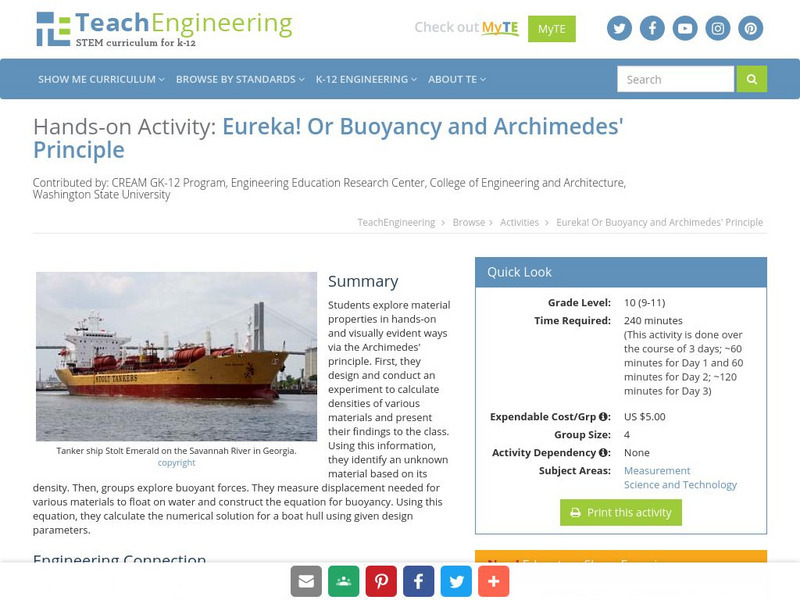
TeachEngineering
Teach Engineering: Eureka! Or Buoyancy and Archimedes' Principle
Students explore material properties in hands-on and visually evident ways via the Archimedes' principle. First, they design and conduct an experiment to calculate densities of various materials and present their findings to the class....
PBS
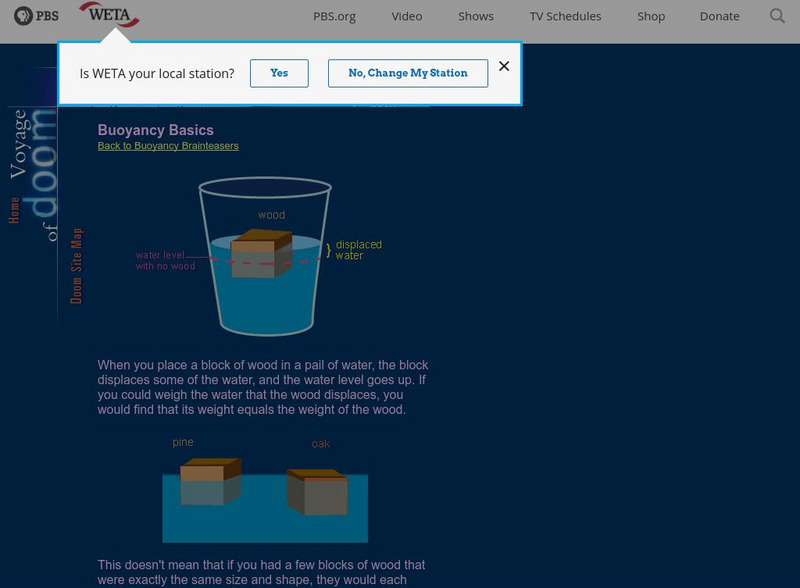
Pbs: Buoyancy Basics
NOVA explores the basic principle of buoyancy. Also included at this site are some interesting brain-teasers related to the topic.
Massachusetts Institute of Technology
Mit: Blossoms: Will an Ice Cube Melt Faster in Freshwater or Saltwater?
Engage students in the study of the ocean and saltwater with these activities. Students will see that saltwater has different physical properties than freshwater - mainly density. This lesson can serve as a springboard into other...
University of California
University of California: Seawater Density & Salinity [Pdf]
Describes the properties of seawater and the variations depending on its location, e.g., near a shoreline, in an estuary, or as sea ice. Discusses the instruments scientists use to measure the density of water and explains other...
TeachEngineering
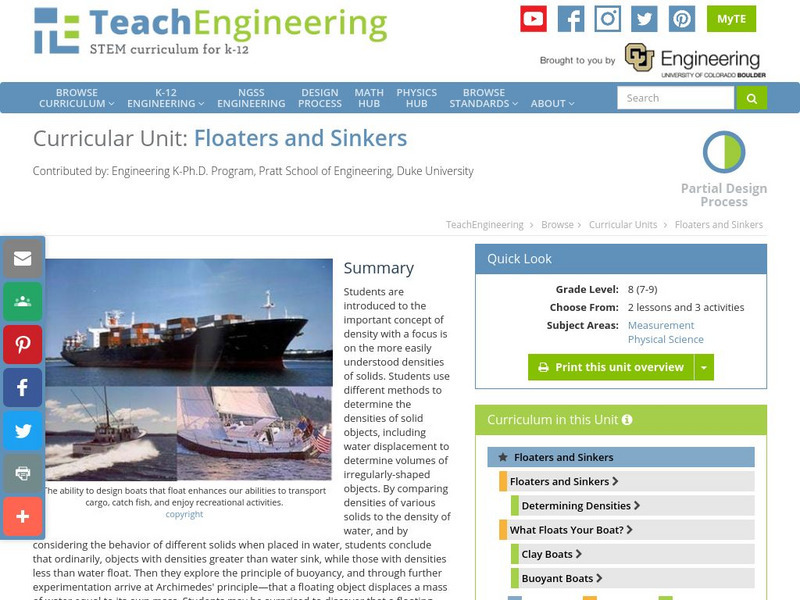
Teach Engineering: Floaters and Sinkers
Through this curricular unit, students are introduced to the important concept of density. The focus is on the more easily understood densities of solids, but students may also explore the densities of liquids and gases. Students devise...

TeachEngineering
Teach Engineering: What Floats Your Boat?
Students use modeling clay, a material that is denser than water and thus ordinarily sinks in water, to discover the principle of buoyancy. They begin by designing and building boats out of clay that will float in water, and then refine...
Utah Education Network
Uen: Nhmu: Boy, Is That Buoyant!
Learn how salt increases the density of water and creates a condition of buoyancy.
NOAA
Noaa: Boat Building Challenge [Pdf]
Read to find out about the first boat builders. Construct your own boat out of common materials to explore buoyancy.
TeachEngineering
Teach Engineering: Floaters and Sinkers
This lesson introduces students to the important concept of density. The focus is on the more easily understood densities of solids, but students can also explore the densities of liquids and gases. Students devise methods to determine...
TeachEngineering
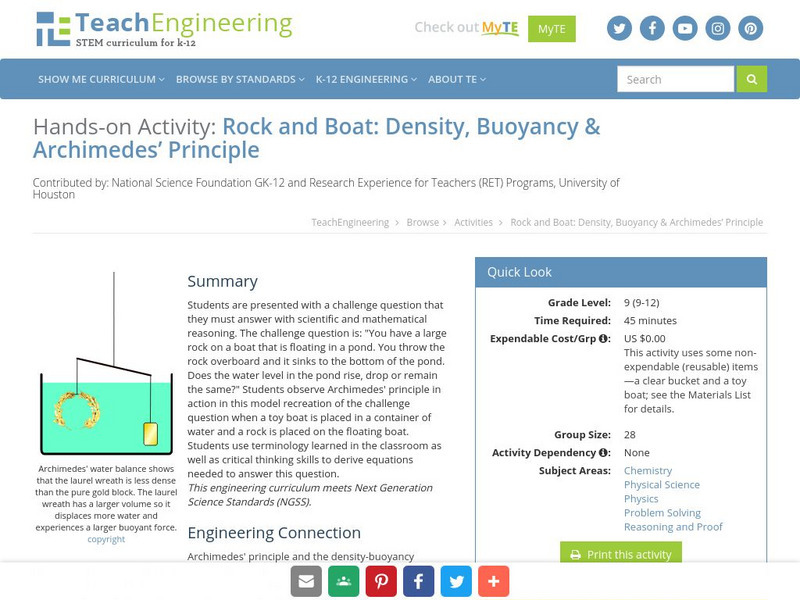
Teach Engineering: Rock and Boat
Students observe Archimedes' principle in action in this challenge where a toy boat is placed in a container of water and a rock is placed on the floating boat. Students must explain why the water level rises/falls/stays the same based...

Alabama Learning Exchange
Alex: Teaching Measurement: Literature and Manipulatives
The tradebook, Who Sank the Boat? by Pamela Allen, is an excellent tool in teaching measurement. Learners will engage in activities involving different types of measurement. In the story, five animal friends decide to take a boat ride....
Other
Sprk: Sphero Hydro Hypothesis Stem Challenge [Pdf]
SPRK STEM challenges are fun, interactive activities that challenge students to use creativity and team-work to move through simple steps of the design process in order to build Sphero-based creations. The Hydro-hypothesis challenge...
TeachEngineering
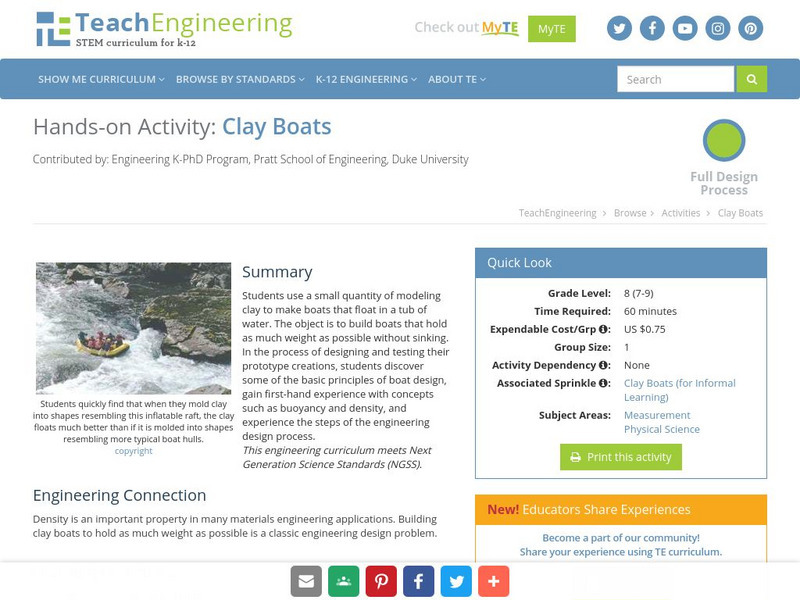
Teach Engineering: Clay Boats
Each student uses a small quantity of modeling clay to make a boat that will float in a tub of water. The object is to build a boat that will hold as much weight as possible without sinking. In the process of designing and testing their...
Scholastic
Scholastic Instructor: Seashore Science
Come and learn with this incredible seashore science resource. The content includes fun facts, experiments, reproducible activities, resources and more.
Museum of Science
Museum of Science and Industry: Online Science: Design a Submarine
Become an engineer, and design a submarine that moves in the water like a real submarine. Try making it sink, float, and hover in the water.

Alabama Learning Exchange
Alex: What's the Matter: A Sinker or Floater?
Students will explore matter that sinks or floats when submerged in water and that matter is categorized as either a sinker or a floater. Students will work actively in small, cooperative learning groups as well as gather in a whole...