Hi, what do you want to do?





Woods Hole Oceanographic Institution
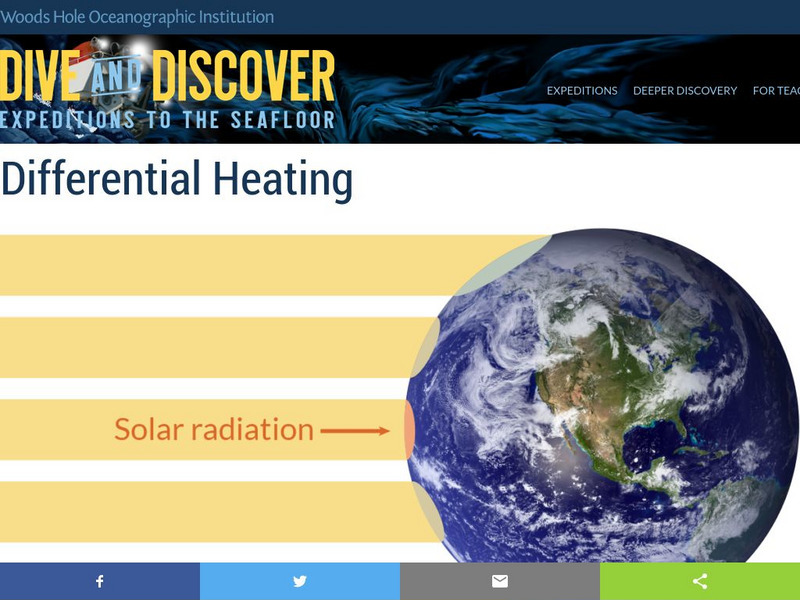
Woods Hole Oceanography Institute: Deep Ocean Circulation
What causes the circulation of ocean waters that are too deep to be affected by wind? Find out how salinity and temperature drive the deep sea currents. This resource has several videos and an online quiz.
TeachEngineering
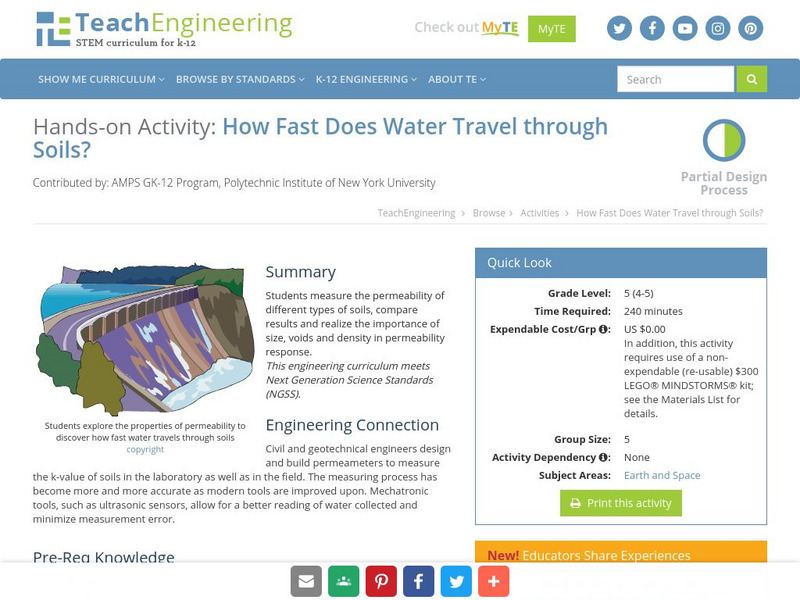
Teach Engineering: How Fast Does Water Travel Through Soils?
Students measure the permeability of different types of soils, compare results and realize the importance of size, voids and density in permeability response.
American Geosciences Institute
American Geosciences Institute: Earth Science Week: Ocean Currents
Students map the patterns of the major ocean currents, and learn about the influences of wind, water temperature, landmasses, and water density on currents.
Science Education Resource Center at Carleton College
Serc: Mn Step: Sink or Float: All Liquids Do Not Have the Same Density
An experiment in density. After a review of floating and sinking of different materials, students test four bottles, all holding four ounces of water, to see if they will float or sink. They each contain a different density of sugar...
Scholastic
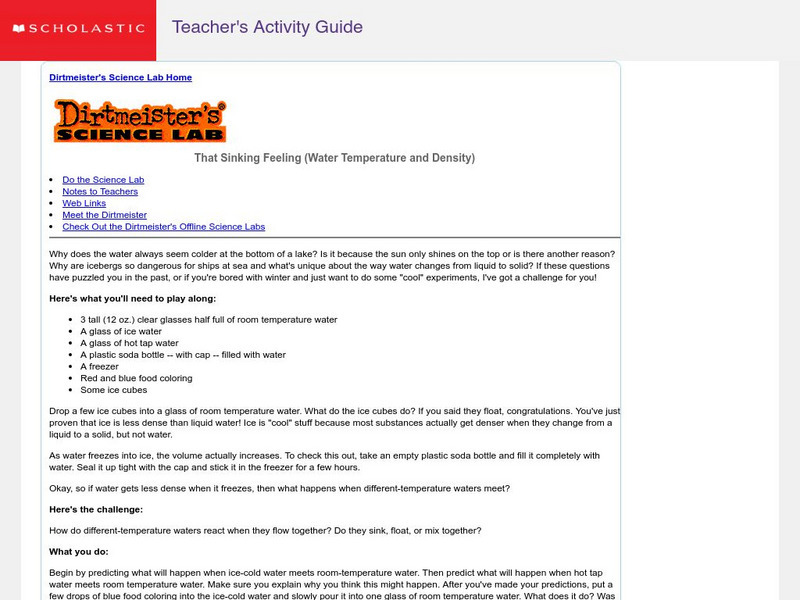
Scholastic: Dirtmeister's Science Lab: That Sinking Feeling
Simple experiments dealing with water temperature and density that you can complete in the lab and at home.
PBS
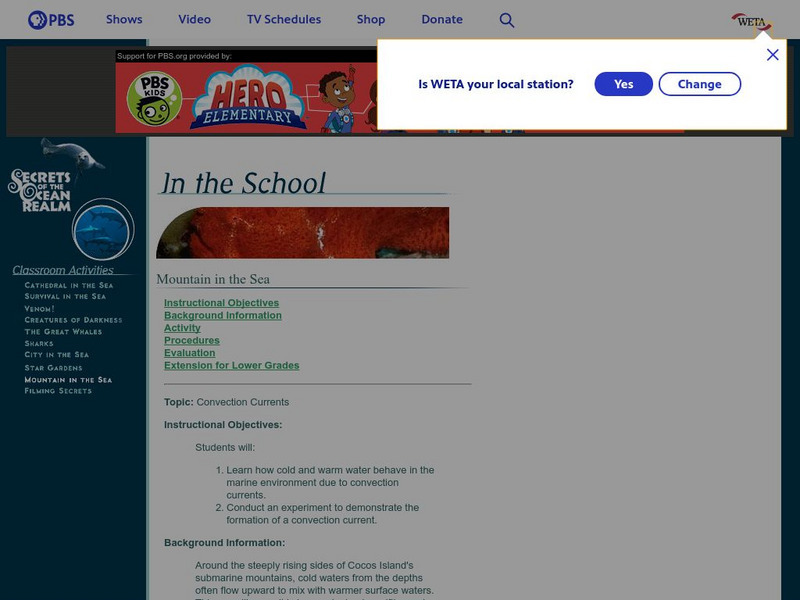
Pbs, Secrets of the Ocean Realm: Mountain in the Sea
This experiment allows your students to study the effect of temperature on water motion and also to create their own density driven current.
Other
Beloit College: K 12 Geology
This is a good source of basic information about density currents in water. It includes simple activities you can do to demonstrate these currents.
Read Works
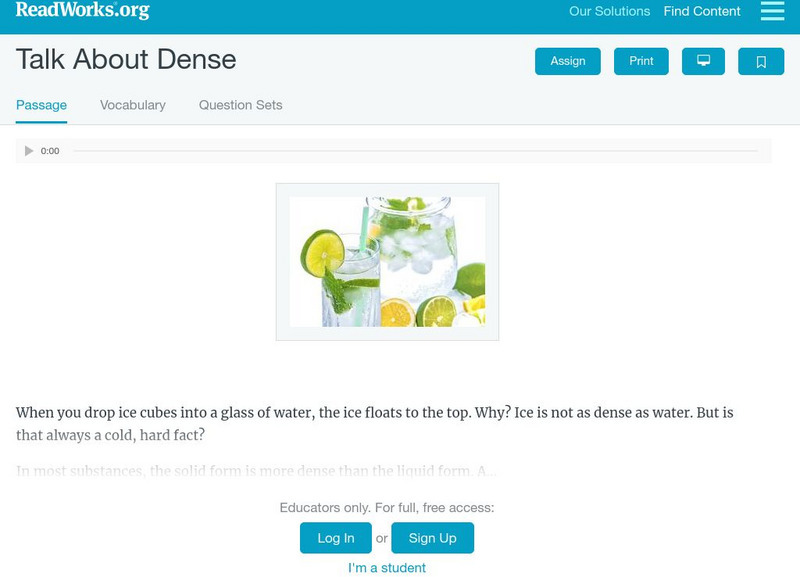
Read Works: Talk About Dense
[Free Registration/Login Required] An informational text explaining the density of solids and liquids. A question sheet is available to help students build skills in reading comprehension.
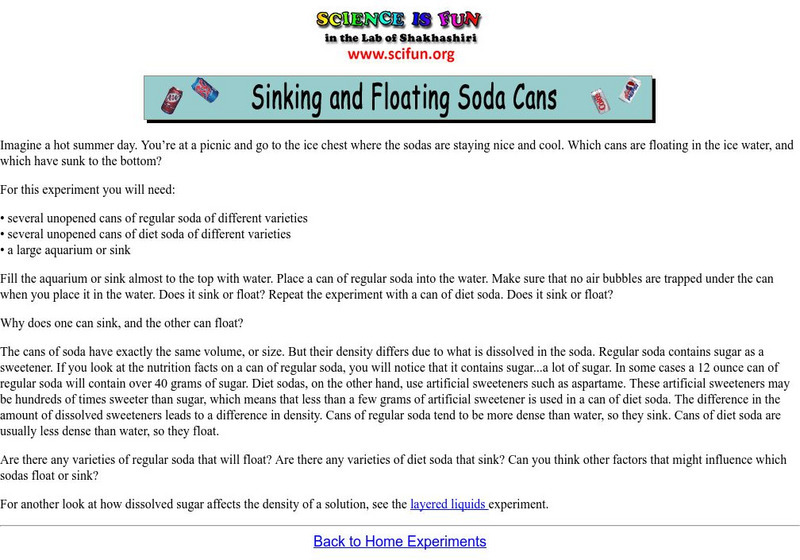
Science is Fun
Fun Science: Sinking and Floating Soda Cans
Why do some pop cans float in water while others don't? This easy experiment is a great example of the principle of density.
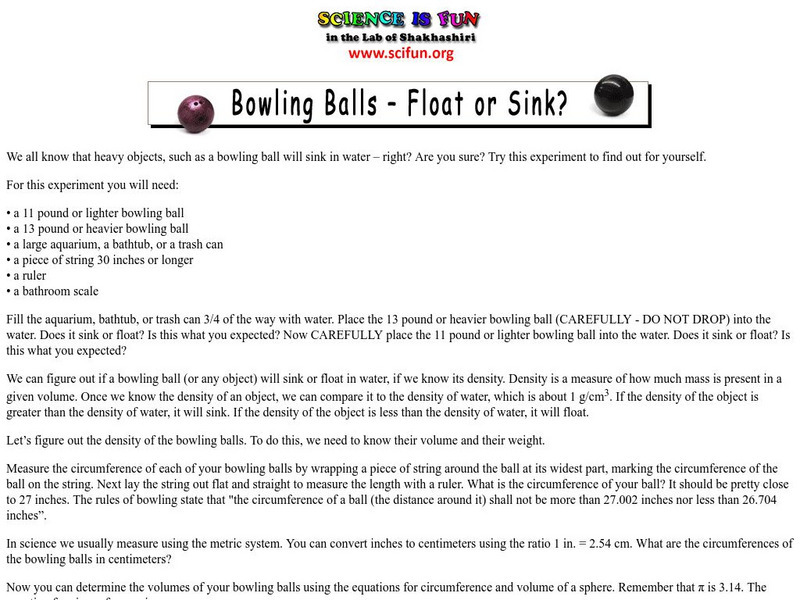
Science is Fun
Fun Science: Bowling Balls: Sink or Float?
For a dramatic illustration of density check out this demonstration. It's simple to do, only requiring a bowling ball and some water.
Illustrative Mathematics
Illustrative Mathematics: G Mg Archimedes and the King's Crown
The King of Syracuse reportedly requested Archimedes' advice for determining if a crown was made with the appropriate mixture of gold and silver. The problem asks students to find the amount of water displaced in Archimedes' experiment...
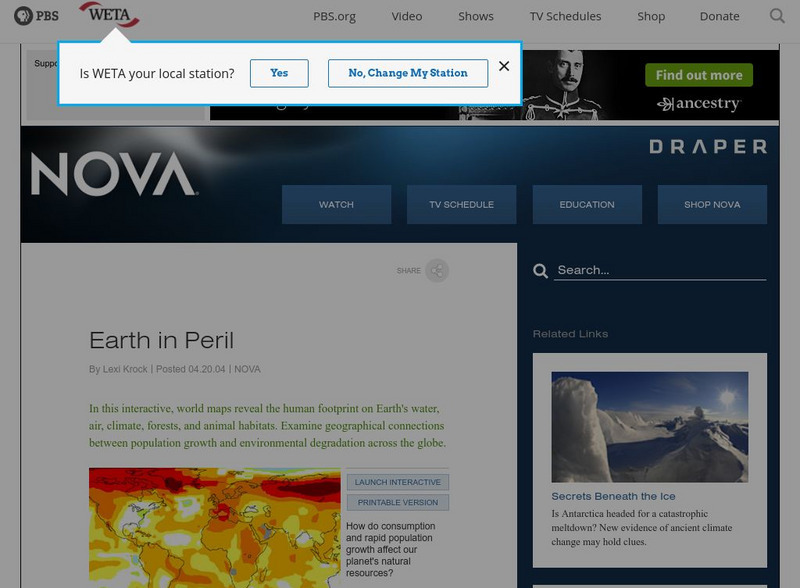
PBS
Nova: Earth in Peril
A series of nine maps with accompanying explanations. They show how population growth has affected the environment around the world in terms of water availability, climate change, land and forest use, and more. There are both interactive...
Science Education Resource Center at Carleton College
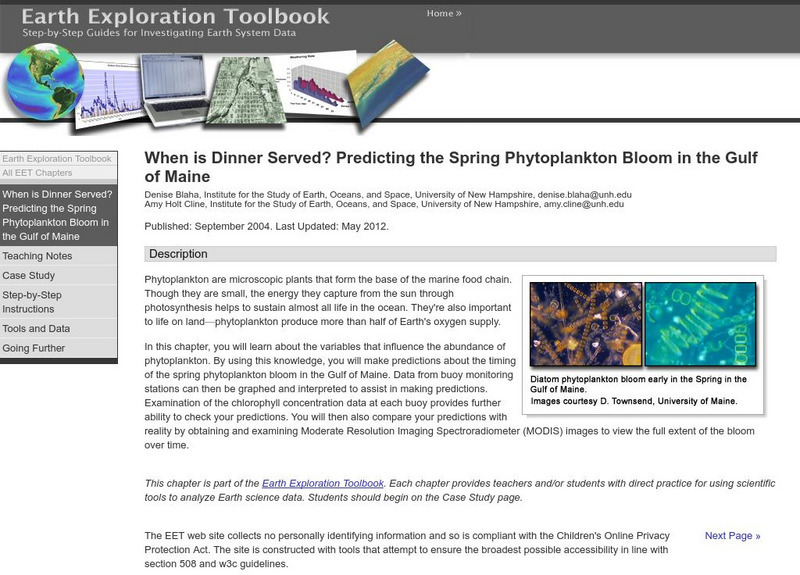
Serc: Predicting the Spring Phytoplankton Bloom in the Gulf of Maine
This lesson helps students understand the variables that influence the abundance of phytoplankton. Students will make predictions about the timing of the spring phytoplankton bloom in the Gulf of Maine. Furthermore, data from buoy...
Massachusetts Institute of Technology
Mit: Blossoms: Will an Ice Cube Melt Faster in Freshwater or Saltwater?
Engage students in the study of the ocean and saltwater with these activities. Students will see that saltwater has different physical properties than freshwater - mainly density. This lesson can serve as a springboard into other...
TeachEngineering
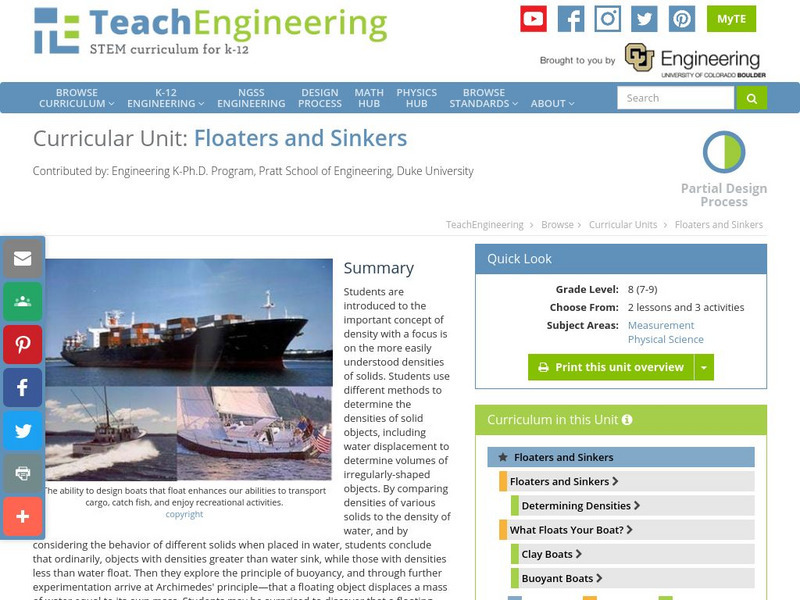
Teach Engineering: Floaters and Sinkers
Through this curricular unit, students are introduced to the important concept of density. The focus is on the more easily understood densities of solids, but students may also explore the densities of liquids and gases. Students devise...
TeachEngineering
Teach Engineering: Floaters and Sinkers
This lesson plan introduces young scholars to the important concept of density. The focus is on the more easily understood densities of solids, but students can also explore the densities of liquids and gases. Young scholars devise...
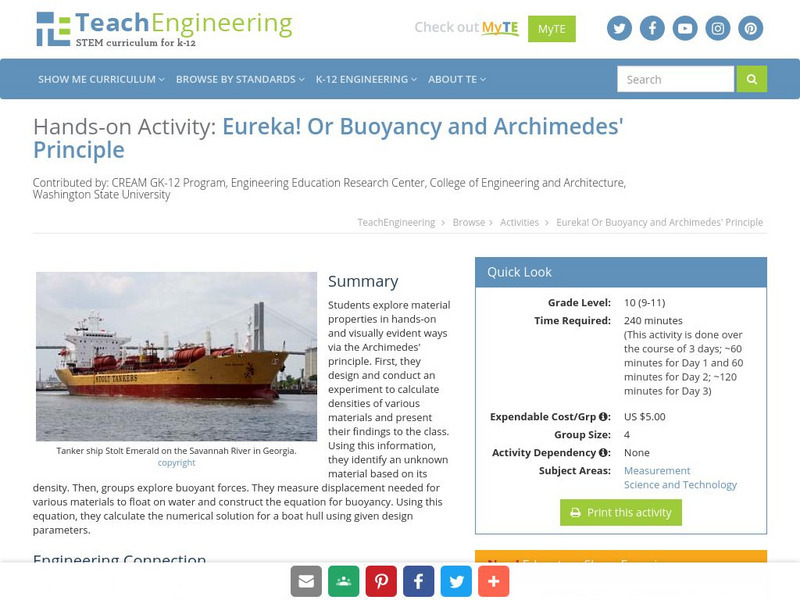
TeachEngineering
Teach Engineering: Eureka! Or Buoyancy and Archimedes' Principle
Students explore material properties in hands-on and visually evident ways via the Archimedes' principle. First, they design and conduct an experiment to calculate densities of various materials and present their findings to the class....
Science Education Resource Center at Carleton College
Serc: Layering Liquids
A lab activity to show students how different densities of liquid layer on top of each other by using four different colored liquids that contain different levels of salinity. This activity can also be used in an ocean unit where...

TeachEngineering
Teach Engineering: What Floats Your Boat?
Students use modeling clay, a material that is denser than water and thus ordinarily sinks in water, to discover the principle of buoyancy. They begin by designing and building boats out of clay that will float in water, and then refine...

University of Colorado
University of Colorado: Ph Et Interactive Simulations: Under Pressure
An interactive simulation that teaches about pressure, fluids, and density by observing changes in pressure under and above water with changes in variables including fluids, gravity, container shapes, and volume. This simulation can...

TED Talks
Ted: Ted Ed: How Taking a Bath Led to Archimedes' Principle
This video explains how the early Greek mathematician Archimedes discovered the principle relating density, volume, and displacement of water. [3:01] Includes a brief quiz and a list of additional resources to explore.
Science Buddies
Science Buddies: Buoyancy of Floating Cylinders
This project presents an interesting puzzle. A disk of wood will float face-up, that is, with its circular cross-section parallel to the surface of the water. A long log of wood, however, floats with the circular cross-section...
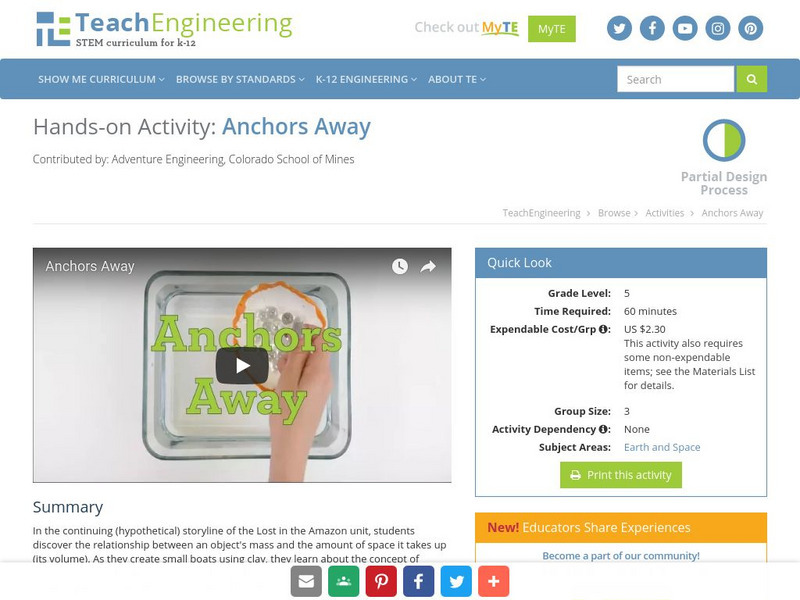
TeachEngineering
Teach Engineering: Anchors Away
In this activity, the students will discover the relationship between an object's mass and the amount of space it takes up (its volume). The students will learn about the concept of displacement and how an object can float if it...
TeachEngineering
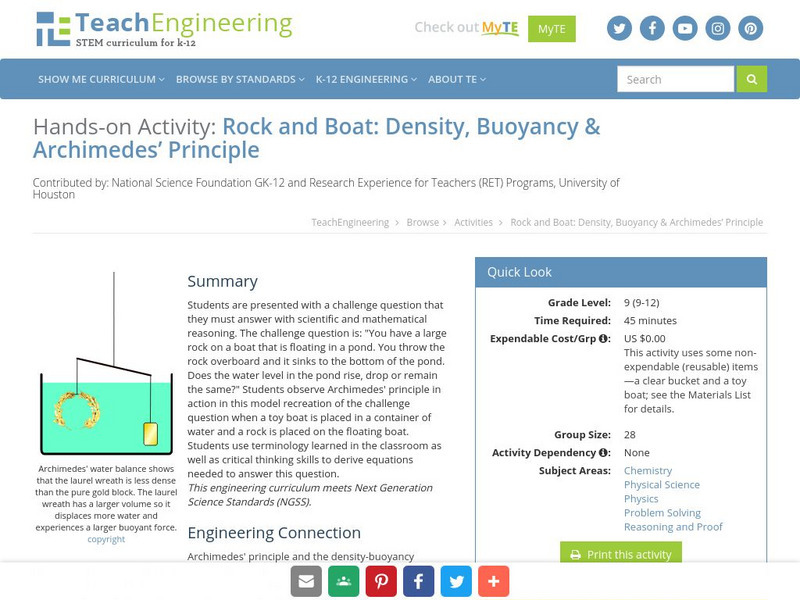
Teach Engineering: Rock and Boat
Students observe Archimedes' principle in action in this challenge where a toy boat is placed in a container of water and a rock is placed on the floating boat. Students must explain why the water level rises/falls/stays the same based...
Other popular searches
- Layering Water Density
- Water Density Experiments
- Floating Egg Water Density
- Liquid Density Water
- Water Density Animation
- Density of Water
- Water Density Worksheet
- Water Density Experements
- Water Density Using Raisins
- Water Density Freezing Water
- Water Density Using Rasins
- Density Hot Water