Hi, what do you want to do?






Curated OER
Mumbai Bomb Investigation
Students brainstorm legal and illegal ways people try to influence politics. They examine the vocabulary in news reports about the Mumbai, India terrorist bombing and create their own train safety posters.

Curated OER
First Letter Changes
Students use the books of Eric Carle to change the first letter in a word to see a new word. In this phonics lesson plan, students change the beginning letters in poems and books.

Curated OER
Onomatopoeia
Fifth graders investigate onomatopoeia. In this reading lesson, 5th graders create a list of onomatopoeic words from books read and brainstorm words of their own in small groups.

Curated OER
Prehistoric Native American Lesson Plan: Pictionary with the Past
Students participate in a vocabulary exercise at a website dedicated to Prehistoric Native Americans.

Curated OER
Color, Play, Podcast
Learners encounter the format of a podcast and plan what content they will include. They work in small groups or with the whole class to develop an outline. Students practice reading their scripts to other learners.

Curated OER
The Underground Railroad
Fourth graders participate in a literature circle after reading a book about the Underground Railroad. They discuss their selected book with their literature circle group, and complete a handout about their role in the circle. Students...

Curated OER
Introduction to Multiplication
Students construct equivalent sets, skip count by twos, threes, fours, etc., combine the sets, and finally, multiply simple numbers. Each student use candy to construct sets, write multiplication algorithms, and solve simple...

Curated OER
What's In A Name
Second graders write a paragraph about their findings on what their name represents. In this writing lesson plan, 2nd graders will research their name and why they were named that. They will draw a picture that represents them along with...

Curated OER
What is Good Writing?
Students assess samples of writing for each trait and discuss rationale for scoring. They comprehend that the traits of writing offer a common language for revision. Students are shown how to asses their writing and what makes good...

Curated OER
What is Good Writing
Learners identify the qualities of good writing. In this writing lesson, students use the 6+1 Traits of Writing and use a rubric to discuss samples of writing on the overhead. Learners discuss the strengths and weaknesses of each writing...

Curated OER
Expected Value
Students discuss what expected value is, they are introduced to the concept of varyting payoffs. Students use a computer simulation of a "real world" example where expected value is used.

Curated OER
How To Use the Internet To Make Student Glossaries
Middle schoolers use an internet dictionary to produce a glossary of words related to a particular subject area being studied. They choose the correct meaning of the word for their glossary, based on it's relationship to the subject...

Curated OER
The Time I Got Lost
Third graders go through the writing process but substitute paper and pencil with the computer to create a story about "The Time I Got Lost".

Curated OER
Memories
Fifth graders collect artifacts of their fifth grade school year and make a technology based Memory Book.

Curated OER
Things About Me
Learners watch as the teacher explains how to use a storyboard to plan a PowerPoint presentation. They examine how to use clip art, background colors, and at least one transition before creating a PowerPoint presentation according to the...

Curated OER
Assessing the Traits: What is Good Writing?
Students assess samples of writing for each trait and discuss the rationale for scoring. They understand that the traits of writing offer a common language for revision. This lesson plan includes a scoring rubric for the students to use.
Texas Education Agency
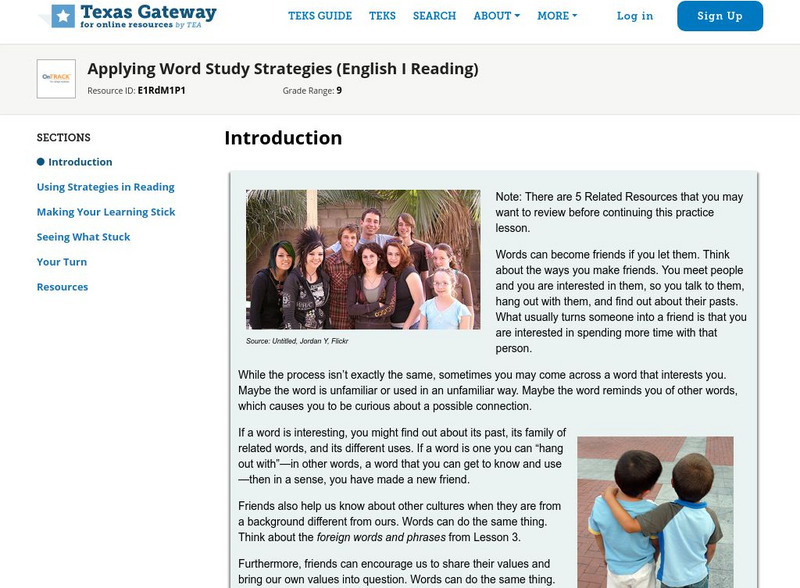
Texas Gateway: Applying Word Study Strategies (English I Reading)
In this lesson, students will practice applying word study strategies to improve your reading fluency and comprehension. L.9-10.5b nuances
Texas Education Agency
Texas Gateway: Reading to Learn Academy, Grade 4 Additional Resources
This website provides links to teacher resources to effectively teach reading to learn skills. These include topics for all learners and ESL learners. Learning resources for Word Study and Recognition, Fluency, Vocabulary, Comprehension,...
Texas Education Agency
Texas Gateway: Reading to Learn Academy, Grade 5 Additional Resources
This website provides links to teacher resources to effectively teach reading to learn skills. These include topics for all learners and ESL learners. Learning resources for Word Study and Recognition, Fluency, Vocabulary, Comprehension,...
Texas Education Agency
Texas Gateway: Literacy Achievement Academy, Grade 3: Additional Resources
This website provides links to teacher resources to effectively teach reading to learn skills. These include topics for all learners and ESL learners. Learning resources for Word Study and Recognition, Fluency, Vocabulary, Comprehension,...
TESL Journal
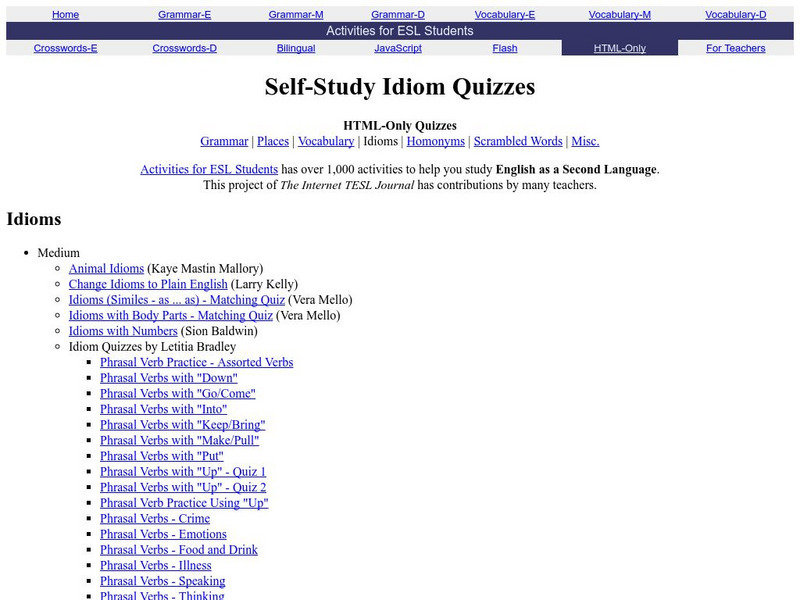
Activities for Esl Students: Self Study Idiom Quizzes
Vast array of quizzes and self-study exercises based on idioms and idiomatic expressions, categorized in a variety of ways (beginning with A, B, etc., by keyword, or by association with other groupings). Great practice for the ELL/ESL...
Texas Education Agency
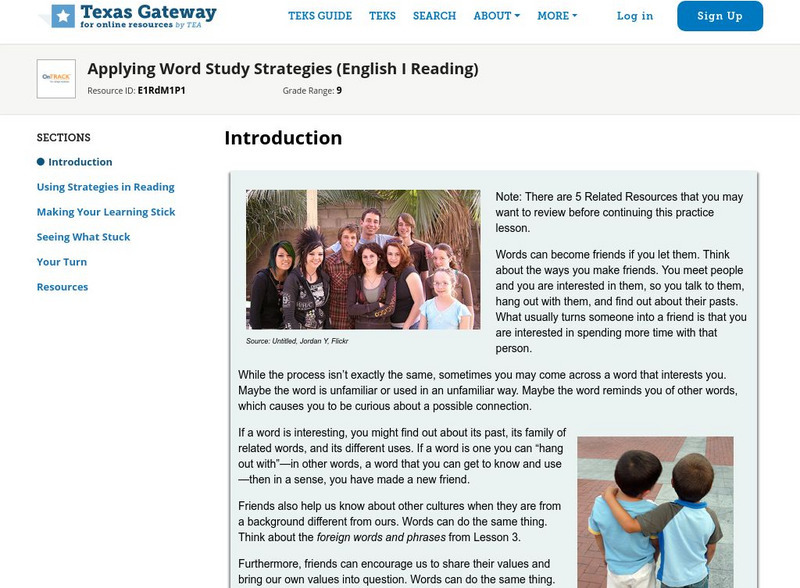
Texas Gateway: Applying Word Study Strategies (English I Reading)
Apply previous lessons, (1) Linguistic Roots and Affixes, (2) Denotation and Connotation, (3) Origins and Meanings of Foreign Words, (4) Cognates, and (5) Reference Materials, to improve fluency and comprehension.
![Austin Independent School District: Quick and Easy Word Study Routine [Pdf] Activity](https://statictemp.lp.lexp.cloud/images/attachment_defaults/resource/large/FPO-knovation.png "Austin Independent School District: Quick and Easy Word Study Routine [Pdf] Activity")
Austin Independent School District
Austin Independent School District: Quick and Easy Word Study Routine [Pdf]
When older students struggle with decoding difficult words, the word study routine described in this slide presentation can teach them to chunk bigger words into smaller parts to learn pronunciation skills.

Annenberg Foundation
Annenberg Learner: Workshops: Teaching Reading 3 5
This instructional workshop provides eight sessions on teaching reading in intermediate classrooms: "Creating Contexts for Learning," "Fluency and Word Study," "Building Comprehension," "Writing," "New Literacies of the Internet,"...