Hi, what do you want to do?






Curated OER
Declaration of Independence
Eighth graders explain the meaning of the Declaration of Independence. They view a political cartoon of the period, then do a writing assignment for homework. They write about how they would feel if the British were calling them traitors.

Curated OER
Science Reporter for Where in the World is Science? Project
Students take the role of a science reporter and gather data for a newspaper article. Students create a question sheet. Students receive a copy of the Science Reporter's Journal task sheet. They complete the items on the sheet and...


Curated OER
Writing a Mystery Story
Students examine the elements of mystery stories and read Rage in Harlem. In reciprocal teaching groups, they discuss the author's development of the story, and complete dialectical journals.

Curated OER
The Great Exchange
Sixth graders examine the connection that the present has to the past and how different cultures impact each other with lasting results. They discuss European exploration in North America and West Africa by describing cultural...

Curated OER
What Counts as History?
Eighth graders explore the question "What Counts as History?" In this Philosophy lesson, 8th graders pretend that they are going to interview a historian. Students read a primary source and answer the questions that follow.

Curated OER
The Effects of Environment on Plant Growth: Selecting Seeds for Survival on a New Planet
Fifth graders conduct experiments to compare seed germination and plant growth rates. They construct a hydroponic plant unit and a lighthouse. They care for the plants for a month and collect data for graphs. They write a report.

Curated OER
Affects of Geography on Colonial Cultures
Sixth graders examine the effects of geography on the development of culture. They discuss how geography can affect the lifestyles and development of a society's culture. Students examine the geography and climate of New England and the...

Curated OER
United States Regions
Fifth graders identify the regions of the United States. They gain general knowledge of Regions of the U.S., create a spreadsheet and use word processing to create a report.

Curated OER
"What Do You Mean?" How Language Changes Over Time
Students examine words used at Jamestown in 1607. They predict what the words meant in 1607, write sentences using three of them, then analyze the sentences after they have read the actual definitions of the words.

Curated OER
Lesson 1: The Image of Maine in Sinclair Lewis' Babbitt
Students study excerpts from Sinclair Lewis, "Babbitt" for its accuracy and socio-economic point of view. They rewrite a portion of "Babbit" using the point of view of a Maine guide.

Curated OER
It's My Right
Students participate in activities examining the Bill of Rights. They discover the different articles and Amendments.

Curated OER
Dear Wife and Children Everyone
Students study the issue of slave vs. free states. They explore the actions and personal commitment of John Brown and write a newspaper article about the Battle of Osawatomie from John Brown's perspective.

Curated OER
Lewis and Clark Encounters with Native Americans
Students research what the exchange was between the various Native American groups and Lewis and Clark. They are able to write reflections after truly considering the issue with the help of research.

Curated OER
Around and Across
Tenth graders investigate the circumference and diameter of a circle. In this geometry lesson, 10th graders relate circumference to diameter. They create a scatter plot to estimate the value of pi.

Curated OER
Pollution Solution
Fourth graders examine how trees help to absorb the pollution that is emitted from automobiles. They review the process of photosynthesis and determine how forest management is important on their reservation. They think about the...
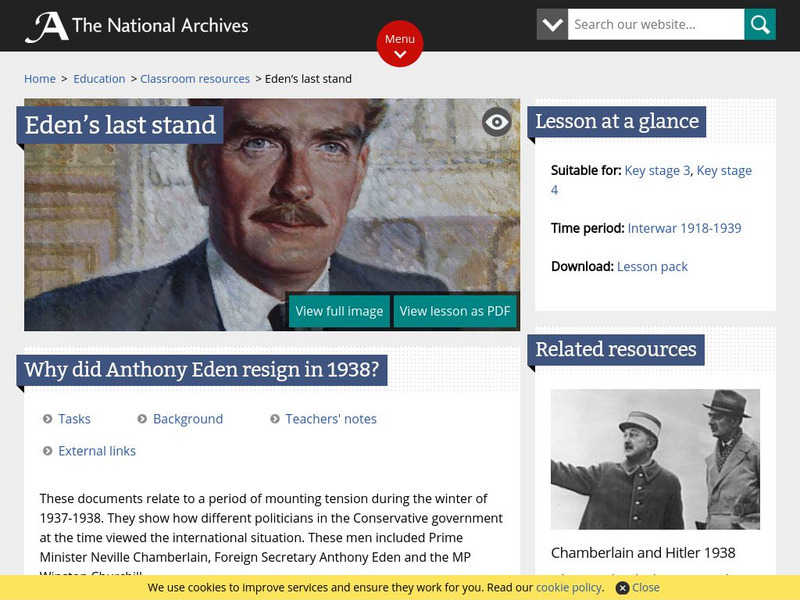
National Archives (UK)
National Archives Learning Curve: How to Read a Document
This site is a lesson on Document Analysis using a letter written by Anthony Eden to PM Chamberlain in late 1937.

US National Archives
Our Documents: Our Documents Welcome Page
Explore 100 selected milestone historical documents relating to American History. Click on the link to the list of links to documents. RI.11-12.8 seminal U.S. texts, W.11-12.9b US Doc Analysis.
Stanford University
Sheg: Document Based History: Reading Like a Historian:sourcing Classroom Poster
[Free Registration/Login Required] Sourcing asks learners to consider who wrote a document as well as the circumstances of its creation. Who authored a given document? When? For what purpose? This poster reminds students before reading a...

Curated OER
History Matters: Making Sense of Documents
Designed to help teachers and students make effective use of primary documents. There are well written section on how to make sense of numbers, ads, music, diaries, and more. included are interactive activities for students to help them...
Stanford University
Sheg: Document Based History: Reading Like a Historian: The Puritans
[Free Registration/Login Required] Students solve a problem surrounding a historical question by reading primary source documents. This historical inquiry lesson allows students to source, corroborate, and contextualize speeches from...

Stanford University
Sheg: Document Based History: Reading Like a Historian: The Korean War
[Free Registration/Login Required] Learners are given an opportunity to look at two textbooks recalling the same event, but one is written in and for North Korean schools and the other in and for South Korean schools. After reviewing the...
Schools of California Online Resources for Education
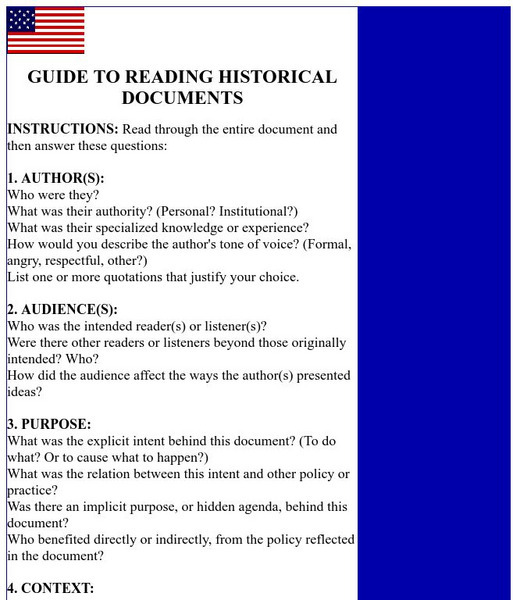
Score: Guide to Reading Historical Documents
Here are some questions that serve as a guide while you read and study historical documents. The information at this website was originally written by the National Council for the Social Studies. W.11-12.9b US Doc Analysis
University of Texas at Austin
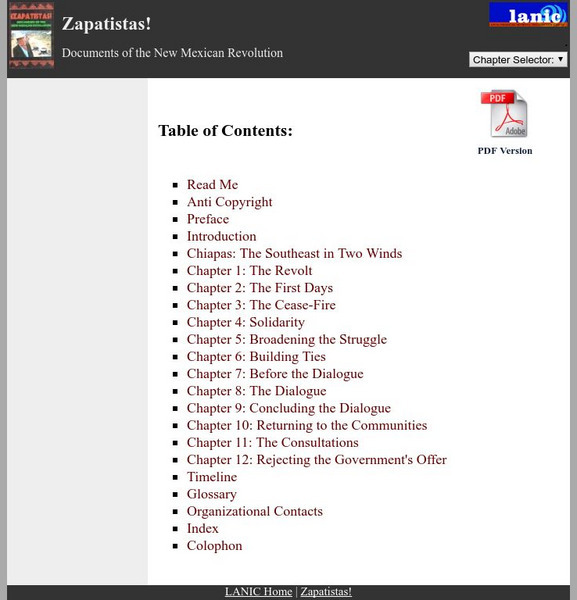
Lanic: Zapatistas! Documents of the New Mexican Revolution
Primary source documents describing the Zapatista revolt in Southern Mexico. These were written, either by the revolutionaries, or supporters of the revolution. This is a good resource to get background on why this revolt took place in...