Hi, what do you want to do?





Science Buddies
Science Buddies: Yeast Reproduction in Sugar Substitutes
There's nothing quite like the smell of fresh-baked bread to make your mouth water. As any baker can tell you, you can't bake bread without yeast. This project makes clever use of bread dough to measure yeast reproduction three different...

Science Buddies
Science Buddies: Rise to the Occasion: Investigating Yeast Fermentation
Did you ever wonder how yeast makes bread dough rise? This project will show you what yeast does to make this happen. You'll also investigate the conditions yeast needs to grow.
Science Buddies
Science Buddies: An Aerobic Exercise: Yeast Metabolism and Aeration
This is a straightforward project on glucose metabolism in yeast. You'll grow yeast under aerobic and anaerobic conditions and measure carbon dioxide output to assess metabolic efficiency.
Bio Topics
Bio Topics: Demonstrate the Effect of Temperature on Fermentation by Yeast
Using grape juice as the yeast's food, this lab experiment allows students to test the effect of temperature on yeast fermentation.
TeachEngineering
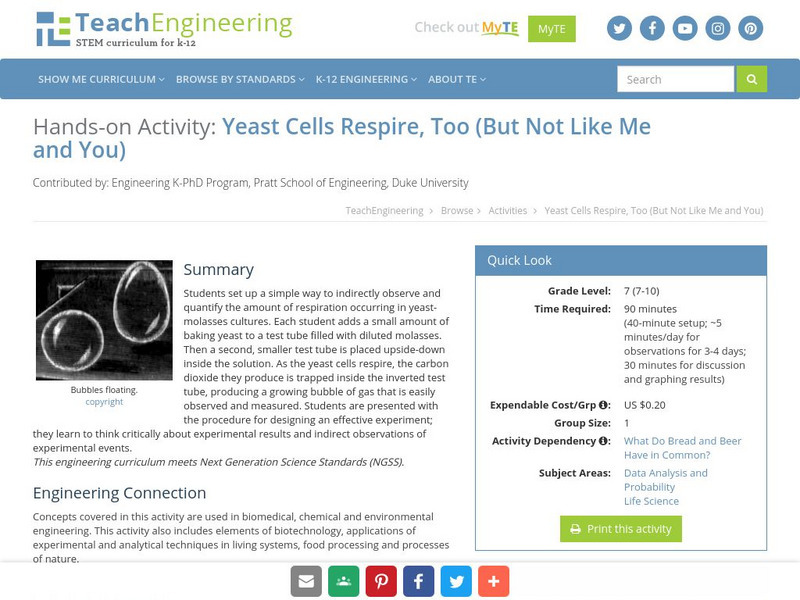
Teach Engineering: Yeast Cells Respire, Too (But Not Like Me and You)
Students set up a simple way to indirectly observe and quantify the amount of respiration occurring in yeast-molasses cultures. Each student adds a small amount of baking yeast to a test tube filled with diluted molasses. A second,...

Alabama Learning Exchange
Alex: Observation of Yeast Growth
In this lesson plan students will observe the growth of yeast cells, which is evidence that yeasts are converting food to energy and are living organisms.
Bio Topics
Bio Topics: To Show the Effects of Temperature on Fermentation by Yeast
In this classroom lab experiment, students measure the effects of temperature on yeast growth and reproduction.
Bio Topics
Bio Topics: To Monitor the Progress of Fermentation of Different Sugars by Yeast
In this classroom lab experiment students measure progress of sugar fermentation by yeast using a hydrometer.
Bryn Mawr College
Serendip: Is Yeast Alive?
Brief text summary of what students learn in the Is Yeast Alive? Lab, along with links to download Student Handouts and Teacher Preparation Notes in PDF or Word formats. Characteristics of life are addressed and metabolism and the...
TeachEngineering
Teach Engineering: Population Growth in Yeasts
This activity is the second of two that explore cellular respiration and population growth in yeasts. In the first activity, students set up a simple way to indirectly observe and quantify the amount of respiration occurring in...
Science Buddies
Science Buddies: Project Ideas: Dna Damage: Ultraviolet Rays and Yeast Colonies
In this biotechnology science fair project, investigate how DNA damage affects growth of yeast that are DNA-repair deficient. The Science Buddies project ideas are set up consistently beginning with an abstract, objective, and...

Science Bob Pflugfelder
Science Bob: Watch Yeast in Action!
Gives a procedure for observing the creation of carbon dioxide by active yeast. Following the procedure, a brief description of how yeast is used in bread is presented.
BiologyWise
Biology Wise: Mold vs. Yeast
Discusses the characteristics of mold and yeast and how they are different in terms of structure, where they are found, method of reproduction, and appearance.
Bryn Mawr College
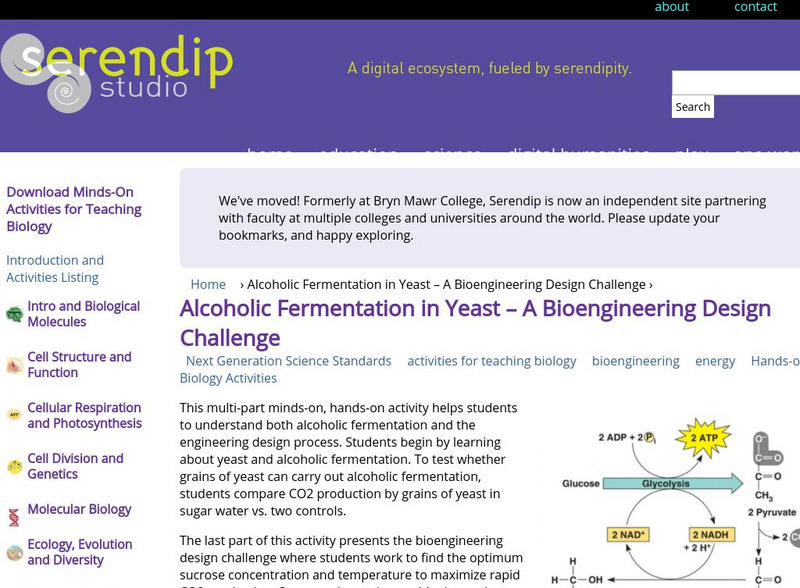
Serendip: Alcoholic Fermentation in Yeast
A text summary of what students learn in the Alcoholic Fermentation in Yeast lab, along with links to download Student Handouts and Teacher Preparation Notes in PDF or Word formats. Aerobic cellular respiration and alcoholic fermentation...
University of Missouri
Microbes in Action: Classroom Activities: A Swell Lab: Yeast Fermentation [Pdf]
This two-day experiment uses different concentrations of sugar to study the rate of fermentation. Students observe the rate of carbon dioxide gas produced by yeast to infer the rate of fermentation. Lesson plan gives a lab procedure,...

Bio Topics
Bio Topics: Direct Observation of Yeast Population Growth
In this classroom lab experiment, students mimic optimal growth conditions for yeast, and with the help of a microscope, observe and record results using a cell counting method.

Bio Topics
Bio Topics: Yeast Cell Structure
Learn about the structure, size, and uses for yeast in this reference article.

TeachEngineering
Teach Engineering: How to Make Yeast Cells Thrive
Students set up and run the experiments they designed in the lesson Population Growth in Yeasts, using simple yeast-molasses cultures in test tubes. Population growth is indicated by the amount of respiration occurring in the cultures,...
Science Buddies
Science Buddies: Yeasty Beasties
While looking at a package of dry yeast it is hard to believe it is alive. But add the right ingredients and presto, the mixture becomes a bubbly, oozing, mess of life. What are the right ingredients? Do this experiment and figure it out...
BioEd Online
Bio Ed Online: Fuel for Living Things
Young scholars learn about how cells fuel themselves by examining how carbon dioxide is produced by yeast cells when the cells feed on sugar. The carbon dioxide is detected through the use of a red cabbage indicator that reacts in the...
TeachEngineering
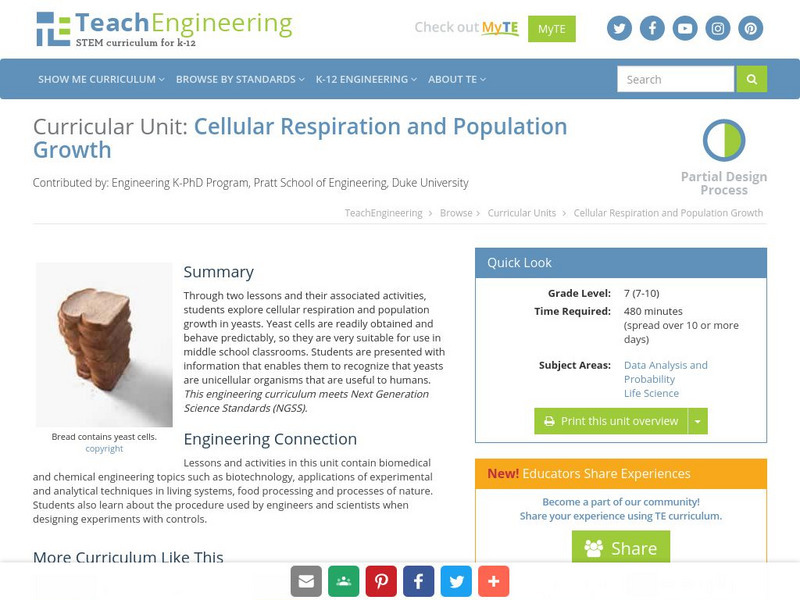
Teach Engineering: Cellular Respiration and Population Growth
Two lessons and their associated activities explore cellular respiration and population growth in yeasts. Yeast cells are readily obtained and behave predictably, so they are very appropriate to use in middle school classrooms. In the...
TeachEngineering
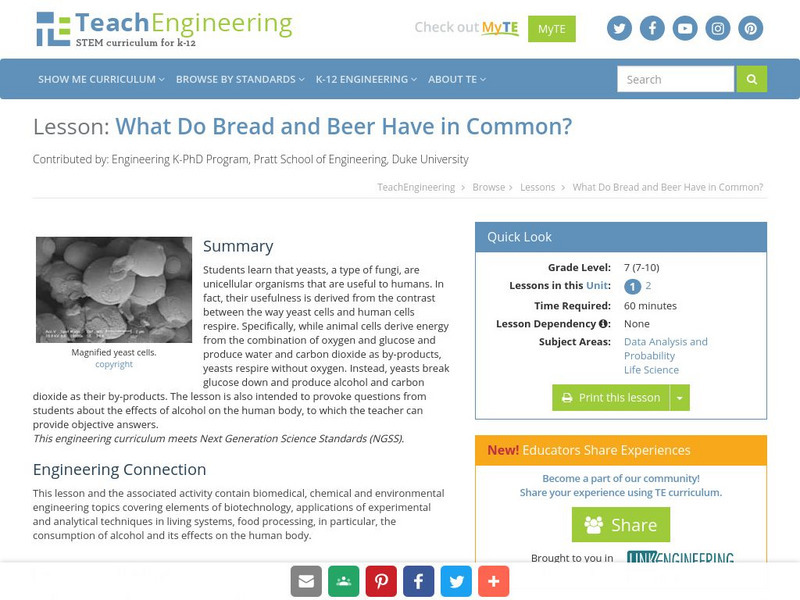
Teach Engineering: What Do Bread and Beer Have in Common?
Students are presented with information that will allow them to recognize that yeasts are unicellular organisms that are useful to humans. In fact, their usefulness is derived from the contrast between the way yeast cells and human cells...

Khan Academy
Khan Academy: Cell Cell Signaling in Unicellular Organisms
Article takes a look at how unicellular organisms "chat" with one another using chemical signals. It examines yeast mating types, bacterial quorum sensing, and biofilms.