Hi, what do you want to do?






Bozeman Science
Bioenergetics
Life requires energy, for without it, you will die! Learners watch a video to see how organisms use free energy, gain knowledge about Gibbs free energy, and observe how free energy plays a role in both photosynthesis and cellular...

Bozeman Science
Adenosine Triphosphate
In this second video, viewers learn the structure of ATP, then watch how our bodies use ATP to provide us with the energy we need at the cellular level. At the end, they learn how all organisms in life, even from the...

Bozeman Science
Anaerobic Respiration
Just when you thought you had a good grasp of aerobic respiration, in the presence of oxygen, you learn that respiration can occur without oxygen. What?! In the video, learners see how organisms, in the absence of oxygen, can survive...

Bozeman Science
What is Physics?
Name that physicist! In the video lesson, Mr. Andersen introduces scholars to the classical physicists that began the branch of science called physics. He also explains the different branches of physics and talks about how to use science...

Bozeman Science
Bozeman Science: Elementary Charge
Paul Andersen explains how electric charge is quantized and how the smallest unit of charge is 1.6x10^-19 C, or the elementary charge. [4:51]

Bozeman Science
Bozeman Science: Newton's Third Law
Paul Andersen explains how Newton's Third Law applies to all objects. [6:01]

Bozeman Science
Bozeman Science: The New Ap Biology Exam a Users Guide
In this video user guide, science teacher, Paul Andersen, describes the scoring and the two parts of the new AP Biology Exam which is different from all previous exams. [13:09]
Bozeman Science
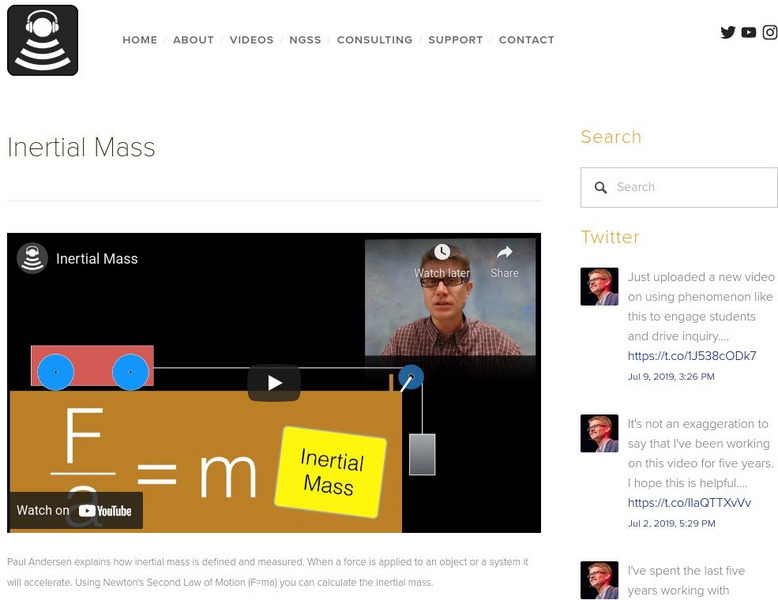
Bozeman Science: Inertial Mass
Paul Andersen explains how inertial mass is defined and measured in context of Newton's second law of motion. [4:30]
Bozeman Science
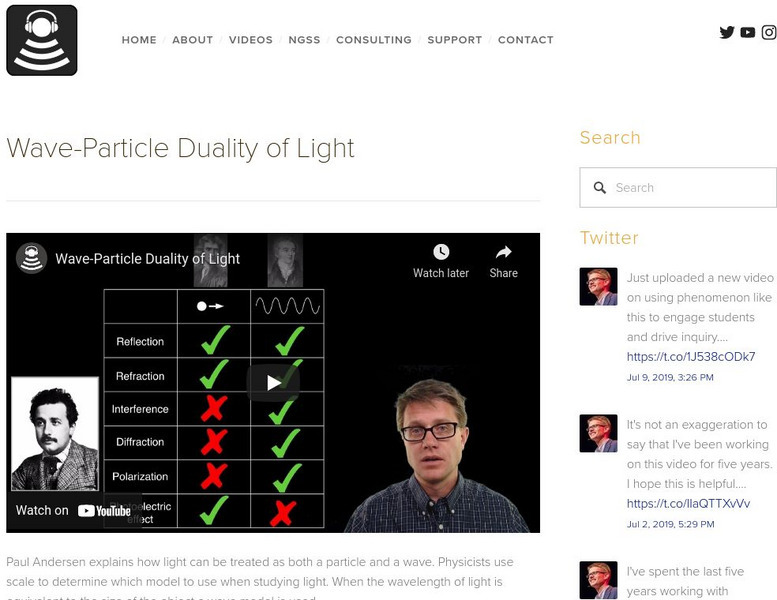
Bozeman Science: Wave Particle Duality of Light
In the following video Paul Andersen explains how light can be treated as both a particle and a wave. Physicists use scale to determine which model to use when studying light. When the wavelength of light is equivalent to the size of the...
Bozeman Science
Bozeman Science: Ps3 C Relationship Between Energy and Forces
In this video Paul Andersen describes the relationship between energy and forces. When objects are directly touching electromagnetic forces can result in forces and energy exchange. When objects are not directly touching fields;...
Bozeman Science
Bozeman Science: Natural Resources
In this video Paul Andersen explains how the resources required for survival come from the Earth. The resources are not evenly distributed on the planet and neither are the humans.

Bozeman Science
Bozeman Science: Ap Physics: Objects & Systems
Paul Andersen explains the differences between a system and an object as it relates to physics. [4:50]

Bozeman Science
Bozeman Science: Ap Physics: Objects
Find out how a system can be viewed as an object and an object can be viewed as a system. [4:10]
Bozeman Science
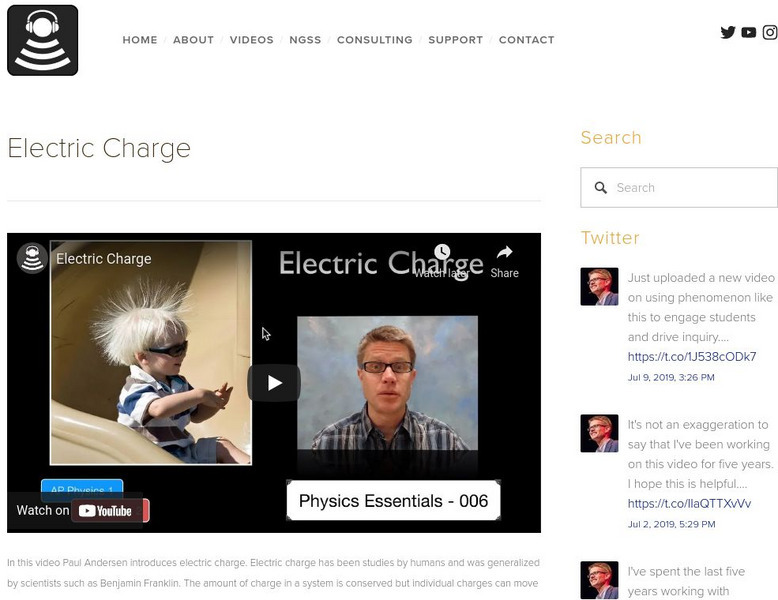
Bozeman Science: Ap Physics: Electric Charge
Paul Andersen introduces electric charges. The amount of charge in a system is conserved but individual charges can move through a conductor as current. [4:19]

Bozeman Science
Bozeman Science: Ap Physics: Positive & Negative Charge
Mr. Andersen illustrates and explains how all objects contain positive and negative charge. [5:24]

Bozeman Science
Bozeman Science: Gravitational Mass
Paul Andersen explains how the gravitational mass is a measure of the force on an object in a gravitational field. [6:02]
Bozeman Science
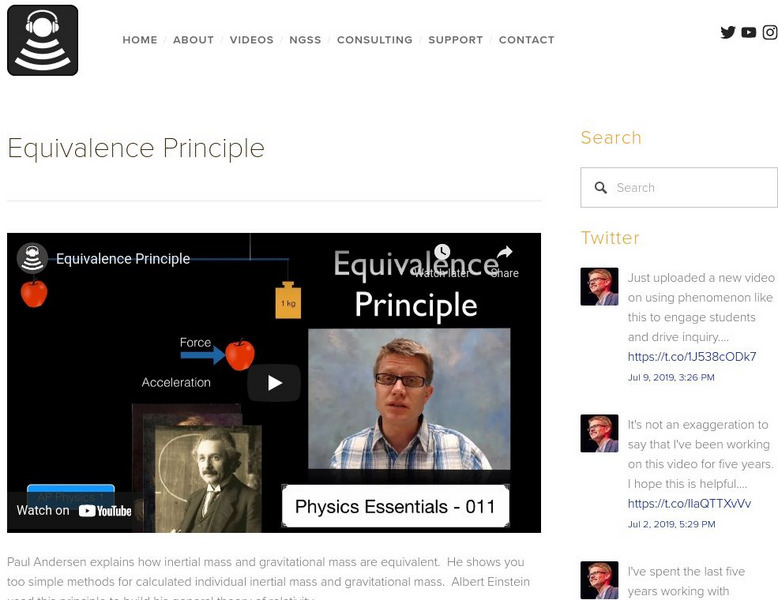
Bozeman Science: Equivalence Principle
Paul Andersen explains how inertial mass and gravitational mass are equivalent. [6:16]
Bozeman Science
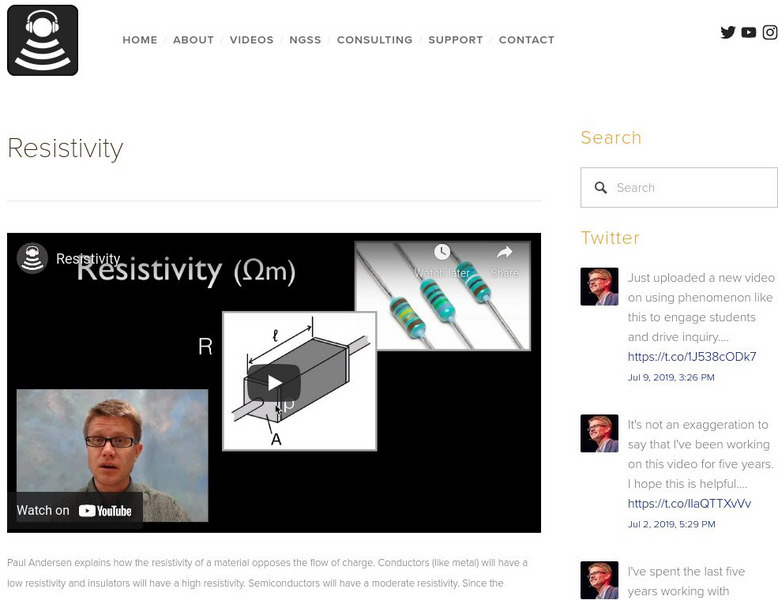
Bozeman Science: Resistivity
Paul Andersen explains how the resistivity of a material opposes the flow of charge. [4:22]
Bozeman Science
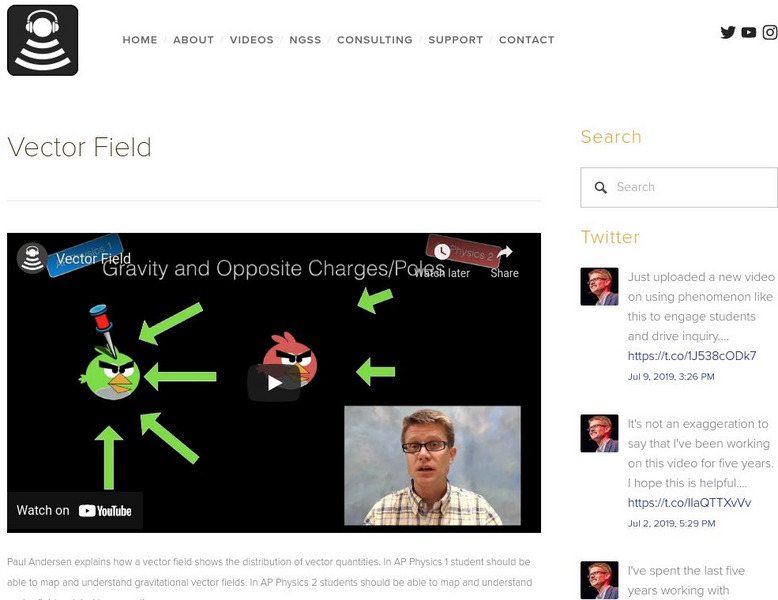
Bozeman Science: Vector Field
Paul Andersen explains how a vector field shows the distribution of vector quantities. [7:47]

Bozeman Science
Bozeman Science: Gravitational Force
Paul Andersen explains how an object with mass placed in a gravitational field experiences a gravitational force. [5:01]
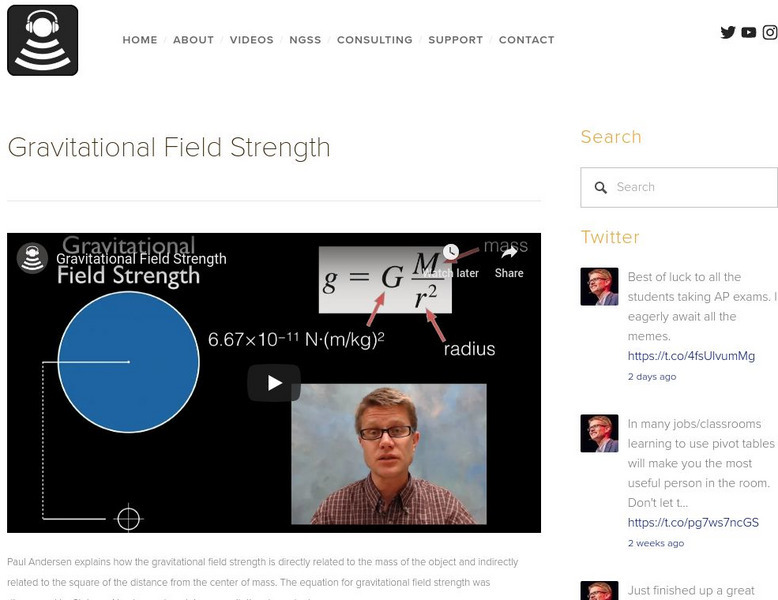
Bozeman Science
Bozeman Science: Gravitational Field Strength
Find out how the gravitational field strength is directly related to the mass of the object and indirectly related to the square of the distance from the center of mass. [5:38]

Bozeman Science
Bozeman Science: Motion
Mr. Andersen describes motion as the movement of an object over time. An experiment in motion is used to calculate velocity and acceleration of a tennis ball. [8:46]

Bozeman Science
Bozeman Science: Forces
A video reviewing over how forces are pushes or pulls on an object. Learn how forces can be determined by measuring the motion of an object. Also, how an objects acceleration can show that a force is present. [5:47]

Bozeman Science
Bozeman Science: Interaction Forces
Mr. Anderson illustrates the concept that forces on an object always require another object, and that an object cannot exert a force on itself. If net forces on an object are balanced the object will remain at rest or move with a...