Lesson Planet
Search educational resources
  • Sign In Try It Free
  • AI Teacher Tools
    • Discover Resources Search reviewed educational resources by keyword, subject, grade, type, and more
    • Curriculum Manager (My Content) Manage saved and uploaded resources and folders To Access the Curriculum Manager Sign In or Join Now
    • Browse Resource Directory Browse educational resources by subject and topic
    • Curriculum Calendar Explore curriculum resources by date
    • Lesson Planning Articles Timely and inspiring teaching ideas that you can apply in your classroom
    • Our Story
    • Frequently Asked Questions
    • Testimonials
    • Contact Us
  • Pricing
  • School Access
    • Your school or district can sign up for Lesson Planet — with no cost to teachers
      Learn More
  • Sign In
  • Try It Free

Hi, what do you want to do?

Create a lesson plan
Generate resources with 80+ AI teacher tools
Search 200,000 instructional videos
Find a teaching resource
Ck 12: Ionic Bonds and Ionic Compounds Unit PlanCk 12: Ionic Bonds and Ionic Compounds Unit Plan
Publisher
CK-12 Foundation
Resource Details
Curator Rating
Educator Rating
Not yet Rated
Grade
9th - 10th
Subjects
Science
2 more...
Resource Type
Unit Plans
Audiences
For Administrator Use
2 more...
Lexile Measures
0L
Unit Plan

Ck 12: Ionic Bonds and Ionic Compounds

Curated by ACT

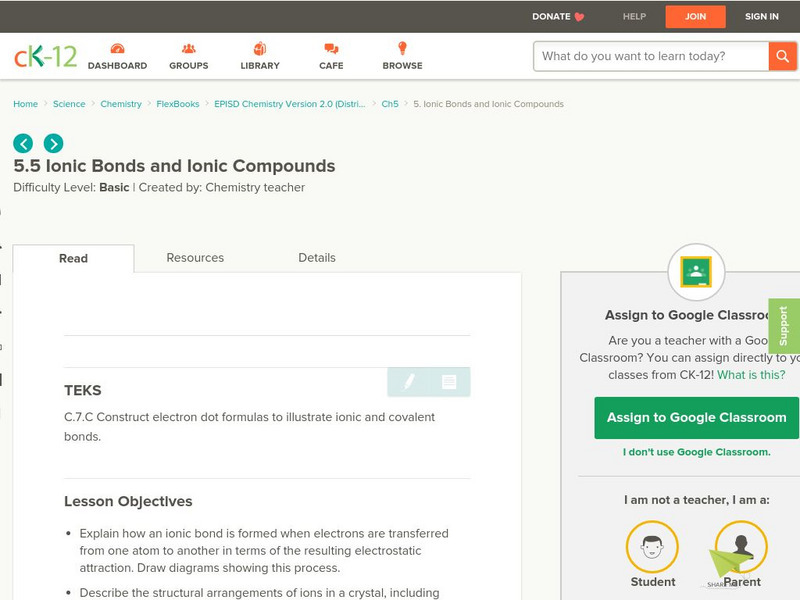
[Free Registration/Login may be required to access all resource tools.] In the following online tutorial students will learn to explain how an ionic bond is formed when electrons are transferred from one atom to another in terms of the resulting electrostatic attraction. They will draw diagrams showing this process and describe the structural arrangements of ions in a crystal, including coordination number and its relationship to a given compound's formula unit. Students will also explain how various physical properties result from the ionic crystal lattice, such as strength, hardness, high melting points, brittleness, and electrical conductivity.

3 Views 1 Download

Concepts

brittleness, hardness, ionic bonds

Additional Tags

coordination number, electrical conductivity, electrostatic attraction, formula unit, high melting point, ck-12 episd, ionic bonds and ionic compounds, ionic crystal lattice, ions in a crystal, strength

Classroom Considerations

  • Knovation Readability Score: 3 (1 low difficulty, 5 high difficulty)

See similar resources:

Worksheet

Review of Ionic and Covalent Compounds and Transitioning from Ionic to Covalent Compounds

Curated OER
Here is a unique assigment: compare and contrast ionic and covalent compounds in an extensive data table and then analyze Lewis dot structures in antoher. Three columns are to befilled in: "characteristic or feature," "applies to ionic...
9th - 12th Science
PPT

The Ionic Bond

Curated OER
An introduction to the noble gases shows how full electron shells on an atom makes an element unreactive. Your class will then develop an understanding of how sodium and chlorine react ideally because of their electron arrangement....
7th - 12th Science
Instructional Video

Ionic Bond and Ionic Compounds

Teacher's Pet
It's true! Opposites do attract! A straightforward video lesson explains the basics of ionic bonding. Using visual models, the instructor describes the repeating patterns in an ionic compound. She also explains how a formula unit simply...
2 mins 9th - 12th Science
CCSS: Adaptable
Instructional Video

Aromatics and Cyclic Compounds

Crash Course
Why can we smell aromatic and cyclic compounds and why they are in rings instead of lines? Viewers learn about organic compounds, resonance, naming standards for aromatic compounds, common chemical reactions, and the many uses...
10 mins 9th - 12th Science
Instructional Video

Ionic Bonding of Calcium Chloride, Lithium Fluoride and Potassium Oxide

Fuse School
How do you know when an ionic bond requires two ions or if it needs more? The fifth video in the six-part series explains this concept. The video uses multiple examples using diagrams of valence electrons. 
3 mins 9th - 12th Science
CCSS: Adaptable
Unit Plan

Ck 12: Ionic Bonds and Ionic Compounds

CK-12 Foundation
[Free Registration/Login may be required to access all resource tools.] Students will understand the general properties that distinguish ionic compounds from other substances, and predict which elements are likely to form ionic compounds...
9th - 10th Science
Unit Plan

Ck 12: Ionic Compounds

CK-12 Foundation
[Free Registration/Login may be required to access all resource tools.] Students investigate ionic compounds, and learn how to write chemical formulas for them.
9th - 10th Science
Unit Plan

Ck 12: Metallic Bonds

CK-12 Foundation
[Free Registration/Login may be required to access all resource tools.] In the following online tutorial, students will begin to describe the electron-sea model of metallic bonding. They will explain how metallic bonding is responsible...
9th - 10th Science
Unit Plan

Ck 12: Ionic Compounds

CK-12 Foundation
[Free Registration/Login may be required to access all resource tools.] In the following online tutorial students will name ionic compounds containing main group or transition metals, covalent compounds, acids, and bases, using...
9th - 10th Science
Interactive

Chemical Bonds: Covalent and Ionic Bonding

CK-12 Foundation
Get back to bonding basics. Science scholars get a chance to show what they know using a simple interactive. Pupils create models of covalent and ionic bonds before answering questions about each interaction. The resource includes a...
6th - 12th Science
Try It Free
© 1999-2026 Learning Explorer, Inc.
Teacher Lesson Plans, Worksheets and Resources

Sign up for the Lesson Planet Monthly Newsletter

Open Educational Resources (OER)

  • Health
  • Language Arts
  • Languages
  • Math
  • Physical Education
  • Science
  • Social Studies
  • Special Education
  • Visual and Performing Arts
View All Lesson Plans

Discover Resources

  • Our Review Process
  • How it Works
  • How to Search
  • Create a Collection

Manage Curriculum

  • Edit a Collection
  • Assign to Students
  • Manage My Content
Contact Us Site Map Privacy Policy Terms of Use