Lesson Planet
Search educational resources
  • Sign In Try It Free
  • AI Teacher Tools
    • Discover Resources Search reviewed educational resources by keyword, subject, grade, type, and more
    • Curriculum Manager (My Content) Manage saved and uploaded resources and folders To Access the Curriculum Manager Sign In or Join Now
    • Browse Resource Directory Browse educational resources by subject and topic
    • Curriculum Calendar Explore curriculum resources by date
    • Lesson Planning Articles Timely and inspiring teaching ideas that you can apply in your classroom
    • Our Story
    • Frequently Asked Questions
    • Testimonials
    • Contact Us
  • Pricing
  • School Access
    • Your school or district can sign up for Lesson Planet — with no cost to teachers
      Learn More
  • Sign In
  • Try It Free

Hi, what do you want to do?

Create a lesson plan
Generate resources with 80+ AI teacher tools
Search 200,000 instructional videos
Find a teaching resource
Concord Consortium: Measuring Current in Parallel Circuits eBookConcord Consortium: Measuring Current in Parallel Circuits eBook
Publisher
Concord Consortium
Resource Details
Curator Rating
Educator Rating
Not yet Rated
Grade
9th - 10th
Subjects
Science
2 more...
Resource Type
eBooks
Audiences
For Administrator Use
2 more...
Lexile Measures
1270L
eBook

Concord Consortium: Measuring Current in Parallel Circuits

Curated by ACT

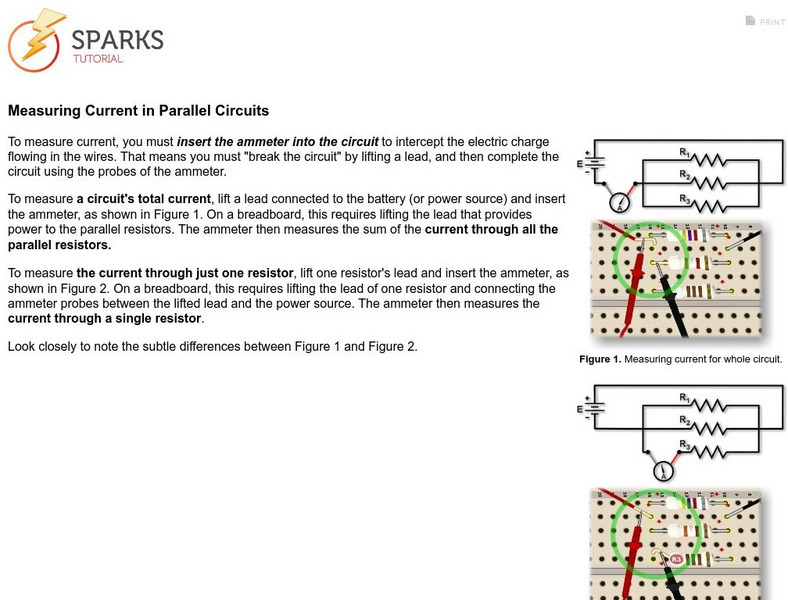
When measuring the current in parallel circuits, compare the circuit's total current with the current through just one resistor.

3 Views 0 Downloads

Additional Tags

electrical current, sparks tutorial, resistor, measuring resistance

Classroom Considerations

  • Knovation Readability Score: 4 (1 low difficulty, 5 high difficulty)
  • The intended use for this resource is Instructional
  • This resource is only available on an unencrypted HTTP website.It should be fine for general use, but don’t use it to share any personally identifiable information

See similar resources:

eBook

Concord Consortium: Calculating Current in Parallel Circuits

Concord Consortium
Use Ohm's Law to calculate the current in parallel circuits.
9th - 10th Science
eBook

Concord Consortium: Measuring Current in Series Parallel Circuits

Concord Consortium
Measure current through resistances in series-parallel circuits requires current-measuring skills used in both series and parallel circuits.
9th - 10th Science
eBook

Concord Consortium: Measuring Voltage in Series Circuits

Concord Consortium
Measuring the voltage in a circuit is like measuring the drop in pressure across two points. Learn more with this tutorial.
9th - 10th Science
eBook

Concord Consortium: Measuring Phase in Ac Circuits

Concord Consortium
See how oscillations in an AC circuit don't always rise and fall together.
9th - 10th Science
eBook

Concord Consortium: Measuring Current on a Breadboard

Concord Consortium
Find out how measuring current in a circuit is like measuring the flow rate of water in a sprinkler system.
9th - 10th Science
eBook

Concord Consortium: Measuring Voltage in Ac Circuits

Concord Consortium
There are three different measures of AC voltage. Here, consider the peak voltage to measure it.
9th - 10th Science
eBook

Concord Consortium: Measuring Voltage in Series Parallel Circuits

Concord Consortium
Measuring voltage drops across resistances in series-parallel circuits requires an understanding of both series and parallel circuit behavior. Learn more with this tutorial.
9th - 10th Science
Interactive

Parallel Circuits - ∆V = I•R Calculations

Physics Classroom
Parallel circuits often provide less of a challenge for teens than parallel parking. An installment of a series on parallel electric circuits requires learners to solve increasingly difficult  levels of calculations. Each level...
9th - 12th Science
CCSS: Adaptable
eBook

Concord Consortium: Calculating Current in Series Parallel Circuits

Concord Consortium
Use resistance formulas to determine the total resistances of the series and parallel parts. Then, use Ohm's Law to calculate the voltage drops across and currents through each part.
9th - 10th Science
eBook

Concord Consortium: Calculating Voltage in Series Circuits

Concord Consortium
See how Ohm's Law can tell us that the voltage across resistors will depend on that current value I and each R-value.
9th - 10th Science
Try It Free
© 1999-2026 Learning Explorer, Inc.
Teacher Lesson Plans, Worksheets and Resources

Sign up for the Lesson Planet Monthly Newsletter

Open Educational Resources (OER)

  • Health
  • Language Arts
  • Languages
  • Math
  • Physical Education
  • Science
  • Social Studies
  • Special Education
  • Visual and Performing Arts
View All Lesson Plans

Discover Resources

  • Our Review Process
  • How it Works
  • How to Search
  • Create a Collection

Manage Curriculum

  • Edit a Collection
  • Assign to Students
  • Manage My Content
Contact Us Site Map Privacy Policy Terms of Use