



Lesson Planet
Search educational resources
  • Sign In Try It Free
  • AI Teacher Tools
    • Discover Resources Search reviewed educational resources by keyword, subject, grade, type, and more
    • Curriculum Manager (My Content) Manage saved and uploaded resources and folders To Access the Curriculum Manager Sign In or Join Now
    • Browse Resource Directory Browse educational resources by subject and topic
    • Curriculum Calendar Explore curriculum resources by date
    • Lesson Planning Articles Timely and inspiring teaching ideas that you can apply in your classroom
    • Our Story
    • Frequently Asked Questions
    • Testimonials
    • Contact Us
  • Pricing
  • School Access
    • Your school or district can sign up for Lesson Planet — with no cost to teachers
      Learn More
  • Sign In
  • Try It Free

Hi, what do you want to do?

Create a lesson plan
Generate resources with 80+ AI teacher tools
Search 200,000 instructional videos
Find a teaching resource
Teach Engineering: Graphing Your Social Network ActivityTeach Engineering: Graphing Your Social Network Activity
Publisher
TeachEngineering
Curator Rating
Educator Rating
Not yet Rated
Activity

Teach Engineering: Graphing Your Social Network

Curated by ACT

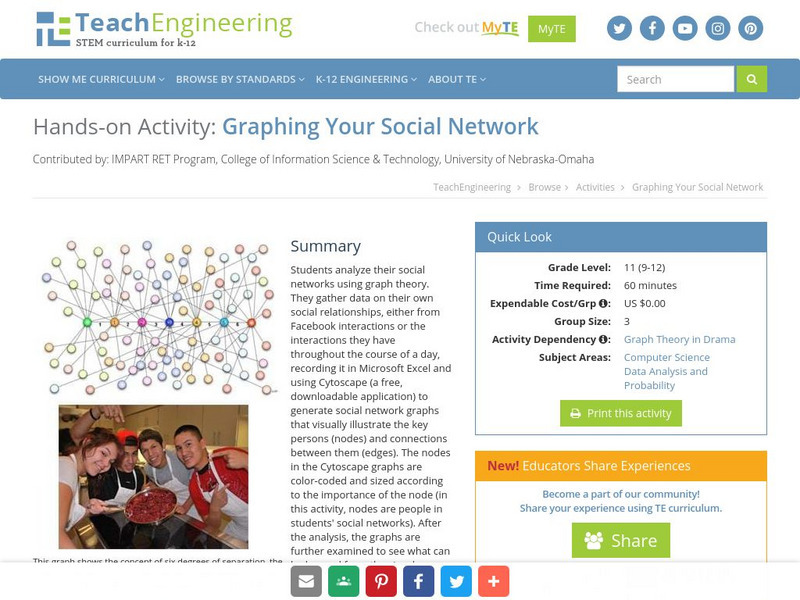
Students analyze their social networks using graph theory. They gather data on their own social relationships, either from Facebook interactions or the interactions they have throughout the course of a day, recording it in Microsoft Excel and using Cytoscape (a free, downloadable application) to generate social network graphs that visually illustrate the key persons (nodes) and connections between them (edges). The nodes in the Cytoscape graphs are color-coded and sized according to the importance of the node (in this activity, nodes are people in students' social networks). After the analysis, the graphs are further examined to see what can be learned from the visual representation. Students gain practice with graph theory vocabulary, including node, edge, betweeness centrality and degree on interaction, and learn about a range of engineering applications of graph theory.

3 Views 0 Downloads
Concepts

electrical engineering, graph theory, facebook, stem, graphs

Additional Tags

mapping, social graph, software engineering, integrated teaching and learning program and laboratory, teachengineering, graph
Show More Show Less

Resource Details

Grade
9th - 10th
Subjects
Science
2 more...
Resource Type
Activities & Projects
Audiences
For Administrator Use
1 more...
Lexile Measures
0L

See similar resources:

Lesson Plan

Teach Engineering: Graph Theory in Drama

TeachEngineering
Students use graph theory to create social graphs for their own social networks and apply what learn to create a graph representing the social dynamics found in a dramatic text. Students then derive meaning based on what they know about...
9th - 10th Science
Activity

Start Networking!

Teach Engineering
Class members create their own social networks by collecting signatures before graphing the interactions with their fellow classmates. The degree distribution of the simulated social network is determined by calculating the degree of...
7th - 10th Science
CCSS: Designed
Unit Plan

Teach Engineering: It's a Connected World: The Beauty of Network Science

TeachEngineering
Students learn about complex networks and how to use graphs to represent them. They also learn that graph theory is a useful part of mathematics for studying complex networks in diverse applications of science and engineering, including...
9th - 10th Science
Lesson Plan

Teach Engineering: Processes on Complex Networks

TeachEngineering
Building on their understanding of graphs, young scholars are introduced to random processes on networks. They walk through an illustrative example to see how a random process can be used to represent the spread of an infectious disease,...
9th - 10th Science
Activity

Teach Engineering: Graphing the Spread of Disease

TeachEngineering
Students simulate disease transmission by collecting data based on their proximity to other students. One option for measuring proximity is by having Bluetooth devices "discover" each other. After data is collected, students apply graph...
9th - 10th Science
Activity

Teach Engineering: If You're Not Part of the Solution!

TeachEngineering
Students continue the research begun in the associated lesson as if they were biomedical engineers working for a pharmaceutical company. Groups each perform a simple chemical reaction (to precipitate solid calcium out of solution) to...
9th - 10th STEM
Activity

Teach Engineering: Grow Your Own Algae!

TeachEngineering
Students discover how tiny microscopic plants can remove nutrients from polluted water. They also learn how to engineer a system to remove pollutants faster and faster by changing the environment for the algae.
9th - 10th STEM
Activity

Teach Engineering: State Your Position

TeachEngineering
To navigate, you must know roughly where you stand relative to your designation, so you can head in the right direction. In locations where landmarks are not available to help navigate (in deserts, on seas), objects in the sky are the...
6th - 9th Science
Activity

Teach Engineering: Start Networking!

TeachEngineering
To get a better understanding of complex networks, students create their own, real social network example by interacting with their peers in the classroom and documenting the interactions. They represent the interaction data as a graph,...
9th - 10th STEM
Instructional Video

LS2D - Social Interactions and Group Behavior

Bozeman Science
Humans aren't the only ones with social networking skills! Examine a fascinating video resource focused on standard LS2D of the Next Generation Science Standards. The narrator guides you through the organization within groups, the...
5 mins 3rd - 12th Science
Try It Free
© 1999-2026 Learning Explorer, Inc.
Teacher Lesson Plans, Worksheets and Resources

Sign up for the Lesson Planet Monthly Newsletter

Open Educational Resources (OER)

  • Health
  • Language Arts
  • Languages
  • Math
  • Physical Education
  • Science
  • Social Studies
  • Special Education
  • Visual and Performing Arts
View All Lesson Plans

Discover Resources

  • Our Review Process
  • How it Works
  • How to Search
  • Create a Collection

Manage Curriculum

  • Edit a Collection
  • Assign to Students
  • Manage My Content
Contact Us Site Map Privacy Policy Terms of Use