Hi, what do you want to do?






Science Friday
Fossil Detectives
What can this rock be? Pupils pretend to be paleontologists by sketching fossils and making predictions about their types. To determine whether they can identify the type of dinosaur, class members compare their observations and...

Howard Hughes Medical Institute
Deep History of Life on Earth
Take it all the way back! Young scientists discover the changes that took place from the time Earth became solid to present day through an interesting interactive. The resource guides users through key events that have shaped our world...

American Museum of Natural History
Layer of Time
Dig through the layers for a better understanding of fossils. Scholars learn that fossils form in layers of sedimentary rock. Pupils arrange virtual layers to show the fossil record of different species. Once the layers are correct, they...

American Museum of Natural History
Anatomy Adventure
Sometimes science is puzzling. Using an online animation, individuals manipulate skeletal bones of an ancient species to recreate its skeleton. Learners complete the skeletal puzzle and learn about the process of paleontology in person...

American Museum of Natural History
What Do You Know About PaleontOLogy?
Believe it or not, some dinosaurs are not extinct. Discover this and other interesting facts about dinosaurs in a 10-question online quiz. As individuals answer questions, the resource provides them with feedback and additional facts...

American Museum of Natural History
Climate Change
It actually is possible to have too much of a good thing when it comes to climate change. A slide show lesson describes how burning fossil fuels contributes to climate change. Individuals read about the scientific process and the...

American Museum of Natural History
Extreme Mammals
Extreme characteristics can create some unusual mammals. Learners flip through a slide show of some of the most interesting mammals that are both living and extinct. Implement as a remote learning resource or use in-class to review...

American Museum of Natural History
A Whale of a Tale
What's the most interesting fact about a blue whale? Learners read an interview about the similarities between the Titanosaur and the blue whale displays at the American Museum of Natural History. Pupils learn not only about blue whales...

Curated OER
Ecosystems - Lessons 1 and 3
In this biology activity, students answer 22 multiple choice questions on ecosystem. They identify which ecosystem component is described in each of the question.

Curated OER
Math in Science-Radioactive Decay and Half-Life
In this radioactive decay and half-life instructional activity, students use given half-lifes to calculate the amount of time it will take for certain amounts of elements to decay. They also find the age of samples and determine how many...

Global Oneness Project
Deconstructing Consumerism
To increase awareness and launch a discussion of consumerism, class members view What Would It Look Like, a 25 minute film of images that capture the global effects of the consumption of goods. Viewers make a list of the images that...
CK-12 Foundation
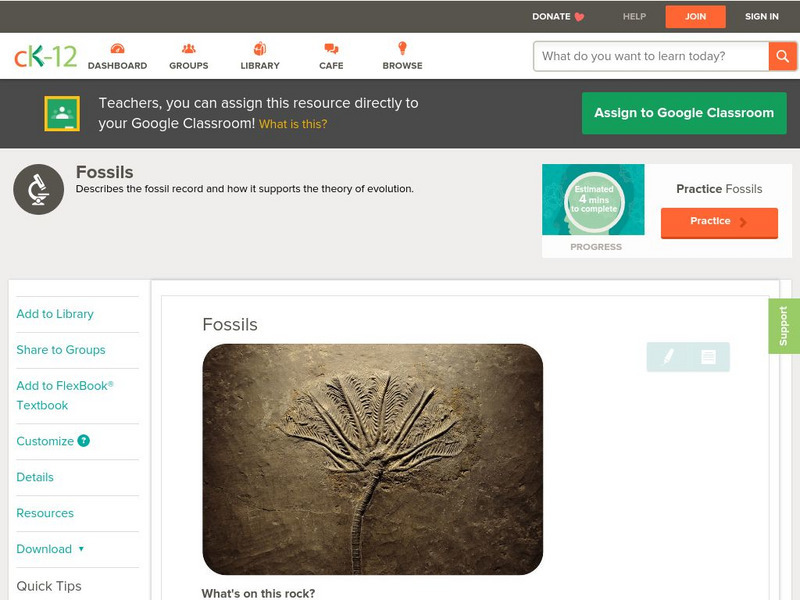
Ck 12: Life Science: Fossils
[Free Registration/Login may be required to access all resource tools.] Fossils are the preserved remains of animals, plants, and other organisms from the distant past. By studying fossils, evidence for evolution is revealed....

CK-12 Foundation
Ck 12: Life Science: 4.4 Fossils
Understand fossils and the fossil record as it relates to Earth's history.
CK-12 Foundation
Ck 12: Life Science: 12.34 Mass Extinction
Discover how mass extinctions play a part in Earth's life history.
CK-12 Foundation
Ck 12: Life Science: 12.30 Nonrenewable Resources
Learn about nonrenewable resources and energy, specifically nuclear power.
CK-12 Foundation
Ck 12: Life Science: 12.22 Carbon Cycle
Understand the role that the carbon cycle plays in the ecosystem.
CK-12 Foundation
Ck 12: Life Science: 12.24 Air Pollution
Learn about some sources of outdoor air pollution.
CK-12 Foundation
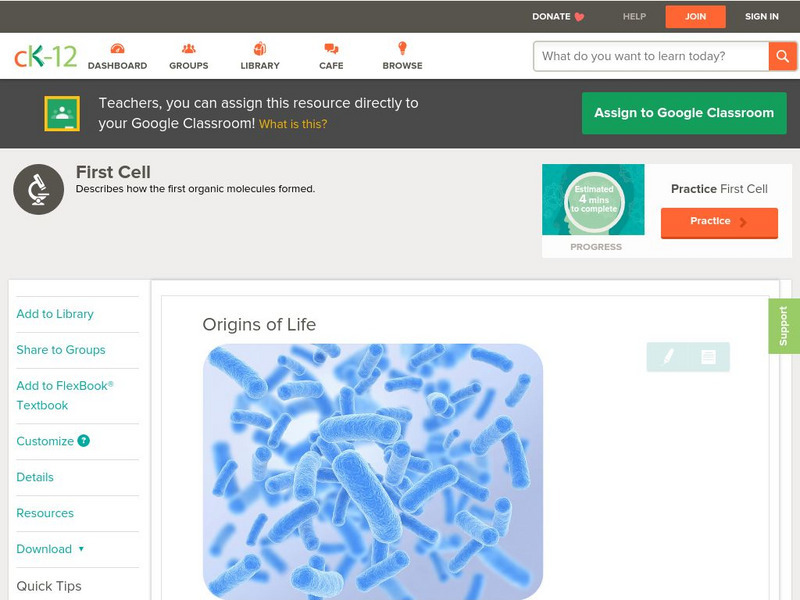
Ck 12: Life Science: Origins of Life
[Free Registration/Login may be required to access all resource tools.] There is good evidence that life has probably existed on Earth for most of Earth's history. Fossils of blue-green algae found in Australia are the oldest fossils of...
CK-12 Foundation
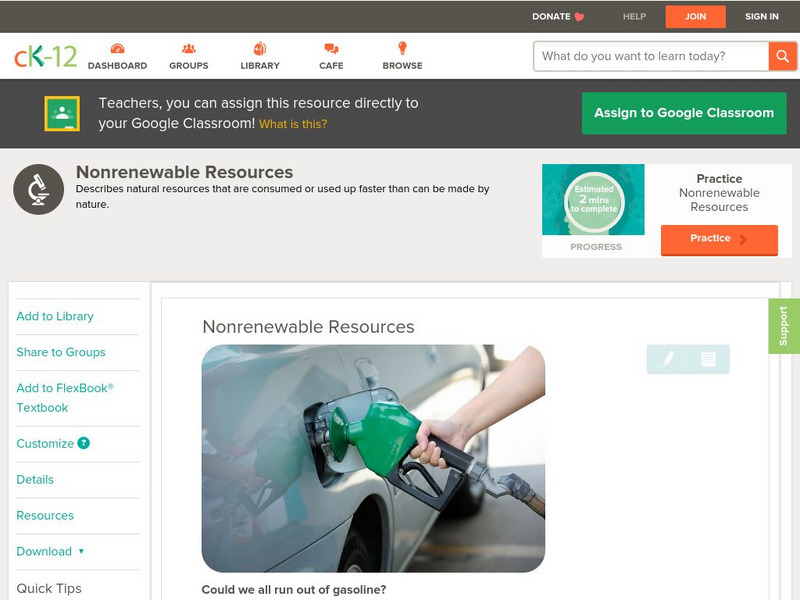
Ck 12: Life Science: Nonrenewable Resources
[Free Registration/Login may be required to access all resource tools.] A nonrenewable resource is a natural resource that is consumed or used up faster than it can be made by nature. Two main types of nonrenewable resources are fossil...
CK-12 Foundation
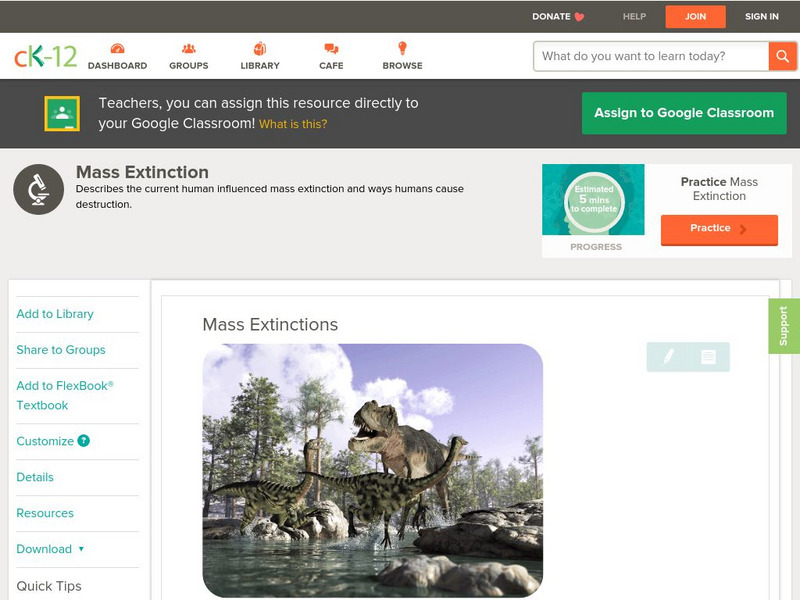
Ck 12: Life Science: Mass Extinctions
[Free Registration/Login may be required to access all resource tools.] An organism goes extinct when all of the members of a species die out and no more members remain. Extinctions are part of natural selection. Species often go extinct...
TED Talks
Ted: Ted Ed: How Life Begins in the Deep Ocean
Educator, Tierney Thys, relates the story of a sea urchin's different phases of development while revealing a beautiful tale of fertilization, development and growth in the deep ocean. [6:02]