Hi, what do you want to do?






Reading Rockets
Reading Rockets: 103 Things to Do Before/during/after Reading
The highly-respected Reading Rockets program offers both teachers and students a toolkit of ways to connect more actively with the materials they read. Some of these techniques are specifically for fiction-reading, others are designed...
ReadWriteThink
Read Write Think: Demonstrating Comprehension Through Journal Writing
Contains plans for lessons that ask students to write journal entries about texts they have read by responding to open-ended questions. The book "Mr. Popper's Penguins" by Richard Atwater is used as an example. In addition to objectives...
AdLit
Ad lit.org: Classroom Strategies: Double Entry Journals
The Double-Entry Journal strategy enables students to record their responses to text as they read. Students write down phrases or sentences from their assigned reading and then write their own reaction to that passage. The purpose of...
ReadWriteThink
Read Write Think: Have Journal Will Travel: Promoting Family Involvement in Litera
Students build positive memories of literacy activities when they take turns taking home a book bag stuffed with items to encourage literacy interactions with their families.
ReadWriteThink
Read Write Think: Literature Circles With Primary Students, Self Selected Reading
Students respond to self-selected books in journals and talk about their books daily in small groups. The teacher guides students by offering suggestions and writing with them in dialogue journals.
![Federal Reserve Bank of New York: Econ Explorers Journal [Pdf] Lesson Plan](https://static.lp.lexp.cloud/images/attachment_defaults/resource/large/FPO-knovation.png "Federal Reserve Bank of New York: Econ Explorers Journal [Pdf] Lesson Plan")
Other
Federal Reserve Bank of New York: Econ Explorers Journal [Pdf]
In this collection of lesson activities, students will complete an "Econ Explorers Journal" to help them learn how economics is involved in their neighborhood, the books they read, in earning a living, at their banks, in their homes, and...
ReadWriteThink
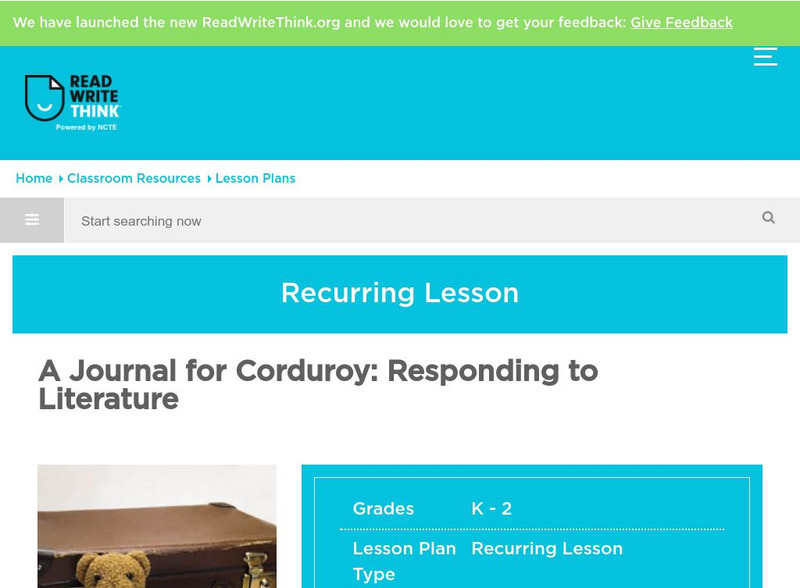
Read Write Think: Corduroy Lesson Plan
This ReadWriteThink lesson features an opportunity for students to respond to literature through writing journals about "Corduroy," by Don Freeman. This idea could be used with other books as well.
ReadWriteThink
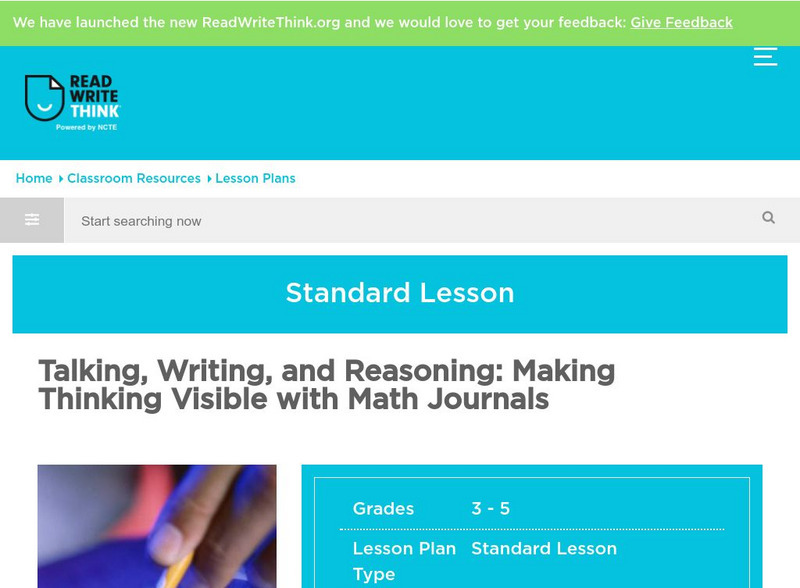
Read Write Think: Making Thinking Visible With Math Journals
Contains plans for three lessons that ask students to write Math Journals of their thinking processes while solving problems. In addition to objectives and standards, this instructional plan contains links to sites used in the lessons as...
THEJournal
The Journal: Making Sense of Nclb
A series of links to articles originally published as a supplement to THE Journal on the No Child Left Behind Legislation (NCLB). These articles focus on the four key areas of accountabilhnology products that meet NCLB requirements.ity,...

Alabama Learning Exchange
Alex: Reading, Writing, and Sounder
The activities included in this lesson plan require the reading of William Armstrong's Sounder. This technology-based lesson fosters critical thinking and includes journal writing, student-led discussions with another class via video...
Other
Big Life Journal: How to Teach Problem Solving Skills to Kids (Ages 3 14)
How you teach problem-solving to kids depends on their age. Read on to learn key strategies for teaching problem-solving to kids, as well as some age-by-age ideas and activities.
ReadWriteThink
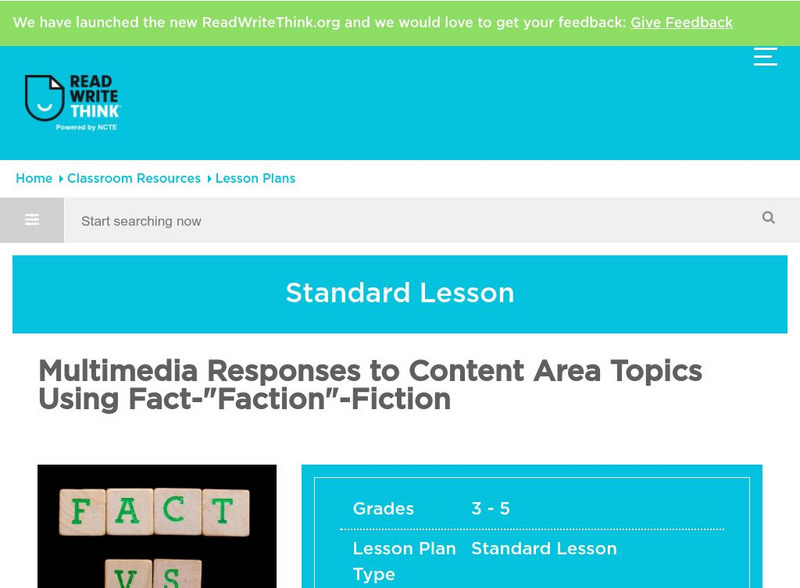
Read Write Think: Did You Say Spiders?
Contains plans for six thirty-minute lessons that ask students to make response journals and multimedia projects about spiders. In addition to objectives and standards, this instructional plan contains links to PDF handouts and sites...
Books in the Classroom
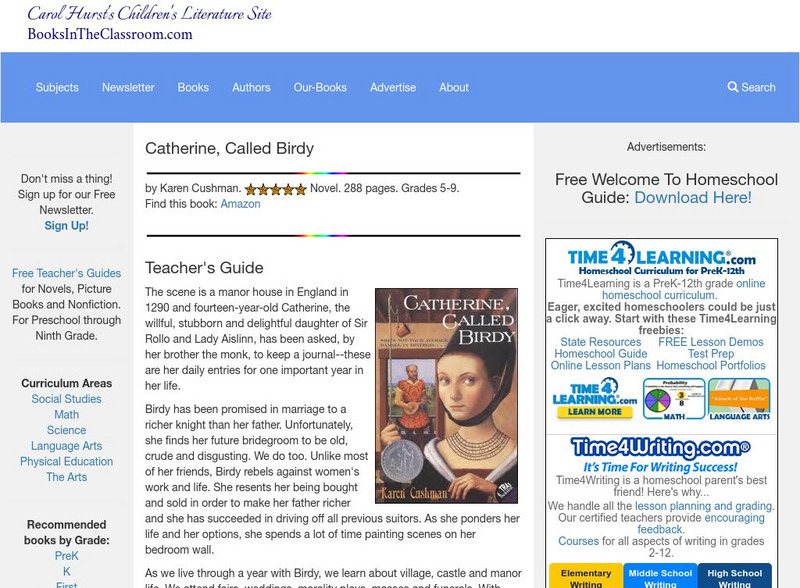
Carol Hurst's Children's Literature Site: Catherine, Called Birdy
Cross-curricular online resource on the book "Catherine Called Birdy," by Karen Cushman. Includes discussion questions and engaging learning activities.
Other
Literature Circles: Lesson Plans and More
What are the major roles in literature circles? Check out this site to learn more about the individual roles needed to form a literature circle. Includes links to various reading handouts and lessons.
Education Development Center
Making Mathematics: Mathematics Research Teacher Handbook: Getting Information
Information for teachers on teaching students how to research and write on mathematical topics. Includes tips for active reading, researching online and journal sources, and conducting interviews to gather information.
TESL Journal
Activities for Esl Students: Grammar Quizzes
This site from The Internet TESL Journal is developed for students for whom English is a Second Language (ESL). This is packed full of helpful quizzes covering all aspects of English grammar, from articles to sentence structure to word...

ReadWriteThink
Read Write Think: Bright Morning
Use this lesson to delve into the exploration of character development in fiction through the novel "Bright Morning," by Scott O'Dell.
Wisconsin Response to Intervention Center
Wisconsin Rt I Center: Writing to Learn [Pdf]
Teachers will learn how to use Writing to Learn as a formative assessment tool. Teachers will learn how to implement the strategy, measure progress, and find research to support writing to learn. A list of Writing to Learn activities is...

ClassFlow
Class Flow: Comprehension and Vocabulary Henry and Mudge and the Starry Night
[Free Registration/Login Required] This flipchart is correlated to Houghton Mifflin Reading, Grade 2 and is a guideline for comprehension and vocabulary for Henry and Mudge and the Starry Night by Cynthia Rylant. Interactive vocabulary...
Other
Teachers Network: Writing a Short Story Based on Kindred
In this lesson plan, students will engage in the technology, social studies, and language arts standards as students engage in reading by Octavia Butler's book entitled Kindred. Students will research tslavery. Students will keep a...
Scholastic
Scholastic Instructor: Not So Scary Storybook October
Great list of ideas for creating a storybook about the month of October.
Scholastic
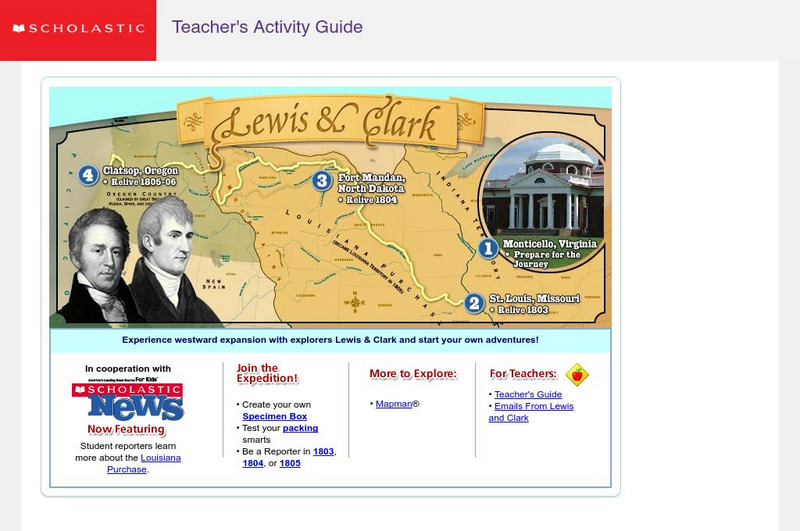
Scholastic: Lewis and Clark
An interactive site that has students follow the Lewis and Clark's expedition. As they travel west, they are able to collect objects on their journey and put them in their specimen box. They also take notes on their specimens so they can...
TeachEngineering
Teach Engineering: Blackout!
Students read news reports and first-person accounts to imagine what it would be like to be in a blackout in a large city. They follow news reports as if the event were unfolding in real-time and keep weblogs or journals of their...
Science Education Resource Center at Carleton College
Serc: Investigating Motion: What Causes Objects to Move?
Students will have an opportunity to determine what makes everyday objects move. Students will be given objects and asked to make predictions on how far each object will move after they blow on it. Then they will measure the distance and...