Hi, what do you want to do?






New York State Education Department
TASC Transition Curriculum: Workshop 4
Why is it important to use precise language? Participants explore this question in the fourth activity in a series of 15 on effective instruction. Perfect for all content areas, the activity promotes appropriate language choice through...

New York State Education Department
TASC Transition Curriculum: Workshop 11
You'll C-E-R a difference in classroom achievement after using a helpful activity. Designed for economics, civics, government, and US history classes, participants practice using the CER model to craft arguments about primary and...

EngageNY
TASC Transition Curriculum: Workshop 15
What do a cheetah, Audi commercial, and air have in common? They're all topics of an engaging inquiry-based, hands-on workshop for educators about background knowledge, reading strategies, the CER model, and argumentative writing. The...

EngageNY
TASC Transition Curriculum: Workshop 6
Is a college education necessary for success in today's world? The class investigates the question, along with others at the end of the sixth workshop in a 15-part series. The lesson has four parts with multiple activities and...

Transforming Education
Self-Efficacy Strategies
Scholars with high levels of self-efficacy perform better in school. Instructors review a list of strategies for enhancing self-efficacy skills. They discover how to teach learners to appropriately define success, celebrate progress, and...

New York State Education Department
TASC Transition Curriculum: Workshop 10
How have educational standards evolved? Educators of adults examine expectations in the 10th workshop out of 15 to better determine how standards have grown. Participants respond to a variety of sample questions to determine how they...

Transforming Education
Self-Management Strategies
What self-management techniques help scholars achieve their goals? Readers review a list of strategies for managing stress, increasing motivation, and setting goals. They discover how to monitor their emotions, create checklists to stay...
Lumen Learning
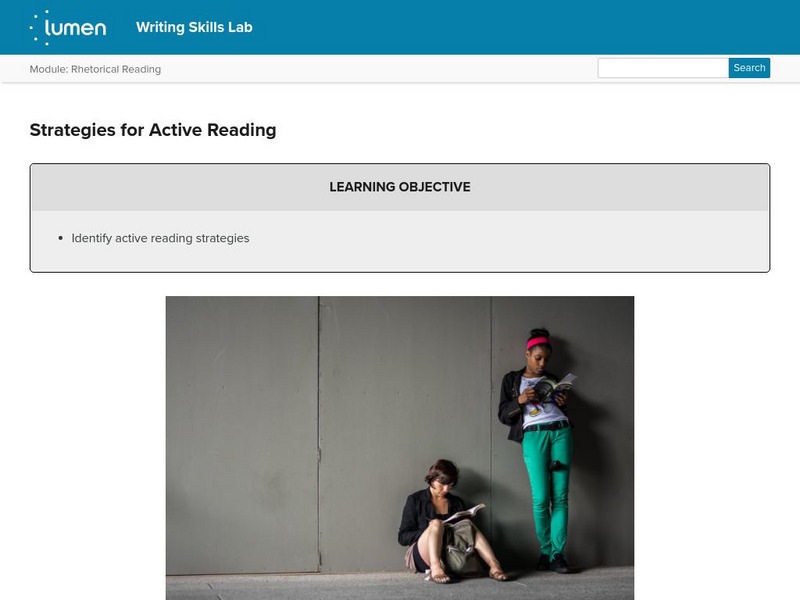
Lumen: Rhetorical Reading: Strategies for Active Reading
This activity focuses on strategies for active reading such as annotating your texts, reading multiple times, and using your prior knowledge.
![Austin Independent School District: Sample Guided Reading Lesson [Pdf] Lesson Plan](https://static.lp.lexp.cloud/images/attachment_defaults/resource/large/FPO-knovation.png "Austin Independent School District: Sample Guided Reading Lesson [Pdf] Lesson Plan")
Austin Independent School District
Austin Independent School District: Sample Guided Reading Lesson [Pdf]
This text on the topic of Women's Rights from Scholastic has been reformatted into a guided reading lesson where learners can see annotated examples of active reading, stop at logical places in the text to answer discussion questions,...
Other
Merit Software: Reading Comprehension Connection: Reading Lessons
In these practice exercises, students select a reading subject and skill level from drop-down menus and then complete the lesson activities. The lessons are on vocabulary, context, and comprehension. There are two skill levels:...
TES Global
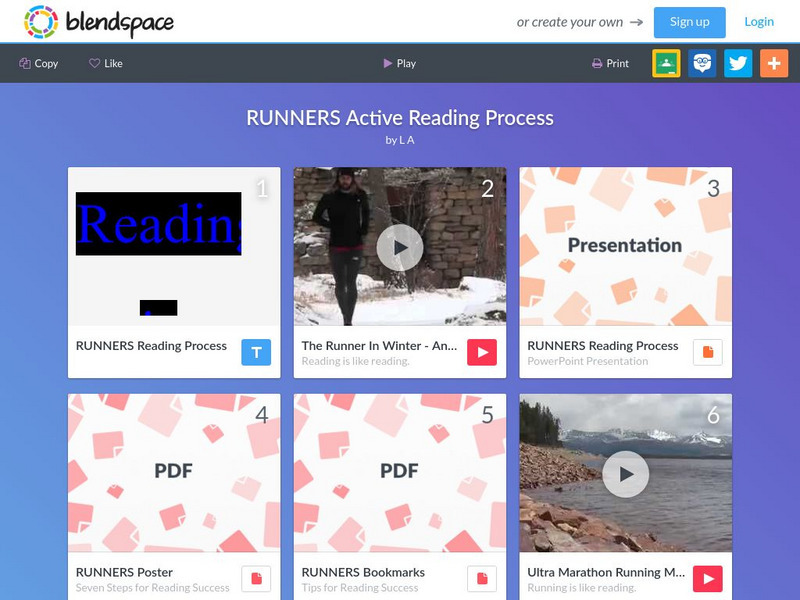
Blendspace: Runners Active Reading Process
A nine-part learning module on using the acronym RUNNERS to learn active reading strategies through text, videos, a PowerPoint, a web link and a quiz.
Hopelink
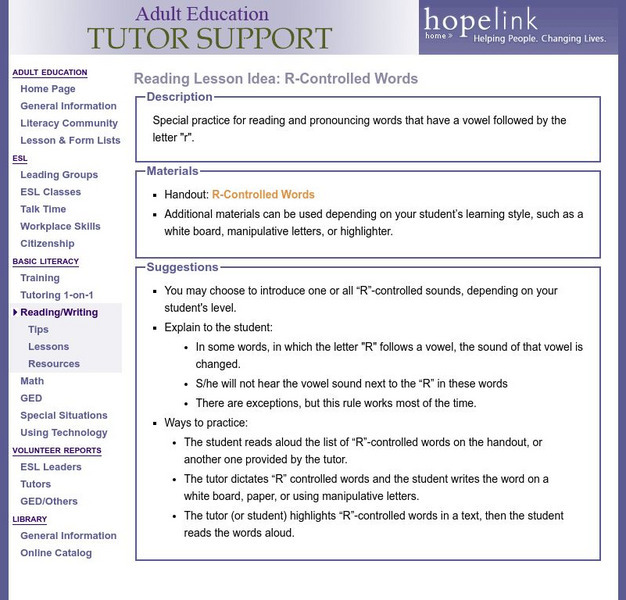
Hopelink: Reading Lesson Idea: R Controlled Words
Practice reading and pronouncing words that have a vowel followed by the letter R.
ReadWriteThink
Read Write Think: Deeper Reading Response a Template for Teachers
Contains plans for three lessons that teach students to express and perform responses to reading. In addition to objectives and standards, this instructional plan contains links to PDF handouts and sites used in the lessons as well as...
ReadWriteThink
Read Write Think: Using Thieves to Preview Nonfiction Texts
Contains plans for three lessons that introduce a nonfiction prereading strategy with the acronym THIEVES, which stands for Title, Headings, Introduction, Every first sentence, Visuals and vocabulary, End Questions, and Summary. In...
Hopelink
Hopelink: Reading Lesson Idea: Fact or Opinion?
In this lesson, students must learn to recognize the differences between fact and opinion.
Free Reading
Free Reading
This free reading intervention site is geared toward students grade K-3, with literacy activities and lessons/ideas links. The site includes teaching tools and activities. See the link at the bottom to "About FreeReading" for a list of...

ReadWriteThink
Read Write Think: National Grandparents Day Activities and Lesson Plans
With this resource, teachers and students can explore the meaning of National Grandparents Day. Includes activity ideas and lesson plans.
Free Reading
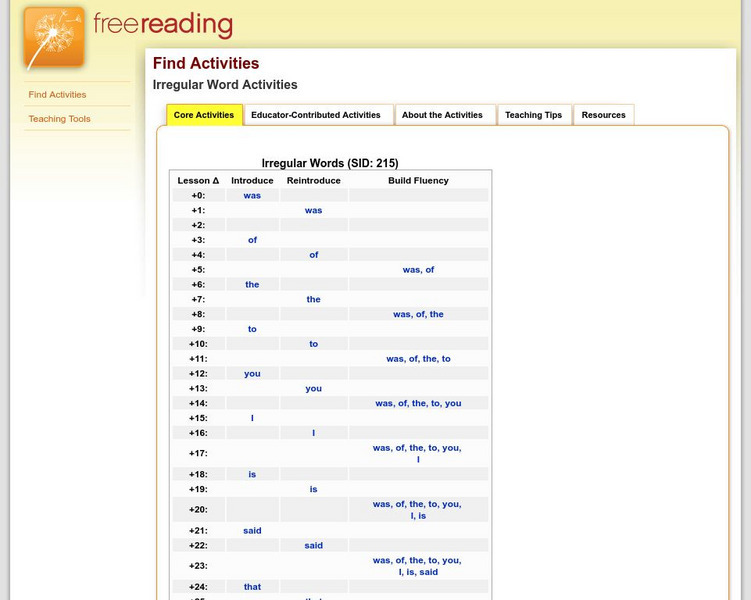
Free Reading: Irregular Word Activities
This extensive site has links to games and activities that teach students to read 30 high-frequency irregular words. There are over 20 activities and games at the bottom of the site in additional to sequenced irregular word activities....
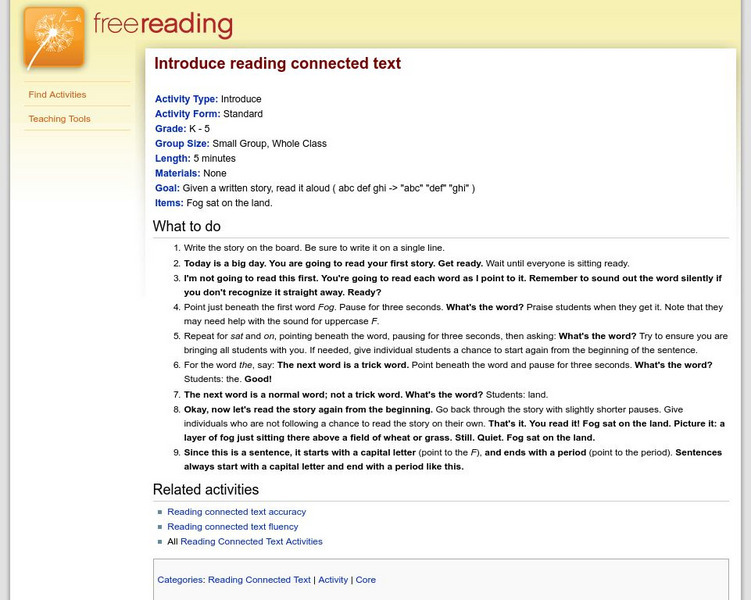
Free Reading
Free Reading: Amplify Education, Inc.: Introduce Reading Connected Text
An exciting introduction to reading! The instructor writes a simple, one-line story on the board from literature, and the students learn to sound out the words.
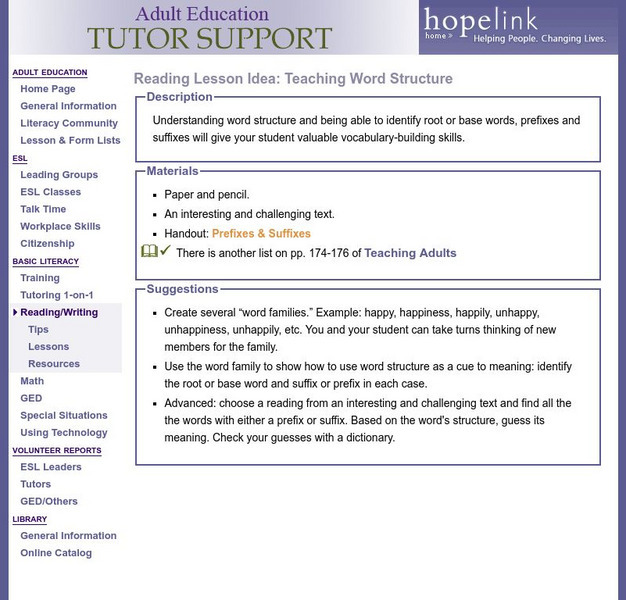
Hopelink
Hopelink: Reading Lesson Idea: Teaching Word Structure
Understanding word structure and being able to identify root or base words, prefixes and suffixes give your student valuable vocabulary-building skills. Click on the Prefixes and Suffixes handout.
ReadWriteThink
Read Write Think: Voting! What?s It All About?
Contains plans for an eight-lesson cross-curricular unit that uses the history of voting to teach reading and research skills. In addition to objectives and standards, this instructional plan contains links to sites used in the lessons...
ReadWriteThink
Read Write Think: The Feature Story?fifteen Minutes (And 500 Words) of Fame!
Contains plans for five lessons that teach students how to write feature news stories and the difference between feature and hard news articles. Students interview each other as prewriting for writing their own human interest stories. In...
ReadWriteThink
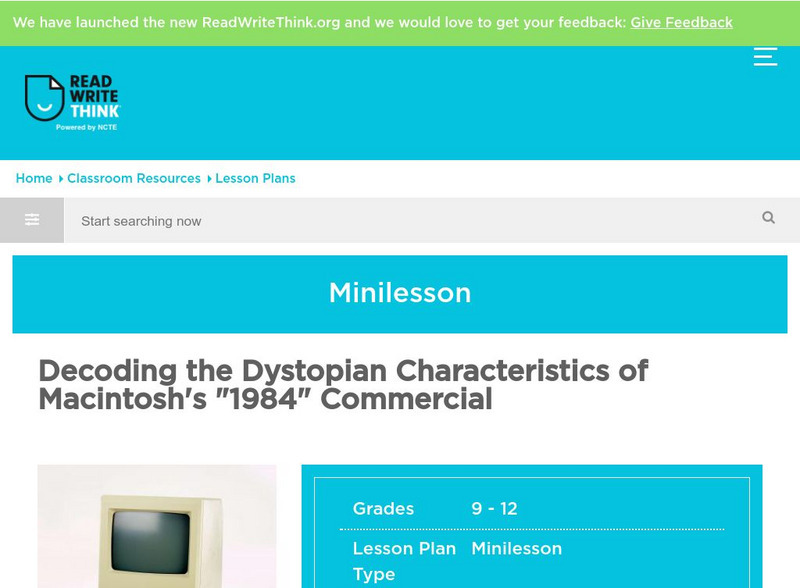
Read Write Think: Decoding Dystopian Characteristics of Mac?s ?1984? Commercial
Contains plans for one lessons that asks students to analyze the dystopian characteristics in the ?1984? Macintosh commercial. In addition to objectives and standards, this instructional plan contains links to PDF handouts and sites used...
Lumen Learning
Lumen: Rhetorical Reading: Putting It Together: Rhetorical Reading
This is a summary of the previous lessons having to do with rhetorical reading including rhetorical context, previewing text, actively reading, using context clues, and reading voraciously.