Hi, what do you want to do?






New York State Education Department
TASC Transition Curriculum: Workshop 3
Teachers turning into students? It's not Freaky Friday! It's a thoughtful workshop that teaches participants how to plan professional development for staff. Third in a 15-part series, the workshop provides a platform for the other...

New York State Education Department
TASC Transition Curriculum: Workshop 2
Flipped classrooms and online tools killed the chalkboard! An awesome, hands-on technology workshop asks teachers across all content areas. to examine model lessons, become familiar with research, and explore tech tools they can...

EngageNY
TASC Transition Curriculum: Workshop 12
How can opinions slant facts? Workshop participants learn how to examine primary and secondary sources and identify the author's point of view. They also examine how visual art impacts the meaning and rhetoric of sources. Full of...
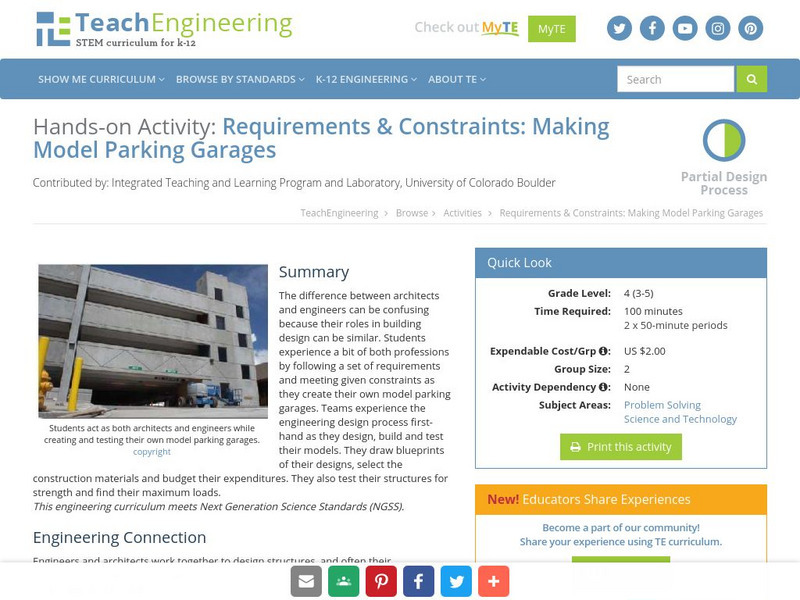
TeachEngineering
Teach Engineering: Requirements & Constraints: Making Model Parking Garages
The difference between an architect and an engineer is sometimes confusing because their roles in building design can be similar. Young scholars experience a bit of both professions by following a set of requirements and meeting given...
ReadWriteThink
Read Write Think: Integrating Math and Literacy
This instructional activity provides the elementary teacher with an opportunity to integrate the concept of mathematics with reading literacy. Students use models to learn shapes, practice spelling the names and shapes, and learn to...
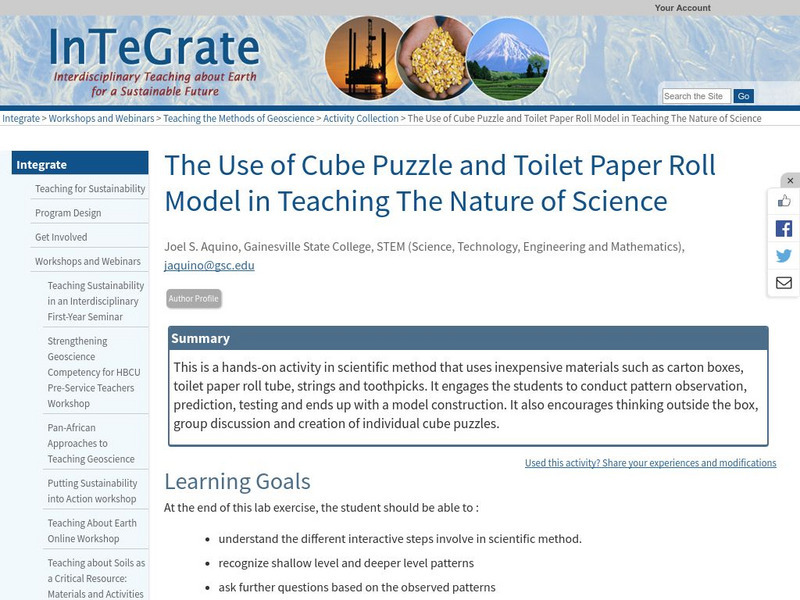
Science Education Resource Center at Carleton College
Serc: Cube Puzzle and Toilet Paper Roll Model in Teaching the Nature of Science
This lesson incorporates inexpensive materials such as carton boxes, toilet paper roll tube, strings and toothpicks. It engages students to conduct pattern observation, prediction, testing and ends up with a model construction. It also...
ReadWriteThink
Read Write Think: Mail Time! An Integrated Postcard and Geography Study
Contains plans for five cross-curricular lessons that teach about geography, reading, and writing by having students send postcards to relatives and asking them to send postcards back. In addition to objectives and standards, this...
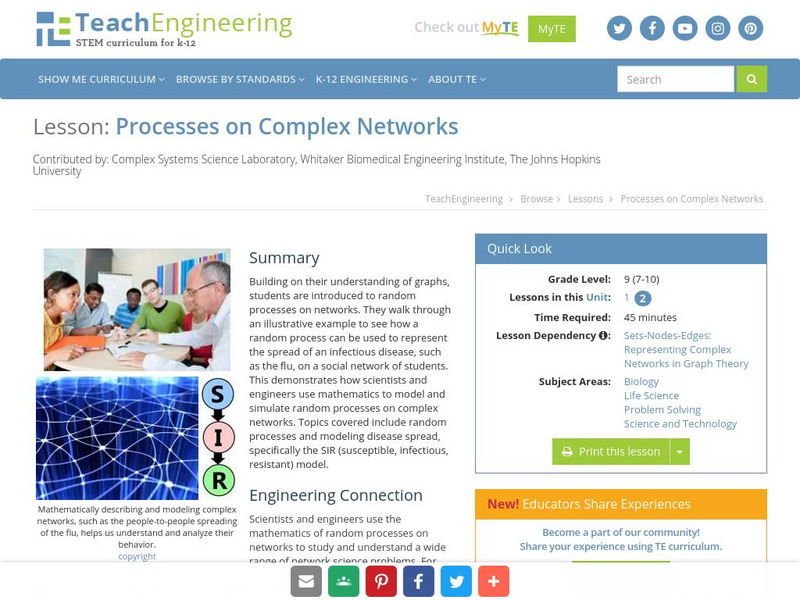
TeachEngineering
Teach Engineering: Processes on Complex Networks
Building on their understanding of graphs, students are introduced to random processes on networks. They walk through an illustrative example to see how a random process can be used to represent the spread of an infectious disease, such...
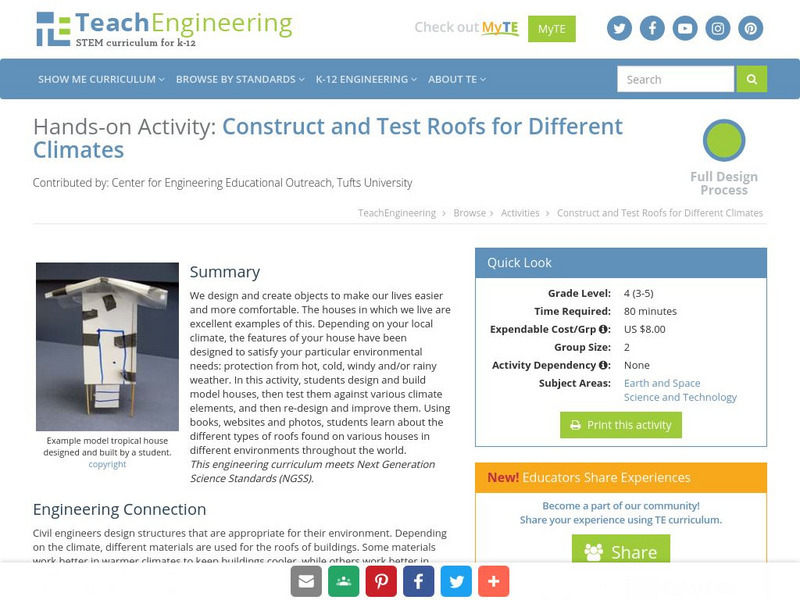
TeachEngineering
Teach Engineering: Construct and Test Roofs for Different Climates
We design and create objects to make our lives easier and more comfortable. The houses in which we live are an excellent example of this. Depending on your local climate, the features of your house will be different to satisfy your...

PBS
Pbs Teachers: Earth's Warming Climate: Are We Responsible?
We obviously don't want to feel responsible for the warming climate, but are we? For this lesson plan you will analyze CO2 data sets and study barriers involved in teaching about global climate change. PBS TeacherLine also provides a...
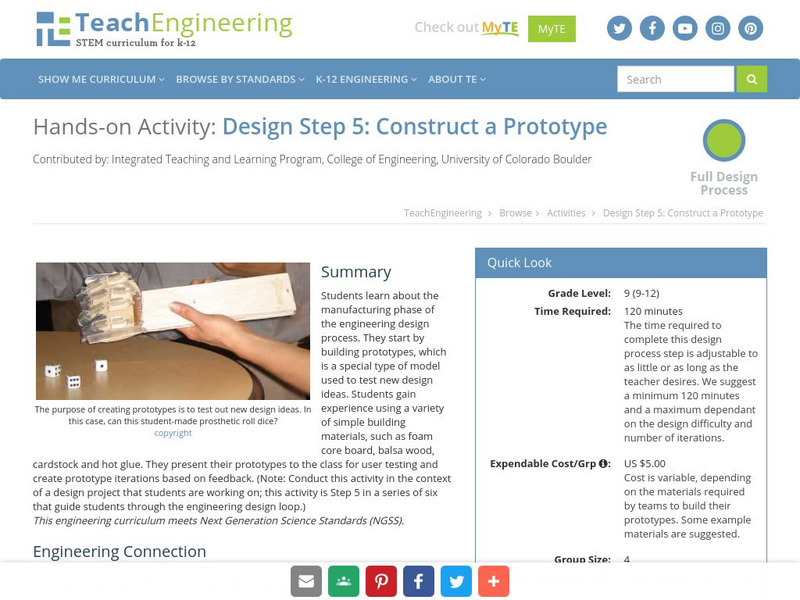
TeachEngineering
Teach Engineering: Design Steps 5 and 6: Create and Test a Prototype
Students learn about the importance of creating and testing prototypes during the engineering design process. They start by building prototypes, which is a special type of model used to test new design ideas. Students gain experience...
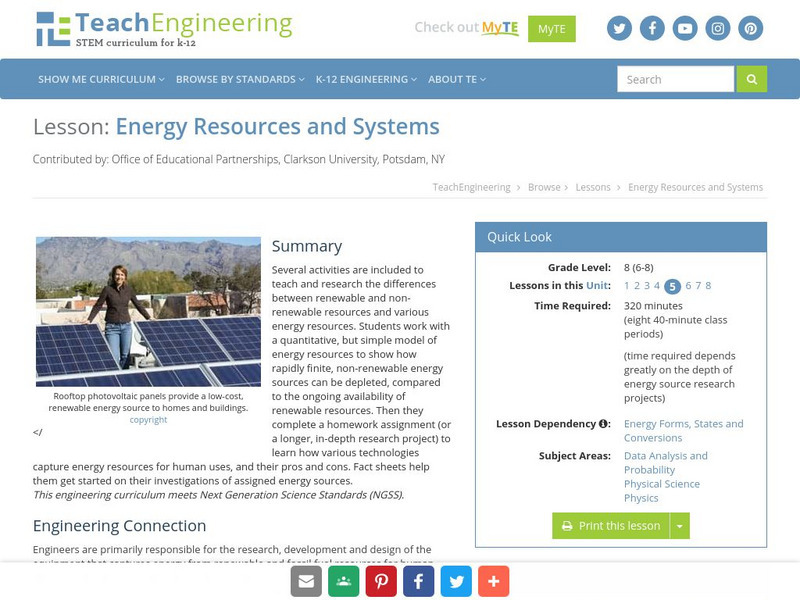
TeachEngineering
Teach Engineering: Energy Resources and Systems
Several activities are included to teach and research the differences between renewable and non-renewable resources and various energy resources. Middle schoolers work with a quantitative, but simple model of energy resources to show how...
TeachEngineering
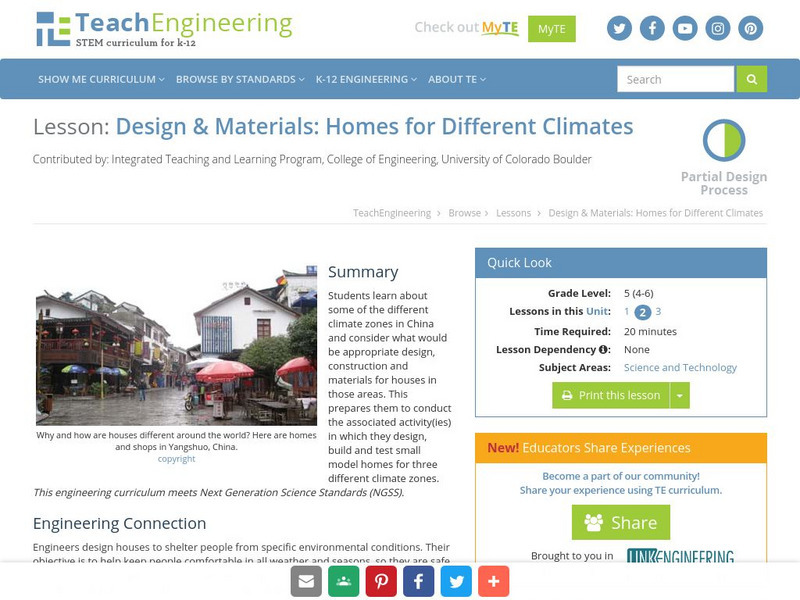
Teach Engineering: Homes for Different Climates
Students learn about some of the different climate zones in China and consider what would be appropriate design, construction and materials for houses in those areas. This prepares them to conduct the associated activity(ies) in which...

TeachEngineering
Teach Engineering: Photosynthesis Life's Primary Energy Source
This lesson covers the process of photosynthesis and the related plant cell functions of transpiration and cellular respiration. Students will learn how engineers can use the natural process of photosynthesis as an exemplary model of a...
TeachEngineering
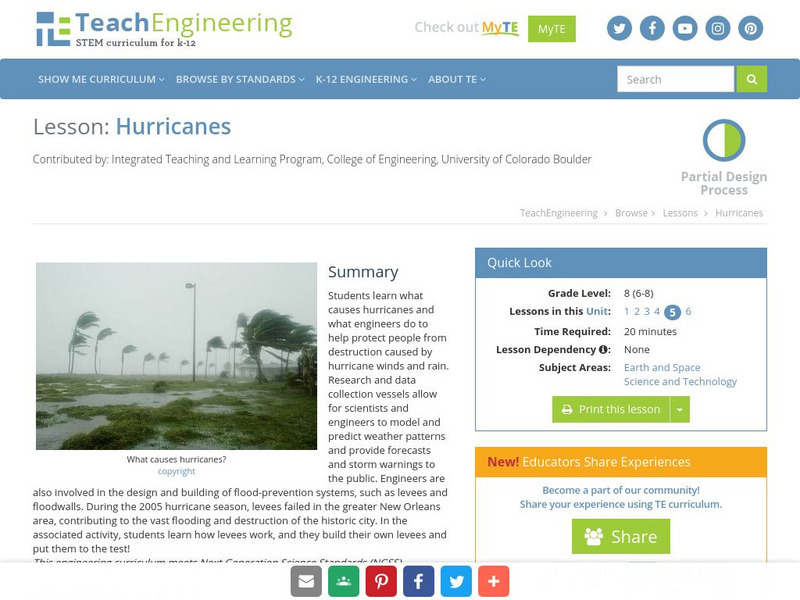
Teach Engineering: Hurricanes
Students learn what causes hurricanes and what engineers do to help protect people from destruction caused by hurricane winds and rain. Research and data collection vessels allow for scientists and engineers to model and predict weather...
TeachEngineering
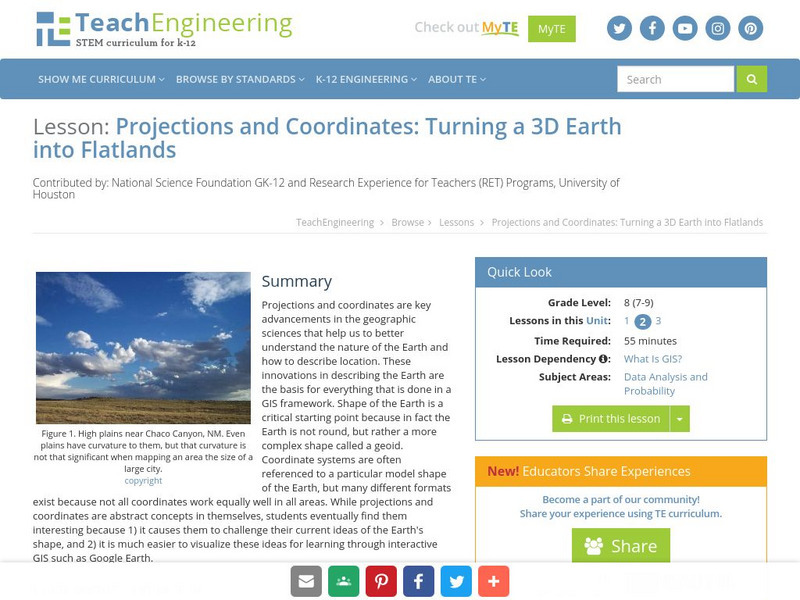
Teach Engineering: Projections and Coordinates: Turning a 3 D Earth Into Flatlands
Projections and coordinates are key advancements in the geographic sciences that allow us to better understand the nature of the Earth and how to describe location. These innovations in describing the Earth are the basis for everything...
TeachEngineering
Teach Engineering: Applications of Linear Functions
This instructional activity culminates the unit with the Go Public phase of the legacy cycle. In the associated activities, students use linear models to depict Hooke's law as well as Ohm's law. To conclude the instructional activity,...
![Core Knowledge: Poetry in Motion [Pdf] Lesson Plan](https://static.lp.lexp.cloud/images/attachment_defaults/resource/large/FPO-knovation.png "Core Knowledge: Poetry in Motion [Pdf] Lesson Plan")
Other
Core Knowledge: Poetry in Motion [Pdf]
Collection in pdf format of seven lessons integrating poetry across-the-curriculum. Includes dramatization, developing poetry reading skills, and creating poetry appreciation. Printable graphic organizers and a fine bibliography...
TeachEngineering
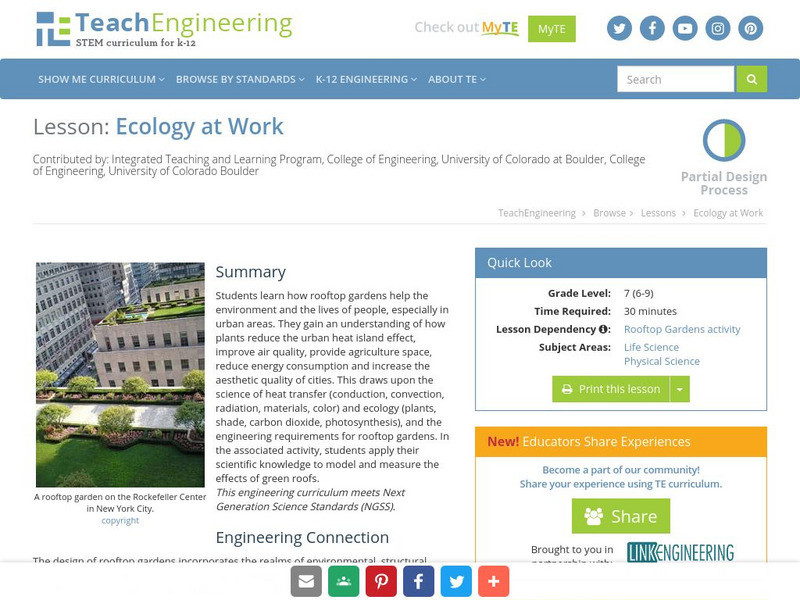
Teach Engineering: Ecology at Work
Students learn how rooftop gardens help the environment and the lives of people, especially in urban areas. They gain an understanding of how plants reduce the urban heat island effect, improve air quality, provide agriculture space,...
TeachEngineering
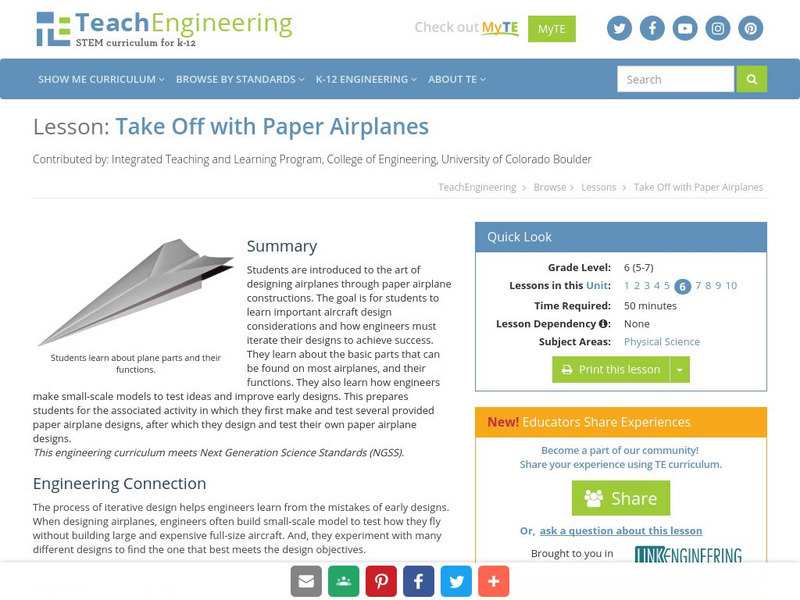
Teach Engineering: Take Off With Paper Airplanes
This lesson plan introduces students to the art of designing an airplane through paper airplane constructions. The goal is that students will learn important aircraft design considerations and how engineers must iterate their designs to...
TeachEngineering
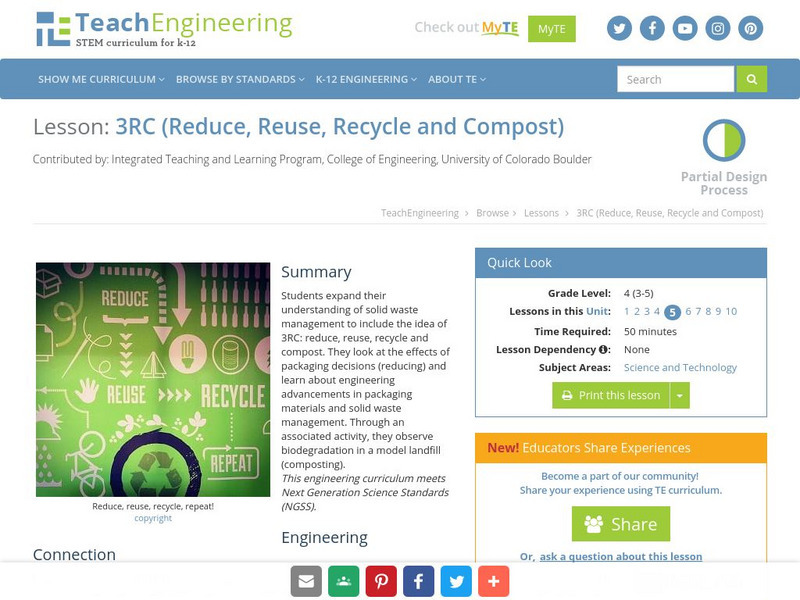
Teach Engineering: 3 Rc (Reduce, Reuse, Recycle and Compost)
In this lesson, students expand their understanding of solid waste management to include the idea of 3RC (reduce, reuse, recycle and compost). They will look at the effects of packaging decisions (reducing) and learn about engineering...
ReadWriteThink
Read Write Think: Digging Up Details on Worms: Using Science in an Inquiry Study
A lesson plan based on a study unit of earthworms, using the inquiry model to integrate scientific processes with literacy practices. Instruction plans, related resources, and standards are included.
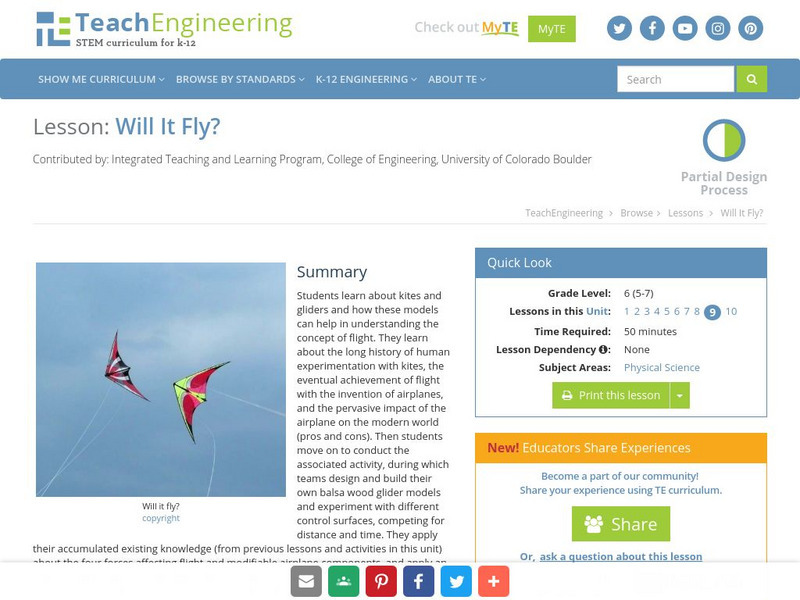
TeachEngineering
Teach Engineering: Will It Fly?
In this lesson plan, students will learn about kites and gliders and how these models can help in understanding the concept of flight. Students will design and build their own balsa wood models and experiment with different control...
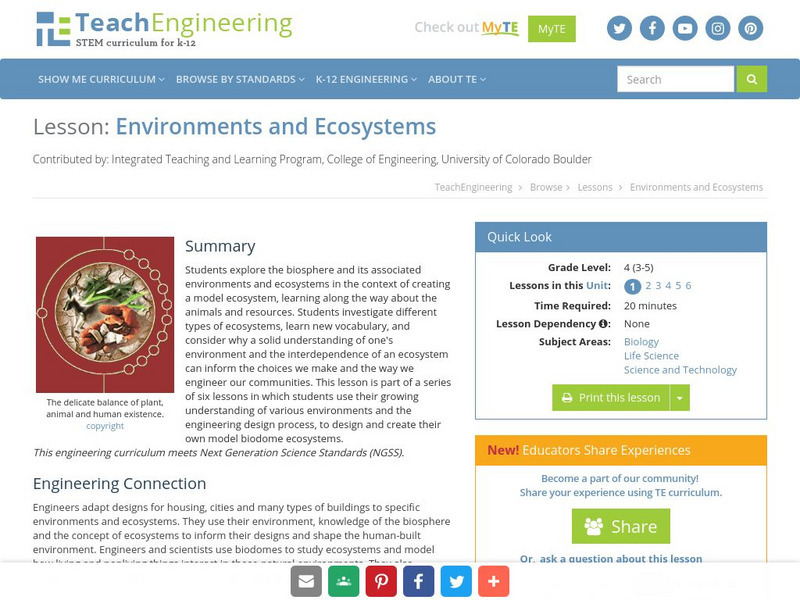
TeachEngineering
Teach Engineering: Environments and Ecosystems
Learners explore the biosphere and its associated environments and ecosystems in the context of creating a model ecosystem, learning along the way about the animals and resources. Students investigate different types of ecosystems, learn...