Hi, what do you want to do?






NASA
Seas of Infinity: OAO 2's 50th Anniversary
On Dec. 7, 1968, an Atlas-Centaur rocket carrying NASA’s heaviest and most ambitious uncrewed satellite to date blasted into the sky from Launch Complex 36B at Cape Canaveral Air Force Station, Florida....
NASA
NASA | MicroSpec: Revolutionary Instrument on a Chip
Scientists may finally get a glimpse at our adolescent universe from a revolutionary new technology being developed at NASA's Goddard Space Flight Center. An instrument on a chip. This new, potentially game-changing instrument, called...
Professor Dave Explains
Practice Problem: Assigning Molecular Structure From an NMR Spectrum
For this one we need to be able to interpret NMR data in order to arrive at the correct molecular structure based on an empirical formula. It's not as hard as it sounds!
NASA
Hubble Makes First Measurements of Earth-Sized Exoplanet Atmospheres
On May 4th, 2016, the Hubble Space Telescope made the first spectroscopic measurements of two of the three known Earth-sized exoplanets in the TRAPPIST-1 system just 40 light-years away.
Music credit: "Feels Good" by...
Music credit: "Feels Good" by...
Curated Video
Exploring the Wonders of Gallium
This video provides a comprehensive description of gallium, its discovery, properties, and various applications in different industries.

Crash Course
Star Clusters
Take your class to the next level of star gazing and introduce them to star clusters with an entertaining video. The narrator explains the differences between open and globular star clusters. Pupils also discover the ages and orbiting...

Crash Course
Distances
How can you determine the distance between two objects when one is incredibly far away? Discover how early astronomers and mathematicians calculated quantities such as the distance between Earth and the Sun in an insightful video. The...

Crash Course
Stars
Star light, start bright! What do the brightness and color of stars tell us about the stars we see at night? Learners explore the life of stars with an information-packed video. Topics include the relationship between mass and...

PBS
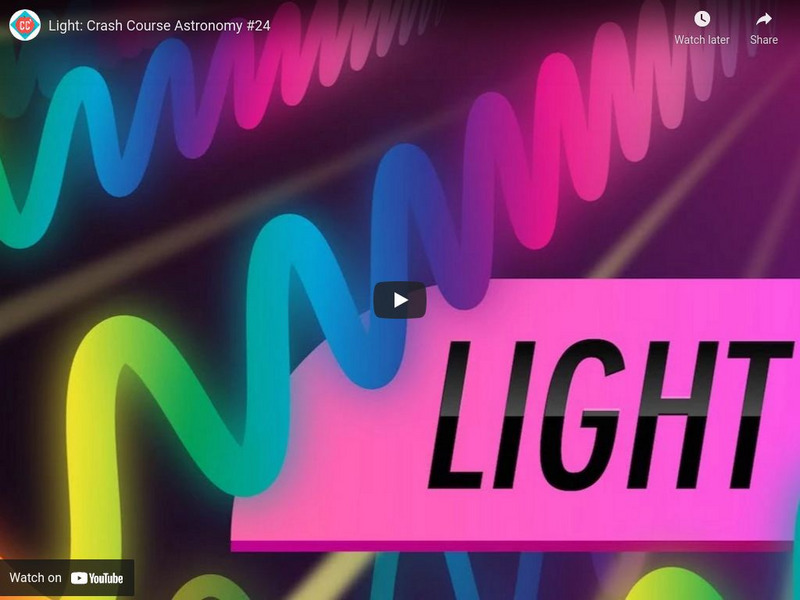
Pbs Learning Media: Crash Course Astronomy: Light
In order to understand how we study the universe, we need to talk a little bit about light. Light is a form of energy. Its wavelength tells us its energy and color. Spectroscopy allows us to analyze those colors and determine an object's...
Crash Course
Crash Course Astronomy #24: Light
In order to understand how we study the universe, we need to talk a little bit about light. Light is a form of energy. Its wavelength tells us its energy and color. Spectroscopy allows us to analyze those colors and determine an object's...
PBS
Pbs Learning Media: The Origin of the Elements
This video segment adapted from NOVA explains the origin of the elements and how scientists use unique element profiles to identify supernova types. Includes background reading and discussion questions. [1:55]
Khan Academy
Khan Academy: Spin Spin Splitting (Coupling)
How peaks in a proton NMR can get split into multiplets due to coupling with neighboring protons. [12:22]

Khan Academy
Khan Academy: Signal Characteristics Wavenumber
This article from Khan Academy provides information about spectroscopy. Students will use equations to predict the wavenumber for different types of chemical bonds. This information is intended for organic chemistry students.

Khan Academy
Khan Academy: Signal Characteristics Intensity
This article from Khan Academy provides information about spectroscopy. Students will understand how dipole moment determines the intensity of a signal in an IR spectrum.
Khan Academy
Khan Academy: Symmetric and Asymmetric Stretching
This video explains how symmetric and asymmetric stretching of two identical groups can lead to two distinct signals in IR spectroscopy.[11:02]