Hi, what do you want to do?






Veritasium
How To Make Colour with Holes
Nature inspiring technology isn't new, but butterflies inspiring new nanotechnology excites everyone. As part of a larger playlist, an engaging video explains how we see color and the relationship with both magnetic and electric fields....

Veritasium
Welding in Space
After the first American space walk, the hatch would not close on the spacecraft. Engineers later identified the problem as cold welding. An out-of-this-world video shows scholars how this discovery led to many changes in space crafts as...

PBS
Hot Shots and Hot Jobs: Biomechanical Engineering of a Nano-Tattoo
The job of the biomechanical engineer is to figure out how physical forces influence living organisms. The narrator describes the education needed, while a fascinating video shows how engineers develop tattoos that can control remote...

Crash Course
Computer Engineering and the End of Moore's Law: Crash Course Engineering #35
Engineers make better computers, and computers make better engineers. An informative video describes the components of computers, including both hardware and software, and how engineers have a hand in improving these components. It...

American Chemical Society
Chameleons Are Masters of Nanotechnology
The oddball reptiles, chameleons, can teach animal lovers a little something about nanotechnology. Viewers peel away the layers of the chameleon skin to discover the different types of chromatophores using an episode of a larger series...

Crash Course
The Mighty Power of Nanomaterials: Crash Course Engineering #23
Did you know that gold at the nanoscale level actually appears purple? An informative video looks at nanomaterials in engineering. Viewers learn about the properties of nanomaterials and their importance in medicine, manufacturing,...

Crash Course
Cathedrals and Universities: Crash Course History of Science #11
How are so many medieval buildings still standing today? And, how did ancient builders learn such skills? Discover the amazing feats of medieval engineers with part 11 in a 15-installment History of Science series. The narrator describes...

American Chemical Society
The World's Smallest Robots: Rise of the Nanomachines
Think robots are big, clunky heaps of metal? Not anymore! Introduce your class to a whole new breed of robots through a video from the American Chemical Society's Reactions playlist. The resource shows what these tiny machines are made...

American Chemical Society
How to Make Electronic Skin with Stanford's Zhenan Bao
How many scientists does it take to make electronic skin? No, it's not a riddle! See a breakthrough in nanotechnology, courtesy of a video from the American Chemical Society's Reactions series. You'll hear the project leader, plus...

American Chemical Society
How Does Fluorescence Work?
Here's a video that will light up your day! Young scientists learn about fluorescence by watching an engaging video in the ACS Reactions series. They also study the uses of fluorescence in microbiology, quantum dots, and forensic science.

Veritasium
How To Make Graphene
The thinnest material known to man also conducts electricity and heat. The video discusses graphene, highlighting its strength and usefulness, explains nanotechnology, and details the Nobel Prize for playing with tape.

Fuse School
Buckyballs, Graphene, and Nanotubes
Graphene's uses increase almost daily since it is the strongest metal, but is also flexible, thin, and lightweight. Graphene, buckyballs, and nanotubes — all recent discoveries, revolutionized many industries. Their applications include...

SciShow
The 2016 Nobel Prizes: Chemistry and Physics!
Tiny discoveries won big at the 2016 Nobel prize ceremony, recognizing chemists who developed new machines out of molecules and pushed the limits of nanotechnology. Individuals see how physicists created new materials through topology...

SciShow
Cloaking Devices!
Cloaking devices aren't just for Star Trek and Harry Potter any more! Here's a video that explains how cloaking devices work, or don't work. It details the technology needed to perfect cloaking and offers ideas for where researchers...

SciShow
Space Elevators
Why don't we just take an elevator to space instead of wasting all of those rockets? Video begins with an explanation of the concept of space elevators, and continues with the things that must be considered in developing and operating...

SciShow
Great Minds: Richard Feynman, The Great Explainer
Who is known for his bongo playing and solving the hardest algebra problem of all time? Richard Feynman loved to solve puzzles and didn't handle being bored very well. He is known for the Feynman diagrams that explain quantum...

University of California
How Dust Is Holding Science Back
There are millions of dust particles in every breath of air. These tiny particles have a huge impact on nanotechnology, microchips, and other types of scientific research. The video highlights these concerns and how they are working to...
Massachusetts Institute of Technology
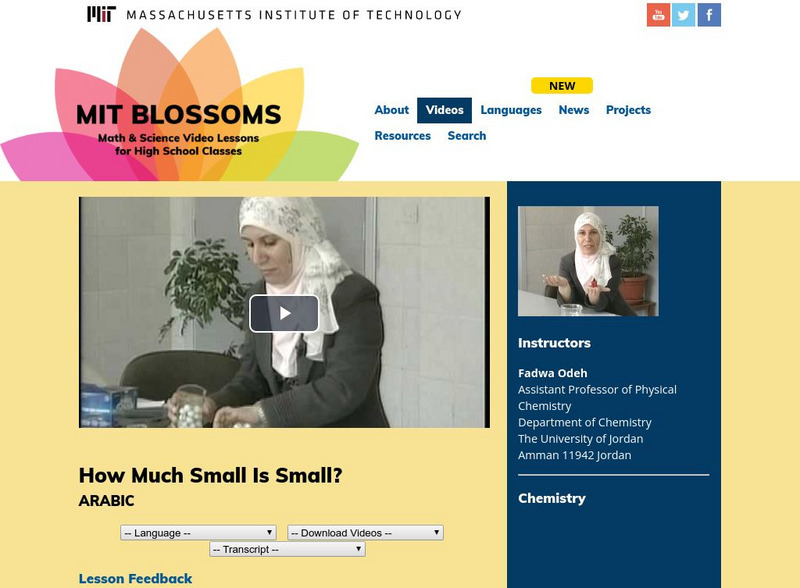
Mit: Blossoms: How Much Small Is Small?
This video lesson introduces students to the concept of size. It looks at how to classify objects based on their size and how the size of an object affects its properties and behavior. In our world, we have many different sizes -...
Science Friday Initiative
Science Friday: Hitting the "Off" Switch on Antibiotic Resistance
A nanotechnologist talks about his work on using nano particles of DNA and RNA to turn off the resistance of bacteria to antibiotics. Aired Dec. 2, 2011 [9:08]

PBS
Pbs Kids: Bone Regrowth: Nonotubes
Adam broke his leg, now what? Scientists are looking at using nanotechnology to heal broken bones by using a mixture of nanotubes and minerals like calcium that can be injected into the bone. Watch a video in which Kobel and Nathan...

National Science Foundation
National Science Foundation: Science of Innovation: Fuel Cell Efficiency
Scientists are working on trying to make fuel cells as efficient as possible using nanotechnology. The explanations are accompanied by helpful diagrams. [5:20]
National Science Foundation
National Science Foundation: Science of Innovation: Using Viruses to Make Batteries
MIT researcher, Angela Belcher uses viruses engineered in her laboratory to form nano-scale wires for tiny batteries that could eventually be used to produce a wide range of electronics at a lower cost. [5:30]
PBS
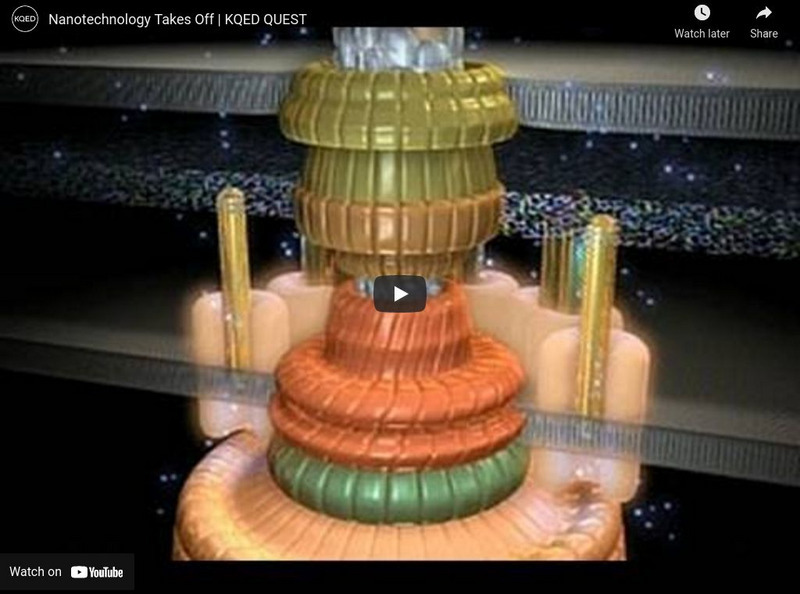
Kqed: Quest: Video: Nanotechnology Takes Off
A video exploring how nanotechnology changes material properties by working with the tiny particles at the nanometer level. Also discussed is the potential applications of nanoscience in our world. [10:28]

PBS
Pbs: Naomi Halas: Expert Q&a
For a week in April 2005, Dr. Naomi Halas, a pioneering nanotechnologist at Rice University, answered questions about nanoshells and the role of women in science. This is the Halas' interview about nanoshells.