Hi, what do you want to do?






SciShow Kids
Meet the 5 Dwarf Planets!
What's bigger than an asteroid but smaller than a planet? A dwarf planet! Take a peak into the five dwarf planets—Pluto, Haumea, Makemake, Eris, Ceres—with a captivating video hosted by Jenni and Squeaks.

SciShow Kids
Explore Saturn's Rings
Be prepared to get an in-depth look into the sixth planet from the sun—Saturn—with a fast paced, eye-catching video that details the planet's famous rings.

SciShow
Space Mining
We are using some natural resources at a rate that means we will run out of them in the near future, but what if we could get them from space? Watch a video that highlights a company that was founded to mine asteroids and other...

Crash Course Kids
Seeing Stars
What are all those shiny things we see in the sky at night? It could be a star, planet, or asteroid! This is the focus of a video that helps viewers distinguish between these three objects in the sky.

TED-Ed
Where Did Earth's Water Come From?
It's commonly known that over 70 percent of of the earth's surface is covered by water, but exactly where did it all come from? Join this short video as it travels back to the beginning of the universe in search of the origins...

Curated OER
Doomsday Asteroid
A thought-provoking video about asteroids and a "doomsday asteroid" that may hit Earth in the 2020's is presented here. This program could be used as a way to start a research project about asteroids with your class.

Curated OER
Asteroid vs. Comet
How were we, as a planet, effected by ancient asteroid impact? We find that a cosmic impact was responsible for killing the dinosaurs, but it also led to the conditions that made human life possible. This is an informative clip that...

TED-Ed
Is Space Trying to Kill Us?
Taking somewhat of a humorous, paranoid viewpoint, this video explores the question of whether or not space objects are likely to take us out. From asteroids, to the sun dying out, to the Milky Way's supermassive black hole, the...

PBS
Pbs: Asteroid
If an asteroid was to hit the earth what would be the effect? The result would be based on its speed, trajectory and most importantly, its size. This site provides a feature that allows you to learn the effects of these variables and...

Khan Academy
Khan Academy: How Do Earth and Life Interact?
A look at the 'comfort zone' humans live in, and the interplay of life and the biosphere. [9:58]

PBS
Pbs Learning Media: Crash Course Astronomy: Asteroids
Asteroids are chunks of rock or metal, or both, that were once part of a planet, but were destroyed after collisions. Most asteroids orbit the Sun between Mars and Jupiter, but some get near the Earth. The biggest asteroid, Ceres, is far...
Science Friday Initiative
Science Friday: Asteroid Heading Toward Mars
Scientists discuss an asteroid near miss from hitting Mars in 2007. Find out the implications of such a collision.
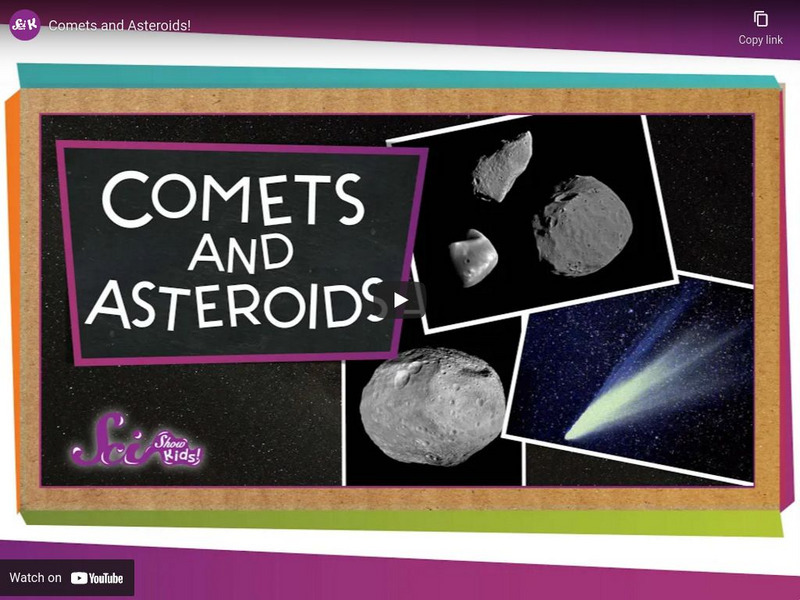
SciShow
Sci Show Kids: Comets and Asteroids!
A video exploring "flying space rocks" known as comets and asteroids. Learn about how comets got their name and the most famous comet. Also understand where asteroids are found and how they change into meteor then meteorite. [4:00]
AsapSCIENCE
Asap Science: Could We Stop an Asteroid?
Bill Nye explores how an asteroid impact could affect Earth in this video. Learn how the asteroid would be detected and what we could to do to try to stop it! [7:07]
Crash Course
Crash Course Astronomy #20: Asteroids
Now that we've finished our tour of the planets, we're headed back to the asteroid belt. Asteroids are chunks of rock, metal, or both that were once part of smallish planets but were destroyed after collisions. Most orbit the Sun between...
NASA
Nasa Space Place: Solar System Formation
Animated video tells the story of how the solar system came to be. [3:02]
PBS
Pbs Learning Media: Moon Craters
Explore why the moon looks the way it does. Watch kids use the scientific method to learn how craters form.

NASA
Nasa: Solar System Exploration: Asteroids: Mini Planets
This is a good resource for asteroids in general, but it also gives some specific details on NEAR's mission to Eros. You can also find out how much you weigh on an asteroid.
Science Friday Initiative
Science Friday: Nasa's Dawn Spacecraft Closes in on Its Target
The spacecraft will soon enter orbit around Vesta, an asteroid the size of Arizona, to study it.
Science Friday Initiative
Science Friday: Tracking Near Earth Objects
The US spends $4 million each year to search for comets or asteroids that could threaten the planet. That's not enough to get the job done, according to a new report from the National Research Council.

Science Friday Initiative
Science Friday: A Trojan Asteroid Keeps Earth Company
Listen as scientist discuss that the moon is not the only body in space following Earth's path. Learn how planet Earth has a new found neighbor, an asteroid that shares our orbit around the sun. [17:30]
California Academy of Sciences
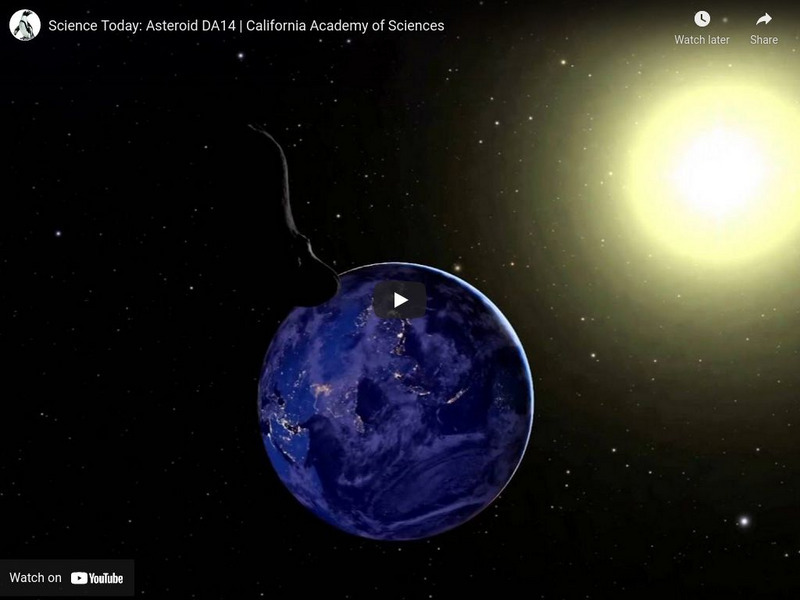
Ca Academy of Sciences: Asteroid 2012 Da14
Asteroid 2012 DA14 comes very close to Earth on February 15, 2013. [2:28]

CGP Grey
Cgp Grey: Grey Explains: Is Pluto a Planet?
Discusses the history of astronomy and how scientists grouped disparate bodies as planets, and why Pluto is no longer considered a planet. [4:45]

Science Friday Initiative
Science Friday: Pulsar Pulverizes Incoming Asteroids
A pulsar 37,000 light-years from Earth collided with a billion-ton asteroid.