Hi, what do you want to do?






Mathematics Vision Project
Module 5: Modeling with Geometry
Solids come in many shapes and sizes. Using geometry, scholars create two-dimensional cross-sections of various three-dimensional objects. They develop the lesson further by finding the volume of solids. The module then shifts...

Math Mammoth
Volume Problems
For this volume problem instructional activity, learners determine the volume of various objects. They compare similar objects and determine the percent of increase and decrease of the surface area and volume. This one-page instructional...

EngageNY
How Do 3D Printers Work?
If we stack up all the cross sections of a figure, does it create the figure? Pupils make the connection between the complete set of cross sections and the solid. They then view videos in order to see how 3D printers use Cavalerie's...

Arizona Department of Education
Area and Perimeter of Regular and Irregular Polygons
Extend young mathematicians' understanding of area with a geometry lesson on trapezoids. Building on their prior knowledge of rectangles and triangles, students learn how to calculate the area of trapezoids and other...

Radford University
Next Top Model
Create a world of similar models. The geometry and measurement unit uses real-world scenarios to create models of familiar buildings and rooms. Scholars work with blueprints and scale models to compare areas and volumes between the...

CK-12 Foundation
Basic Geometric Definitions: Alternate Dimensions
How do you calculate problems in alternate dimensions? The interactive allows learners to manipulate points in 2-D as scholars explore the relationship the points must have to create a one-dimensional object. Pupils identify objects that...

National Security Agency
Backyard Building - Area and Perimeter
Turn young mathematicians into landscape architects with this four-lesson series on area and perimeter. Beginning with a basic introduction to calculating perimeter and area using non-standard units of measurement, this...

Inside Mathematics
Quadratic (2009)
Functions require an input in order to get an output, which explains why the answer always has at least two parts. After only three multi-part questions, the teacher can analyze pupils' strengths and weaknesses when it comes to...

PBS
Using Symmetry to Create Corporate Logos
Young mathematicians investigate the use of symmetry in graphic design. After first learning about reflection, translational, and rotational symmetry, children use this new knowledge to identify symmetry in letters of the...

EngageNY
Why Are Vectors Useful? 2
Investigate the application of vector transformations applied to linear systems. Individuals use vectors to transform a linear system translating the solution to the origin. They apply their understanding of vectors, matrices,...

Inside Mathematics
Quadratic (2006)
Most problems can be solved using more than one method. A activity includes just nine questions but many more ways to solve each. Scholars must graph, solve, and justify quadratic problems.

Inside Mathematics
Hexagons
Scholars find a pattern from a geometric sequence and write the formula for extending it. The worksheet includes a table to complete plus four analysis questions. It concludes with instructional implications for the teacher.

Noyce Foundation
Snail Pace
Slow and steady wins the race? In the assessment task, scholars calculate the rates at which different snails travel in order to find the fastest snail. Hopefully, your class will move much more quickly in finishing the task!

E-learning for Kids
E Learning for Kids: Math: Great Barrier Reef: Shapes: 3 D Objects & Position
Join Mel and Alba and find out more about 3D shapes and the position of objects.
Khan Academy
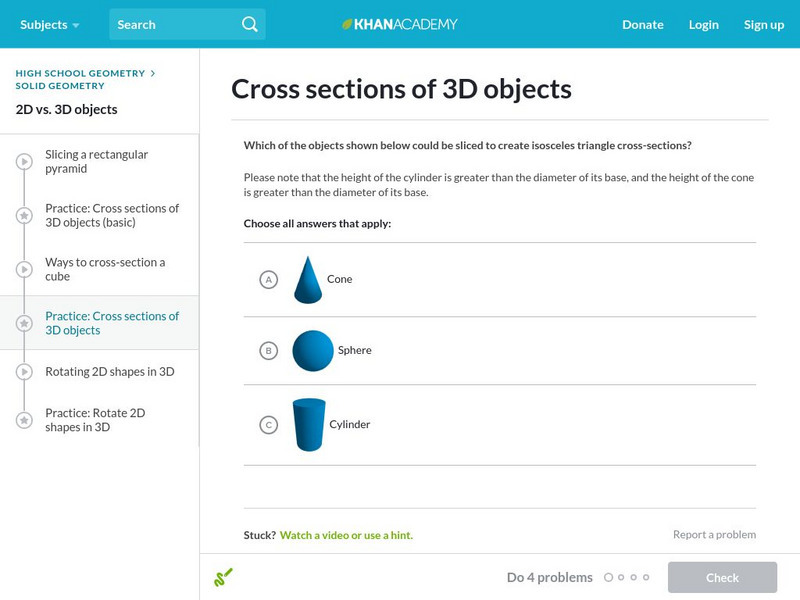
Khan Academy: Cross Sections of 3 D Objects
Practice your knowledge of all possible cross-sections of common 3D objects. Students receive immediate feedback and have the opportunity to try questions repeatedly, watch a video or receive hints.

Khan Academy
Khan Academy: Cross Sections of 3 D Objects (Basic)
Match 3D objects with their 2D cross-sections. Students receive immediate feedback and have the opportunity to try questions repeatedly, watch a video or receive hints.

Khan Academy
Khan Academy: Cross Sections of 3 D Objects (Basic)
Basic practice problems involving cross sections of 3D objects.

E-learning for Kids
E Learning for Kids: Math: Tea Store: 3 D Space
Can you help Leela find objects of different 3D shapes in her parents' tea store?
Khan Academy
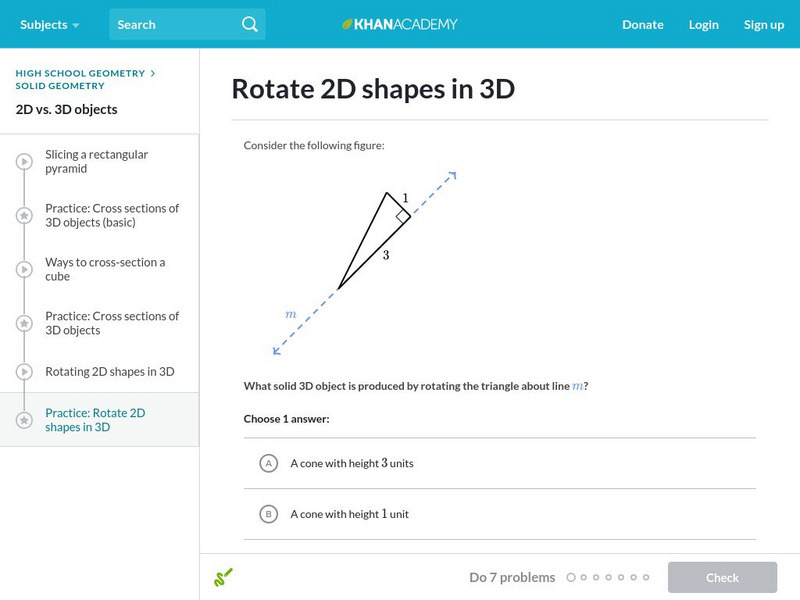
Khan Academy: Rotate 2 D Shapes in 3 D
Practice your 3D visualization skills by rotating 2D shapes. Students receive immediate feedback and have the opportunity to try questions repeatedly, watch a video or receive hints.