Hi, what do you want to do?






EngageNY
Angle Problems and Solving Equations
Learners build connections between algebra and geometry as they study equation solving. The ninth instructional activity in the series of 28 asks pupils to write equations using angle relationships. After writing equations to model...

El Paso Community College
Geometry Definitions
Geometry is full of shapes, figures, and corresponding things here and there. The guide shares all of the key pieces of geometric information in a nicely color-coded and labeled sheet.

EngageNY
Solve for Unknown Angles—Angles and Lines at a Point
How do you solve for an unknown angle? In this sixth installment of a 36-part series, young mathematicians use concepts learned in middle school geometry to set up and solve linear equations to find angle measures.

McGraw Hill
Lines and Angles
Why was the obtuse angle upset? Because it was never right! A valuable resource is loaded with background information on types of angles and lines. Learners review the characteristics of parallel, perpendicular, and...

Virginia Department of Education
Classifying Angles
Don't be obtuse, this geometry unit is the just the right resource for educating the acute young minds in your class. From classifying and measuring angles, to determining the congruence of shapes, this...

CK-12 Foundation
Complementary Angles: Corner Kick
Soccer is all about angles. Young mathematicians use an interactive to correctly position the path of a soccer ball so that it reaches the goal. They consider complementary angles when answering a set of challenge questions.

Alabama Learning Exchange
"I Saw the Sine"
Discover trigonometric ratios that complement each other. Using two videos, the lesson introduces the trigonometric ratios. The class discovers the relationship between the sine and cosine of complementary angles.

EngageNY
Incredibly Useful Ratios
Start the exploration of trigonometry off right! Pupils build on their understanding of similarity in this lesson that introduces the three trigonometric ratios. They first learn to identify opposite and adjacent...

EngageNY
Applying Tangents
What does geometry have to do with depression? It's an angle of course! Learners apply the tangent ratio to problem solving questions by finding missing lengths. Problems include angles of elevation and angles of depression. Pupils make...

EngageNY
Mid-Module Assessment Task: Grade 7 Mathematics Module 6
This is a mid-module assessment for the 16th lesson in 29 geometry lessons. Individuals demonstrate their understanding of concepts such as vertical and adjacent angles, constructing geometric figures, and triangle congruence criteria.

CK-12 Foundation
Ck 12: Vertical Angles
[Free Registration/Login Required] Students explore the concept of vertical angles by navigating through the interactive learning module and then answering questions that go along with the module.
Khan Academy
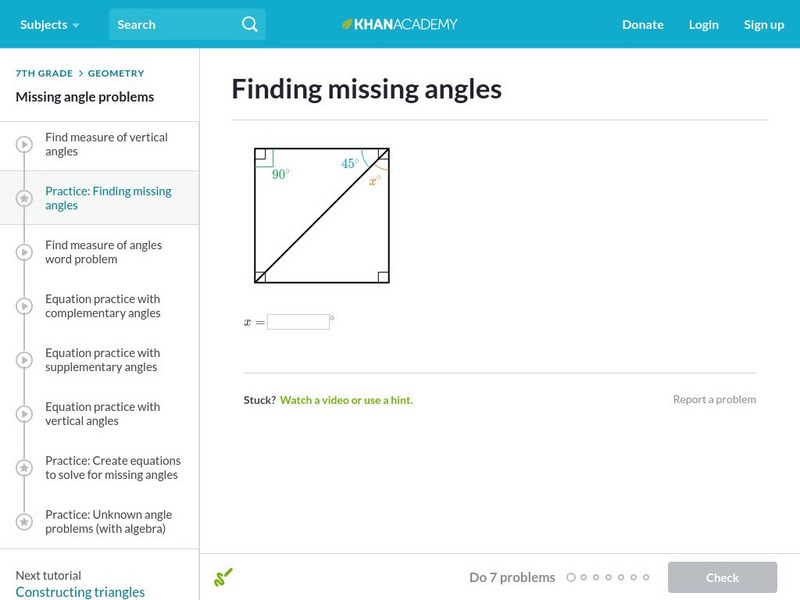
Khan Academy: Finding Missing Angles
Practice using knowledge of vertical, complementary, and supplementary angles to find a missing angle. Students receive immediate feedback and have the opportunity to try questions repeatedly, watch a video or receive hints.
Khan Academy
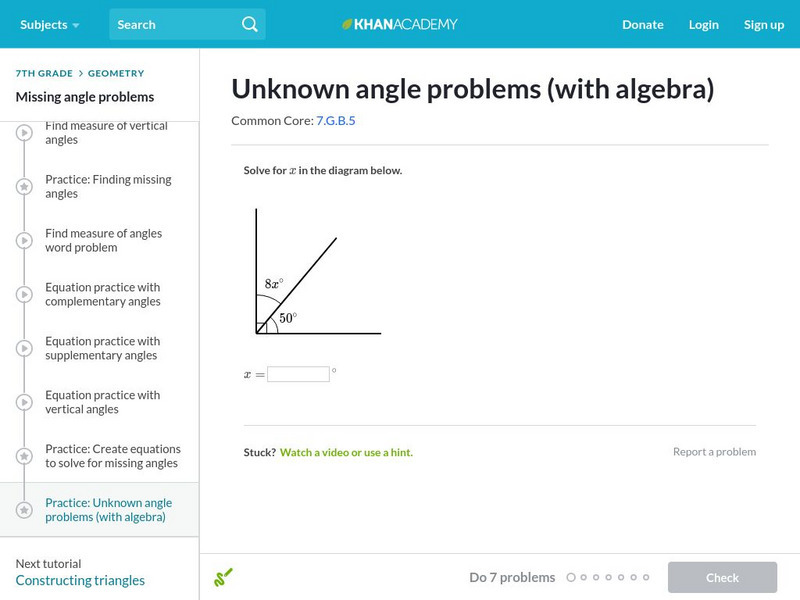
Khan Academy: Unknown Angle Problems (With Algebra)
Practice setting up algebraic equations to solve unknown angle problems. Students receive immediate feedback and have the opportunity to try questions repeatedly, watch a video or receive hints.
Khan Academy
Khan Academy: Identifying Supplementary, Complementary, and Vertical Angles
Practice identifying supplementary, complementary, and vertical angles.

Khan Academy
Khan Academy: Complementary and Supplementary Angles (No Visual)
Practice finding complementary and supplementary angles.

Khan Academy
Khan Academy: Finding Angle Measures Between Intersecting Lines
Practice finding angle measures between intersecting lines.
Khan Academy
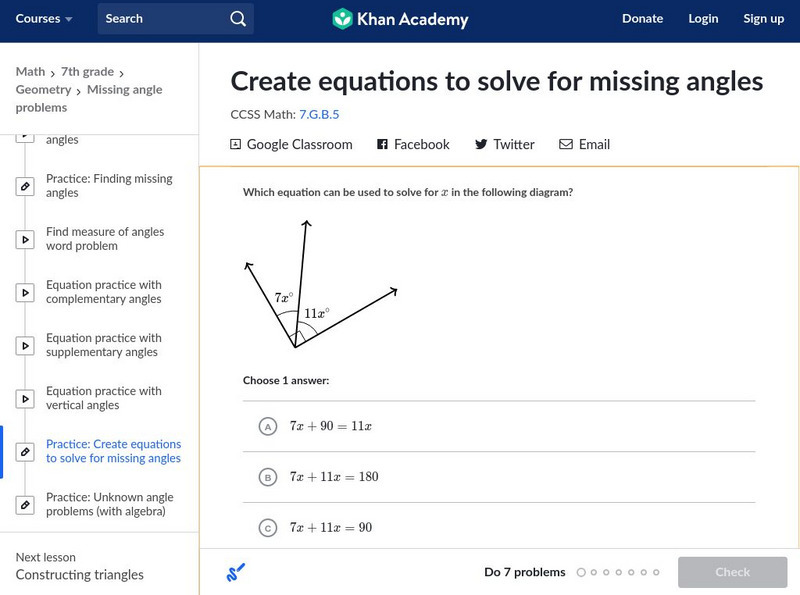
Khan Academy: Create Equations to Solve for Missing Angles
Practice creating equations to solve for missing angles.

Khan Academy
Khan Academy: Complementary and Supplementary Angles
In this exercise, students practice identifying complementary and supplementary angles. Students receive immediate feedback and have the opportunity to get hints and try questions repeatedly.