Hi, what do you want to do?






EngageNY
Grade 10 ELA Module 3: Unit 1, Lesson 5
Science over humanity? Scholars analyze an excerpt from The Immortal Life of Henrietta Lacks. They must consider if the experimentation of Henrietta's cells without her consent was worth the information gained about cancer. They discuss...

Fluence Learning
Writing About Informational Text: Music and the Brain
Even if you've never picked up a musical instrument, chances are that music has directly impacted your mental and emotional development. Sixth graders engage in a reading activity in which they read two articles on the impact of music on...

University of Minnesota
Virtual Neurons
It's electric! Young anatomists use Virtual Neurons software to build, control, and analyze complex nerve circuits within the body. Colorful and packed with content, class members enjoy interacting with the nervous system...

North Carolina State University
Exploring Genetics Across the Middle School Science and Math Curricula
Where is a geneticist's favorite place to swim? A gene pool. Young geneticists complete hands-on activities, experiments, and real-world problem solving throughout the unit. With extra focus on dominant and recessive genes, Punnett...

Curated OER
Rock On! Featuring the Igneous, Sedimentary and Metamorphic Trio!
Get your classroom rocking with this four-lesson earth science unit. Through a series of shared reading activities and hands-on investigations, young geologists learn about the three types of rocks and the unique properties of each.

Michael Hunter and Fiona Kisby
Robert Boyle and Medical Reform in the 17th Century
Introduce pupils to the work of Robert Boyle and his influence on medical practice through a series of informational texts and discussion questions.
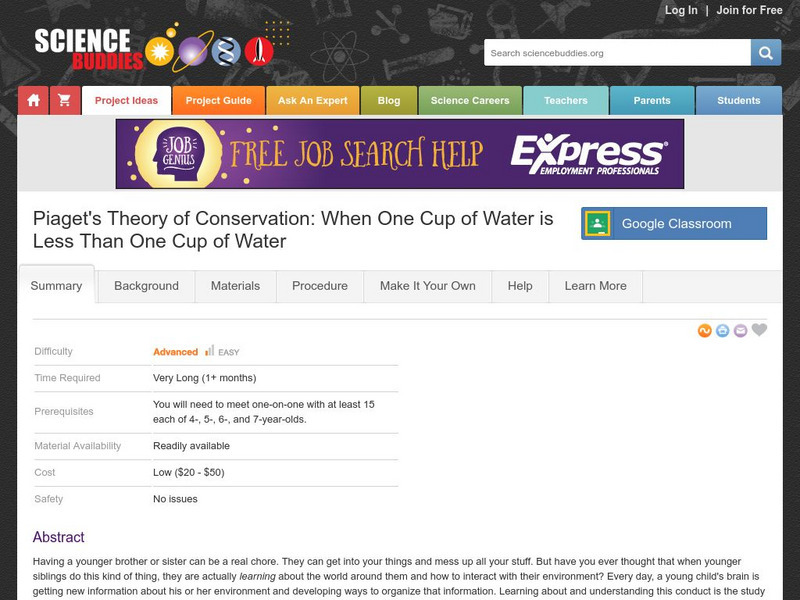
Science Buddies
Science Buddies: Piaget's Theory: One Cup of Water Is Less Than One Cup of Water
In this human behavior science fair project, the student will learn about Piaget's developmental stages and the Theory of Conservation. The student will investigate the age at which children understand the equality of numbers and mass....