Hi, what do you want to do?






Balanced Assessment
Bumpy-Ness
Develop a new measure of the properties of an object. Scholars develop a definition and formula to measure the bumpy-ness of an object. They utilize their formulas to find the property for several spherical objects.

Illustrative Mathematics
The Geometry of Letters
Use the alphabet as a tool for teaching your class about geometric figures. Break apart capital letters into line segments and arcs. Classify angles as right, acute, or obtuse. Identify parallel and perpendicular lines. An excellent...

CK-12 Foundation
Venn Diagrams: T-Shirt Mystery
Sorting your t-shirts is easy with Venn diagrams. Individuals use a drag and drop interactive to classify shapes on t-shirts into Venn diagrams. A set of challenge questions tests whether the classification is correct.

Noyce Foundation
Lawn Mowing
This is how long we mow the lawn together. The assessment requires the class to work with combining ratios and proportional reasoning. Pupils determine the unit rate of mowers and calculate the time required to mow a lawn if they work...

Inside Mathematics
Winning Spinners
Winning a spin game is random chance, right? Pupils create a table to determine the sample space of spinning two spinners. Individuals determine the probability of winning a game and then modify the spinners to increase the probability...

National Security Agency
Going Green with Graphs
In this unit designed for second graders, youngsters are introduced to conducting surveys and creating tally charts based on the data they gather. Students then construct bar graphs, and observe the relationships between the two...

Core Knowledge Foundation
Rocks & Minerals
Take young geologists on an exploration of the rock cycle with this six-lesson earth science unit on rocks and minerals. Through a series of discussions, demonstrations, and hands-on investigations your class will learn...
CK-12 Foundation
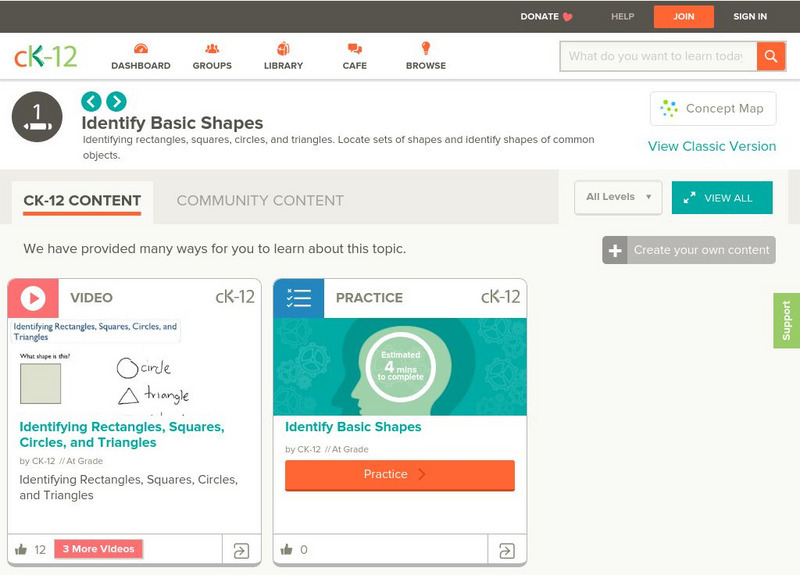
Ck 12: Elem Math: Classifying Real Life Objects as Basic 2 D Shapes
[Free Registration/Login may be required to access all resource tools.] The video describes how to classify a real-world object as a circle, triangle, square or rectangle. The video is followed by additional practice problems.