Hi, what do you want to do?






Curated OER
Count or Non Count Nouns
In this count and non count nouns worksheet, students read the chart on how to identify count and non count nouns. Students then read examples of count and non count nouns.

Curated OER
Squirt Level 3
Students use the lesson, "Squirt", to support students' development of multiplicative thinking. Squirt encourages students to anticipate multiplicative measurement relationships, e.g. three measures of A fit in B, by partially filling a...

Curated OER
All About Me
Third graders investigate the use of centimeters while measuring items with rulers which they construct. They examine the need for standard units of measure. They estimate the length of body parts before making the actual measurements.

Curated OER
Enlightening Explorations, Part III
Sixth graders continue their examination of light. In groups, they make rainbows and examine the spectrum of visible light. They travel between various stations recording their observations about the behaviors of light. To end the...

Curated OER
The Difference Bar 2
Students use Internet software, The Difference Bar, to work out the difference between two numbers by breaking numbers into parts. Students use mental strategies to work out the difference between any 2 two-digit numbers. Students...

Curated OER
Sign Language 1
Third graders explore signs and vocabulary linked to the work of Keith Haring.

Curated OER
The Part-adder 1
Second graders investigate the addition of whole numbers. They mentally perform calculations involving addition and subtraction. They make sensible estimates and check the reasonableness of answers.

Curated OER
Location, Location
Third graders draw and interpret simple scale maps, use maps to move around efficiently or plans to propose actions. They use of a compass to specify and find directions. They display and discuss a map of the local region.

Curated OER
Squirt
Fourth graders using the idea of "how many more squirts" fill a container to develop multiplicative thinking. They also investigate the idea of conservation of volume when working with oddly shaped containers. They attempt to use...

Curated OER
Not Enough Drawers
Young scholars describe three different categories to sort into. They sort these clothes into these three chosen categories. After asking questions the student divide the clothes.

Curated OER
The Take-Awar Bar 1
Students use an Internet tool, "The Take-Away Bar" to solve subtraction problems by breaking them into parts. They write and solve comparison problems. Students make sensible estimates and check the reasonableness of answers. They use...

Curated OER
Take Away Bar 2
Students use an Internet tool, The Take-Away Bar" to solve subtraction problems. They use mental strategies to subtract a two-digit number from a larger two-digit number. Students write and solve subtraction problems. They describe...

Curated OER
Parts of Speech Review
Students need to know how to correctly use words in their writing and speaking. By reviewing parts of speech with hands-on activities, students retain and enjoy studying sentence structure.

Curated OER
The Colored Cube Question
Fourth graders examine how to determine the probabilities or likelihood of outcomes. They complete trials to determine probability while using different manipulatives. They determine how games can be made fair or unfair in this unit of...

Curated OER
The Fathers' Day Card
Students subtract using decimals and find half of a decimal number. They write and solve problems which involve decimals and which require a choice of one or more of the four arithmetic operations.

Curated OER
Gathering Pouch
Students cut out a large rectangle from brown paper with scissors. They fold the narrow end up, leaving room for a flap at the top and have the teacher staple the edges of the pouch together. They then decorate their pouch with markers...
American Chemical Society
Inquiry in Action: Changing the Density of an Object: Changing Shape
Throughout the activities in this investigation, students may have wondered how a boat made out of steel, which is more dense than water, can float. This activity addresses that question. Students will see that changing the shape of an...
American Chemical Society
Inquiry in Action: Changing the Density of an Object: Adding Material
In this activity, students see that a can of regular cola sinks while a can of diet cola floats. As a demonstration, bubble wrap is taped to the can of regular cola to make it float. This high-volume but light-weight material increases...
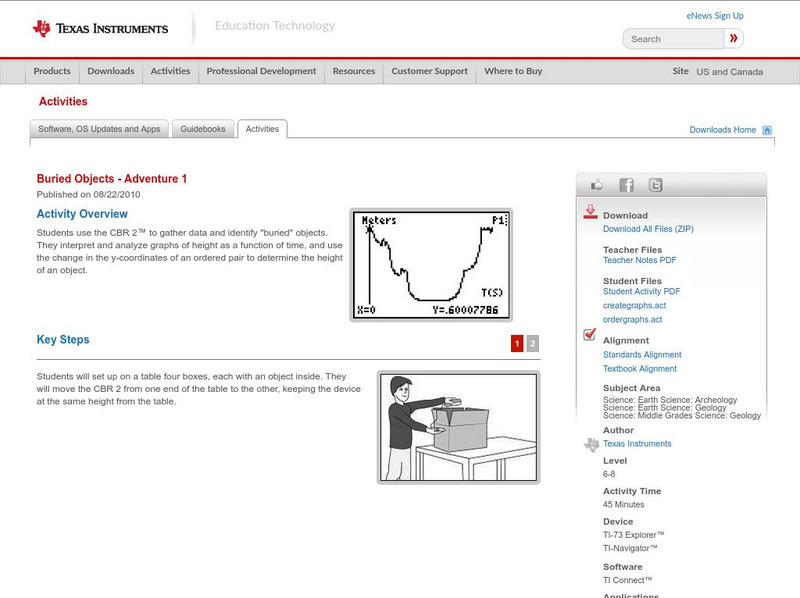
Texas Instruments
Texas Instruments: Buried Objects Adventure 1
Students use the CBR 2 to gather data and identify "buried" objects. They interpret and analyze graphs of height as a function of time, and use the change in the y-coordinates of an ordered pair to determine the height of an object.

Alabama Learning Exchange
Alex: Translucent, Transparent, and Opaque Objects
Students will become familiar with transparent, translucent, and opaque objects. Students predict whether items are transparent, translucent, or opaque. Finally, students will show what they have learned by producing a song, poem, cheer,...
American Chemical Society
Inquiry in Action: Compare the Density of an Object to the Density of Water
In this activity, students use tea light candle holders and a student-made balance to compare the weight of equal volumes of wax, water, and clay. Students will discover that since the wax weighs less than an equal volume of water, it is...
Texas Instruments
Texas Instruments: Chill Out: How Hot Objects Cool
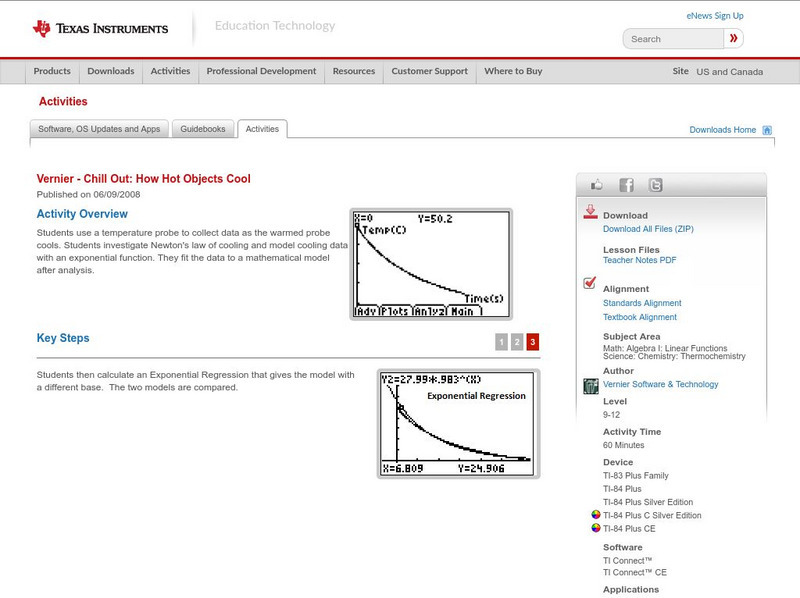
Students use a temperature probe to collect data as the warmed probe cools. Students investigate Newton's law of cooling and model cooling data with an exponential function. They fit the data to a mathematical model after analysis.
Texas Instruments
Texas Instruments: Chill Out: How Hot Objects Cool
In this activity, students can use a temperature probe to collect data as the warmed probe cool. Students will investigate Newton's law of cooling and model cooling data with an exponential function. They will fit the data to a...
Texas Instruments
Texas Instruments: Looking at Polynomials as Dynamic Mathematical Objects
In this activity, students use the TI InterActive! to construct the expression of a polynomial curve based on its dynamic properties. They explore the behavior of the curve at certain points within its domain. Students also determine the...