Hi, what do you want to do?






American Museum of Natural History
Bird Watching with Theodore Roosevelt
If you can't go to the birds, bring the birds to you! An interactive lesson helps learners identify different bird types by sight and sound. Pop-ups provide information about the different birds and audio plays the sound each bird...

National Park Service
The Young Naturalist
Beginning with a brief history of our 26th president, Theodore Roosevelt, then followed by a discussion of his interest in nature, young scientists take to the outdoors to locate and observe local plants and insects....

American Museum of Natural History
Theodore Roosevelt's Outdoor Adventures
Time for a virtual sightseeing trip. Pupils explore the Grand Canyon, Devil's Tower, and Yosemite Valley in an interactive online experience. They answer questions about the organisms in each location and draw conclusions based on their...

Curated OER
A Campfire Conversation
Students examine point of view as it relates to public issues. In this point of view lesson, students become familiar with the point of view of John Muir and Theodore Roosevelt about the wilderness. Students debate if the...

Curated OER
How Does Preserving Wilderness Enhance Forestry
Students identify events of the environmental movement in the United States. For this environment lesson students study Theodore Roosevelt and John Muir, who had a great impact on the environmental movement.

Curated OER
Ansley Wilcox House
Young scholars complete activities that go along with the study of and possible fieldtrip to the Ansley Wilcox House (T. Roosevelt Inaugural National Historic Site) in Buffalo, NY. They trace the background of a historical building in...

American Museum of Natural History
Keeping a Field Journal
Recording scientific evidence allows for important discoveries and conclusions. A remote learning resource outlines how to create a field journal to record scientific observations. The outline resource includes notation about the...

American Museum of Natural History
Keeping a Field Journal
Young scientists begin a field journal by following four steps. A real-world example of an entry showcases the different parts, including location, date, drawings, and more.

Curated OER
The Formation and Value of Temperate Grasslands
Young scholars study the Temperate Grasslands biome of North America. They explain that it is an endangered ecosystem because the rich soils have been converted to farming in most areas. They view videos imbedded in this plan, then...

Curated OER
The Lesson of the Kaibab
Students plot the Kaibab deer population from 1905 to 1939 and analyze the changes over time. In this populations lesson plan, students investigate the causes of changing populations of the Kaibab deer and they find the carrying capacity...

Curated OER
Lessons in Biodiversity: The Writings of Aldo Leopold
Students are introduced to the conservation philosophy of Aldo Leopold as they discuss the importance of biodiveristy.
Annenberg Foundation
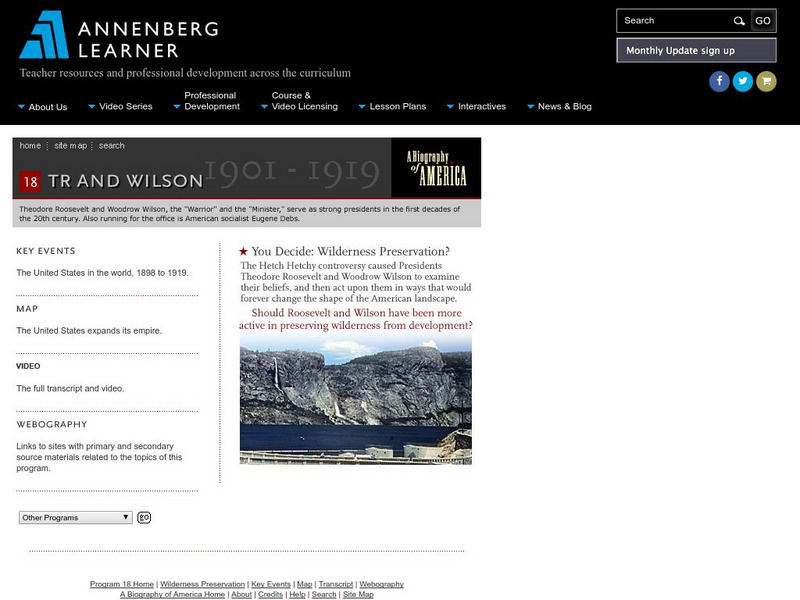
Annenberg Learner: A Biography of America: Theodore Roosevelt and Woodrow Wilson
Consider the perspectives of Theodore Roosevelt and Woodrow Wilson and why they made decisions that they did with respect to the American wilderness. The issue is whether the Hetch Hetchy dam should be built to supply water to San...

Library of Congress
Loc: Mapping the National Parks
This collection documents the history, cultural aspects and geological formations of areas that eventually became National Parks.
Other popular searches
- Roosevelt, Theodore
- Roosevelt Theodore
- Theodore Roosevelt 1st Grade
- Theodore Roosevelt Cartoon
- President Theodore Roosevelt
- Theodore Roosevelt Big Stick
- Theodore Roosevelt Parks
- Blacks Theodore Roosevelt
- Theodore Roosevelt Usda
- Theodore Roosevelt Reform
- Theodore Roosevelt Folk Tale
- Theodore Roosevelt Deal